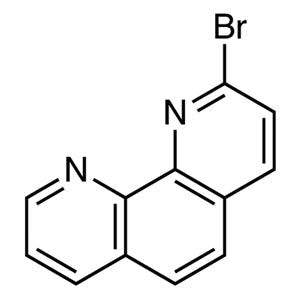
2-Bromo-1,10-phenanthroline is a chemical compound widely utilized in laboratory settings, particularly within the fields of catalysis and inorganic chemistry. As a nitrogen-donor ligand, it plays a crucial role in the formation of stable metal complexes, which are essential in various catalytic processes. This compound is commonly employed in synthetic reactions where the interaction between metal ions and ligands is necessary to achieve desired chemical transformations. Its versatility makes it an important reagent for both organic and inorganic synthesis.
The compound’s unique molecular structure and high reactivity make it a preferred choice for laboratory applications. It exhibits strong coordination ability with transition metals, enabling the creation of highly reactive complexes that can facilitate a wide range of chemical reactions. Its stability under certain conditions also ensures consistent performance in experimental setups. These properties contribute to its widespread use in research environments, where precise control over chemical reactions is essential.
In Indonesian laboratories, 2-Bromo-1,10-phenanthroline is frequently used in organic chemistry research, catalytic studies, and analytical chemistry. It is particularly valuable in investigations involving metal-ligand interactions and in the development of new synthetic methodologies. Its role in advancing chemical research makes it an essential component in many academic and industrial laboratories across Indonesia.
TCI brochures (PDF)
- Ligands 2025-12-01 · p. 14
- Building Blocks for Organic Semiconductor 2026-03-24 · p. 23
Related TCI products
- Organic synthesis applications benefit from this compound's ability to form stable metal complexes, enhancing reaction efficiency and selectivity.
- Catalytic research relies on its role as a nitrogen-donor ligand, enabling the activation of transition metals for various chemical transformations.
- Inorganic chemistry experiments utilize its strong coordination properties to create metal complexes with controlled reactivity.
- Analytical chemistry applications leverage its reactivity for the detection and quantification of metal ions in solution.
- Metal-ligand interaction studies depend on its structural characteristics to investigate binding affinities and coordination geometries.
| Brand | TCI |
|---|---|
| CAS number | 22426-14-8 |
| Molecular formula | — |
| Purity | — |
| Category | Chemistry > Catalysis and Inorganic Chemistry > Nitrogen-Donor Ligands [Catalysis] |
| Pack sizes | Available in various quantities as per supplier specifications |
| Physical form | Solid |
| Storage | Store in a cool, dry place away from light and moisture |
This compound should be stored in a cool, dry place, away from light and moisture to maintain its stability and reactivity. It is recommended to use airtight containers to prevent exposure to air and humidity, which may affect its chemical integrity. Due to its reactivity, it should be handled in a well-ventilated area, and appropriate personal protective equipment, such as gloves and safety goggles, should be worn. It is important to avoid contact with incompatible substances, and proper disposal procedures should be followed to ensure safety in the laboratory environment.
—
Product Categories
Produk Terkait
-
3-Bromo-1,10-phenanthroline TCI B2632
Regular price Rp 3.735.900,00Regular priceRp 2.628.150,00Sale price Rp 3.735.900,00 -
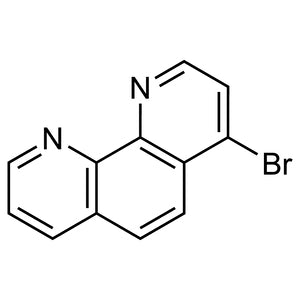
4-Bromo-1,10-phenanthroline TCI B6939
Regular price From Rp 3.285.450,00Regular priceRp 2.313.150,00Sale price From Rp 3.285.450,00 -
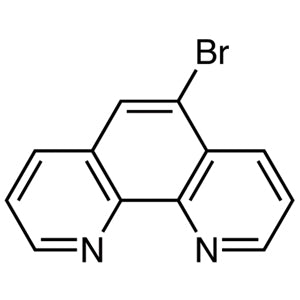
5-Bromo-1,10-phenanthroline TCI B5567
Regular price From Rp 1.643.250,00Regular priceRp 1.164.450,00Sale price From Rp 1.643.250,00 -
5-Amino-1,10-phenanthroline TCI A2977
Regular price Rp 3.790.500,00Regular priceRp 2.665.950,00Sale price Rp 3.790.500,00 -
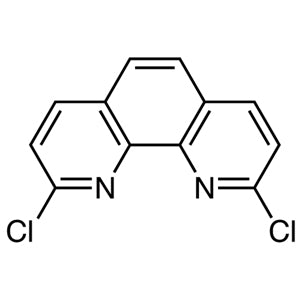
2,9-Dichloro-1,10-phenanthroline TCI D4186
Regular price From Rp 2.942.100,00Regular priceRp 2.072.700,00Sale price From Rp 2.942.100,00 -
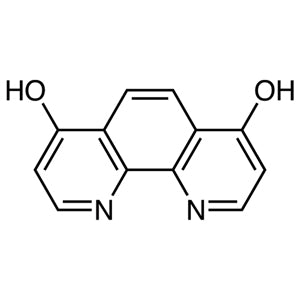
4,7-Dihydroxy-1,10-phenanthroline TCI D3869
Regular price Rp 3.763.200,00Regular priceRp 2.647.050,00Sale price Rp 3.763.200,00 -
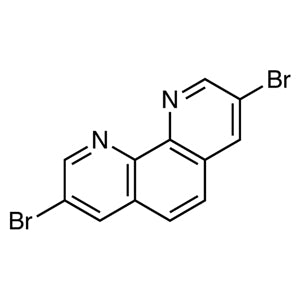
3,8-Dibromo-1,10-phenanthroline TCI D3209
Regular price From Rp 1.801.800,00Regular priceRp 1.275.750,00Sale price From Rp 1.801.800,00 -
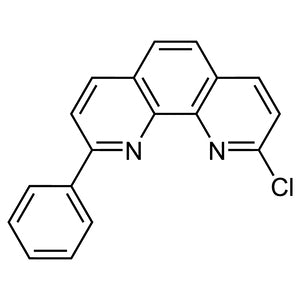
2-Chloro-9-phenyl-1,10-phenanthroline TCI C4161
Regular price Rp 2.835.000,00Regular priceRp 1.998.150,00Sale price Rp 2.835.000,00