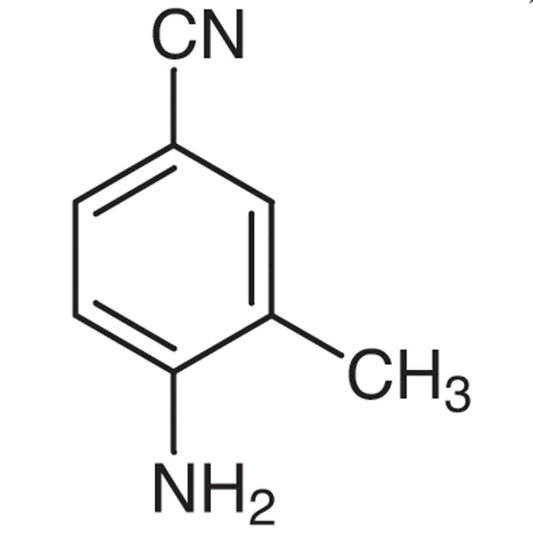
5-Bromo-2-methylbenzonitrile is a chemical compound widely used in organic reactions for the synthesis of complex molecules. This compound serves as a key building block in the field of organic chemistry, offering versatility in synthetic pathways. Its aromatic structure, combined with the presence of bromo and nitrile functional groups, provides a high degree of reactivity, making it an essential reagent in laboratory settings. The compound's ability to participate in various reaction mechanisms, such as nucleophilic substitution and electrophilic reactions, enhances its utility in both research and educational environments.
The compound's stable structure and controlled reactivity make it a preferred choice for chemists working on synthetic routes. Its reactivity allows for the formation of a wide range of derivatives, which are valuable in pharmaceutical and material science applications. The presence of the nitrile group further enhances its utility, as it can be easily modified through various chemical transformations. These properties make it a reliable and effective reagent in both academic and industrial laboratories.
In Indonesian laboratories, 5-Bromo-2-methylbenzonitrile is commonly used in the synthesis of bioactive compounds and in educational settings to demonstrate aromatic reactivity. Its application is particularly relevant in research focused on organic synthesis and drug development. The compound's versatility and reliability make it a valuable resource for both researchers and educators in the chemical sciences.
Related TCI products
- Aromatic Compound Synthesis: This compound is ideal for synthesizing aromatic derivatives due to its stable aromatic ring and reactive functional groups.
- Organic Synthesis Research: Its reactivity and structural versatility make it a preferred choice for complex molecule synthesis in research laboratories.
- Pharmaceutical Development: The compound's ability to undergo various chemical transformations supports the development of bioactive pharmaceutical compounds.
- Educational Demonstrations: It is frequently used in academic settings to illustrate the reactivity of aromatic compounds and reaction mechanisms.
- Bioactive Compound Research: Its structural features make it suitable for the synthesis of compounds with potential biological activity in medicinal chemistry.
| Brand | TCI |
|---|---|
| CAS number | 156001-51-3 |
| Molecular formula | — |
| Purity | — |
| Category | Chemistry > Building Blocks > Non-Heterocyclic Building Blocks |
| Pack sizes | As per supplier specifications |
| Physical form | Solid (as per standard product description) |
| Storage | Store in a cool, dry place away from moisture and direct sunlight |
This compound should be stored in a cool, dry environment to maintain its stability and prevent degradation. It is recommended to use airtight containers to protect it from moisture and air exposure. Due to its reactivity, it should be handled in a well-ventilated area, and appropriate personal protective equipment should be worn. Avoid contact with incompatible materials such as strong acids or bases. Keep the compound away from heat sources and direct sunlight to ensure long-term stability and safety in the laboratory.
—
Produk Terkait
-
2-Bromo-5-methylbenzonitrile TCI B4678
Regular price From Rp 769.650,00Regular priceRp 553.350,00Sale price From Rp 769.650,00 -
4-Bromo-2-methylbenzonitrile TCI B3993
Regular price Rp 2.411.850,00Regular priceRp 1.702.050,00Sale price Rp 2.411.850,00 -
4-Bromo-3-methylbenzonitrile TCI B2718
Regular price From Rp 2.093.700,00Regular priceRp 1.479.450,00Sale price From Rp 2.093.700,00 -
4-tert-Butylbenzonitrile TCI B1576
Regular price From Rp 1.670.550,00Regular priceRp 1.183.350,00Sale price From Rp 1.670.550,00 -
2-Amino-5-methylbenzonitrile TCI A2843
Regular price Rp 3.127.950,00Regular priceRp 2.202.900,00Sale price Rp 3.127.950,00 -
5-Amino-2-methylbenzonitrile TCI A2814
Regular price From Rp 530.250,00Regular priceRp 386.400,00Sale price From Rp 530.250,00 -
2-Amino-4-methylbenzonitrile TCI A2448
Regular price From Rp 2.121.000,00Regular priceRp 1.498.350,00Sale price From Rp 2.121.000,00 -
4-Amino-3-methylbenzonitrile TCI A2107
Regular price From Rp 822.150,00Regular priceRp 590.100,00Sale price From Rp 822.150,00