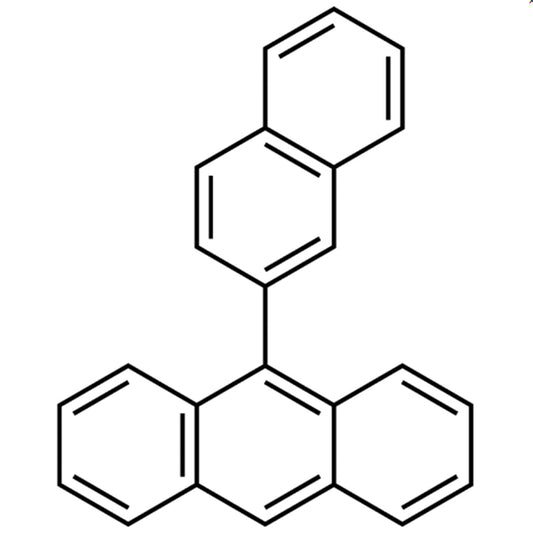
9,10-Bis[N-(2-naphthyl)anilino]anthracene is a complex organic compound widely used in laboratory research for optical and electronic material development. As a key component in the field of organic light-emitting diodes (OLEDs), this material plays a crucial role in the fabrication of display technologies and light-emitting devices. Its molecular structure, featuring anthracene with substituted anilino groups at positions 9 and 10, allows it to act as an emissive layer in OLEDs, emitting light at specific wavelengths. This property makes it essential for the advancement of next-generation display and lighting solutions.
The compound is preferred for its excellent electronic conductivity and high chemical stability. These characteristics ensure reliable performance under various experimental conditions, making it a trusted choice for researchers working with OLED materials. Its ability to efficiently absorb and emit light contributes to the overall efficiency of OLED devices. Additionally, the compound exhibits good thermal and environmental resistance, which enhances its usability in long-term laboratory applications. These properties collectively make it a valuable resource for material scientists and engineers.
In Indonesian laboratories, this compound is commonly used in optical and electronic material research, particularly in the development of OLED-based technologies. It supports studies aimed at improving the efficiency and longevity of display devices. Its application is also seen in academic and industrial research settings where the exploration of new materials for advanced electronic applications is a priority. The compound's versatility and performance make it a key component in the pursuit of innovative material solutions.
TCI brochures (PDF)
- Organic Light-Emitting Diode (OLED) Materials 2026-08-18 · p. 7
Related TCI products
- TCI B4965 189263-81-8 9,10-Bis[N-(m-tolyl)anilino]anthracene
- TCI B4966 177799-16-5 9,10-Bis[N,N-di(p-tolyl)amino]anthracene
- TCI D5066 122648-99-1 9,10-Di(2-naphthyl)anthracene (purified by sublimation)
- TCI D5065 26979-27-1 9,10-Di(1-naphthyl)anthracene (purified by sublimation)
- TCI D4127 122648-99-1 9,10-Di(2-naphthyl)anthracene
- TCI D3975 26979-27-1 9,10-Di(1-naphthyl)anthracene
- OLED material development for high-efficiency light-emitting devices due to its ability to emit light at specific wavelengths.
- Optical material research for applications in display technology and lighting solutions because of its unique molecular structure.
- Electronic material testing in laboratories focused on semiconductor and organic electronics due to its conductivity properties.
- Chemical stability analysis in environments requiring long-term material performance and resistance to environmental factors.
- Advanced material synthesis for the creation of new compounds used in next-generation electronic and optoelectronic applications.
| Brand | TCI |
|---|---|
| CAS number | 473717-08-7 |
| Molecular formula | — |
| Purity | — |
| Category | Materials Science > Electronic Materials > Organic Light-Emitting Diode (OLED) Materials |
| Pack sizes | Available in various quantities as per standard laboratory supply practices |
| Physical form | Solid, typically in crystalline or powder form |
| Storage | Store in a cool, dry place away from direct light and moisture |
This compound should be stored in a cool, dry environment, away from direct sunlight and moisture to maintain its chemical stability. It is recommended to use sealed containers made of glass or high-density polyethylene to prevent contamination and degradation. Due to its organic nature, it is important to handle it with appropriate personal protective equipment, including gloves and safety goggles, to ensure laboratory safety. The compound should be kept in a well-ventilated area to minimize exposure to airborne particles. Proper labeling of storage containers is essential for safe handling and to prevent accidental use. General laboratory precautions should be followed, such as avoiding inhalation of dust and ensuring that spillage is cleaned up promptly.
—
Produk Terkait
-
9,10-Bis[N-(m-tolyl)anilino]anthracene TCI B4965
Regular price From Rp 1.246.350,00Regular priceRp 887.250,00Sale price From Rp 1.246.350,00 -
9,10-Bis[N,N-di(p-tolyl)amino]anthracene TCI B4966
Regular price Rp 2.332.050,00Regular priceRp 1.646.400,00Sale price Rp 2.332.050,00 -
9,10-Di(2-naphthyl)anthracene(purifiedbysublimation) TCI D5066
Regular price Rp 1.881.600,00Regular priceRp 1.315.650,00Sale price Rp 1.881.600,00 -
9,10-Di(1-naphthyl)anthracene(purifiedbysublimation) TCI D5065
Regular price Rp 3.498.600,00Regular priceRp 2.446.500,00Sale price Rp 3.498.600,00 -
9,10-Di(2-naphthyl)anthracene TCI D4127
Regular price Rp 2.491.650,00Regular priceRp 1.741.950,00Sale price Rp 2.491.650,00 -
9,10-Di(1-naphthyl)anthracene TCI D3975
Regular price From Rp 1.538.250,00Regular priceRp 1.075.200,00Sale price From Rp 1.538.250,00 -
9-(1-Naphthyl)-10-(2-naphthyl)anthracene TCI N1135
Regular price From Rp 2.121.000,00Regular priceRp 1.482.600,00Sale price From Rp 2.121.000,00 -
9-(2-Naphthyl)anthracene TCI N1130
Regular price From Rp 1.510.950,00Regular priceRp 1.056.300,00Sale price From Rp 1.510.950,00