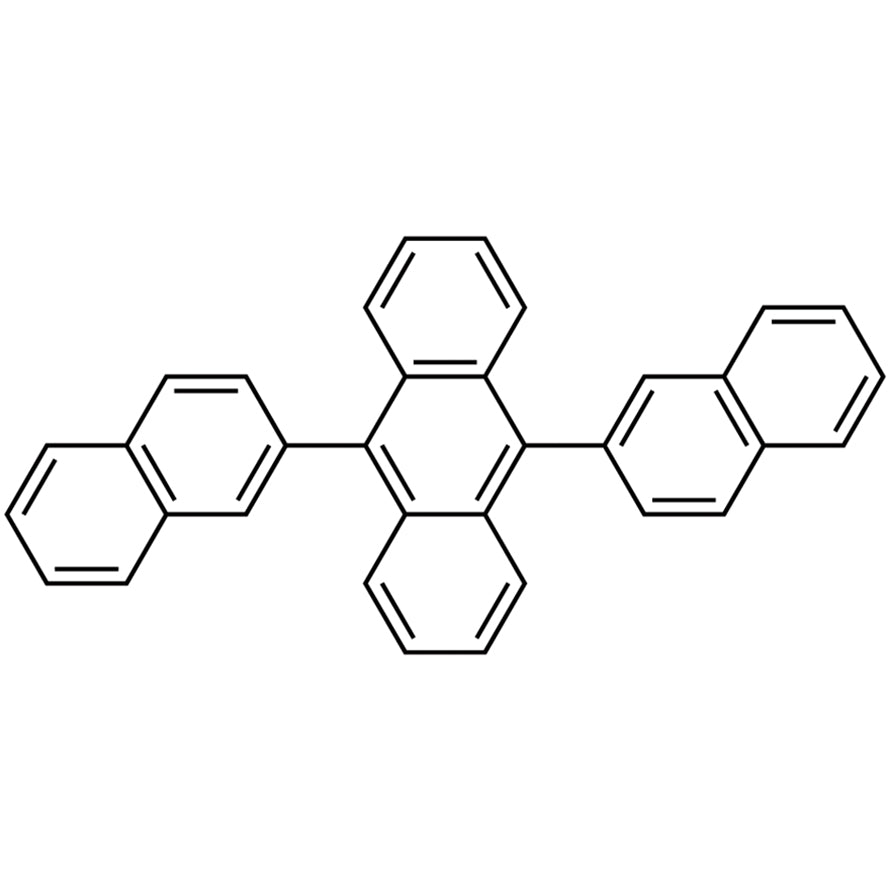
TCI D4127 9,10-Di(2-naphthyl)anthracene, commonly abbreviated as ADN among materials researchers, is a polycyclic aromatic compound built from an anthracene core bearing two naphthyl groups at the 9 and 10 positions. It belongs to the class of organic electronic materials and is one of the most frequently encountered compounds in organic light-emitting diode (OLED) device research. In the laboratory its role is generally as a core material for the light-emitting layer, particularly for blue-emitting devices, or as a host matrix accommodating emissive dopants within multilayer device architectures fabricated by vacuum evaporation.
The rigid, bulky structure of ADN makes it reluctant to crystallize when deposited as a thin film, so the resulting films are relatively uniform — a property that is highly valued in organic device fabrication because the morphological stability of a layer directly affects the reproducibility of results. The anthracene core provides emission character in the blue region, while the naphthyl substituents add steric bulk that suppresses unwanted intermolecular interactions. This combination makes ADN a common reference material when researchers need a well-characterized, well-behaved emissive or host layer as a baseline for comparison.
In Indonesian laboratories, this material is typically used in university and institutional research groups working on organic electronics, thin-film devices, and photophysics. It is normally handled in vacuum thermal evaporation systems inside gloveboxes or cleanroom-adjacent facilities, where small quantities are loaded into evaporation sources for multilayer device stacks. It also appears in fundamental photophysical and spectroscopic studies where a well-established blue-emitting anthracene derivative is required as a comparison standard.
- Blue OLED emissive layer fabrication — the anthracene core provides emission in the blue region, making it a standard choice for building and evaluating blue-emitting organic light-emitting diode structures.
- Host matrix for emissive dopants — its rigid molecular framework accommodates guest emitter molecules in doped emissive layers, supporting energy transfer studies within multilayer device architectures prepared by vacuum evaporation.
- Vacuum thermal evaporation thin-film deposition — the compound forms relatively uniform amorphous films that resist crystallization, which improves layer morphology and the run-to-run reproducibility of deposited device stacks.
- Reference and benchmark material in device studies — as one of the most widely encountered OLED compounds, it serves as a baseline against which newly synthesized emitters and hosts are compared.
- Photophysical and spectroscopic characterization — researchers use it in absorption, emission, and film-morphology investigations where a well-characterized polycyclic aromatic blue emitter is needed for calibration or comparison.
| Brand | TCI (Tokyo Chemical Industry) |
|---|---|
| CAS number | 122648-99-1 |
| Molecular formula | — |
| Purity | — |
| Category | Materials Science > Electronic Materials > Organic Light-Emitting Diode (OLED) Materials |
| Pack sizes | available in standard TCI research-scale packaging; please confirm the pack size when ordering |
| Physical form | — |
| Storage | store in a cool, dry place, protected from light |
- Chemical Name: 9,10-Di(2-naphthyl)anthracene (ADN)
- Product Code: D4127
Store the material in a cool, dry location away from direct light and heat sources, keeping the container tightly closed to limit exposure to air and moisture. Amber glass vials or the original supplier container are suitable, and transferring portions inside a glovebox or under inert atmosphere is common practice for organic electronic materials intended for thin-film deposition. Handle the powder in a fume hood or well-ventilated area, wear gloves, safety glasses, and a laboratory coat, and avoid generating dust during weighing and transfer. Keep the substance separated from strong oxidizing agents, label all secondary containers clearly, and consult the manufacturer's safety data sheet before use and for disposal guidance.
—
Produk Terkait
-
9-([1,1'-Biphenyl]-4-yl)anthracene TCI B5717
Regular price From Rp 1.220.100,00Regular price -
4-(3-Buten-1-yl)-4'-methylbiphenyl TCI B5872
Regular price Rp 2.094.750,00Regular price -
4,4'-Bis(trans-4-propylcyclohexyl)biphenyl TCI B5881
Regular price Rp 1.565.550,00Regular price -
Biphenylene TCI B6284
Regular price From Rp 2.782.500,00Regular price -
Benzo[k]fluoranthene TCI B6317
Regular price From Rp 3.180.450,00Regular price -
Benzo[j]fluoranthene TCI B6424
Regular price From Rp 2.916.900,00Regular price -
Benzo[c]phenanthrene TCI B6541
Regular price From Rp 1.829.100,00Regular price -
1-Benzyl-4-methylbenzene TCI B6623
Regular price From Rp 2.386.650,00Regular price
![9-([1,1'-Biphenyl]-4-yl)anthracene (CAS 323195-31-9) - TCI B5717 - AMI Scientific](http://amiscientific.com/cdn/shop/files/TCI2510B5717.jpg?v=1768815871&width=533)


![Benzo[k]fluoranthene (CAS 207-08-9) - TCI B6317 - AMI Scientific](http://amiscientific.com/cdn/shop/files/TCI2510B6317_9797284f-a326-4c13-8c48-43bc162551a1.jpg?v=1767865252&width=533)
![Benzo[j]fluoranthene (CAS 205-82-3) - TCI B6424 - AMI Scientific](http://amiscientific.com/cdn/shop/files/TCI2510B6424.jpg?v=1768193711&width=533)
![Benzo[c]phenanthrene (CAS 195-19-7) - TCI B6541 - AMI Scientific](http://amiscientific.com/cdn/shop/files/TCI2510B6541.jpg?v=1767093862&width=533)