9,10-Bis(4-methoxyphenyl)anthracene is an organic compound widely used in material research for optoelectronic applications, particularly in the development of OLED (Organic Light-Emitting Diode) materials. This compound plays a crucial role in laboratories where researchers are focused on creating efficient and sustainable light-emitting devices. Its molecular structure enables light emission at specific wavelengths, making it a key component in the design of advanced organic materials. Due to its unique optical properties, it is often utilized in the synthesis of materials that contribute to next-generation display technologies and lighting solutions.
The compound is favored for its chemical stability and ability to form uniform thin films, which are essential for the performance of OLEDs. The presence of methoxy groups in its molecular structure enhances its electronic properties, such as conductivity and thermal stability. These characteristics make it a preferred choice for researchers aiming to develop high-performance organic light-emitting materials. Its reliability and consistent performance in laboratory settings ensure that it remains a valuable resource for material scientists.
In Indonesian laboratories, this compound is commonly used by researchers in educational and research institutions to advance organic light-emitting technologies. It supports innovation in fields such as information technology, display manufacturing, and renewable energy. Its application aligns with the growing demand for sustainable and efficient optoelectronic materials in the region.
TCI brochures (PDF)
- Organic Light-Emitting Diode (OLED) Materials 2026-08-18 · p. 3
- Building Blocks for Organic Semiconductor 2026-03-24 · p. 9
Related TCI products
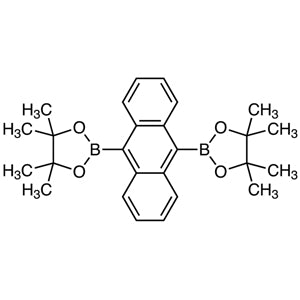
- TCI B4562 863992-56-7 9,10-Bis(4,4,5,5-tetramethyl-1,3,2-dioxaborolan-2-yl)anthracene
- TCI A2664 7044-91-9 Anthracene-9,10-dicarboxaldehyde
- TCI P1137 10075-85-1 9,10-Bis(phenylethynyl)anthracene
- TCI N1295 667940-34-3 9-[4-(Naphthalen-1-yl)phenyl]-10-(naphthalen-2-yl)anthracene
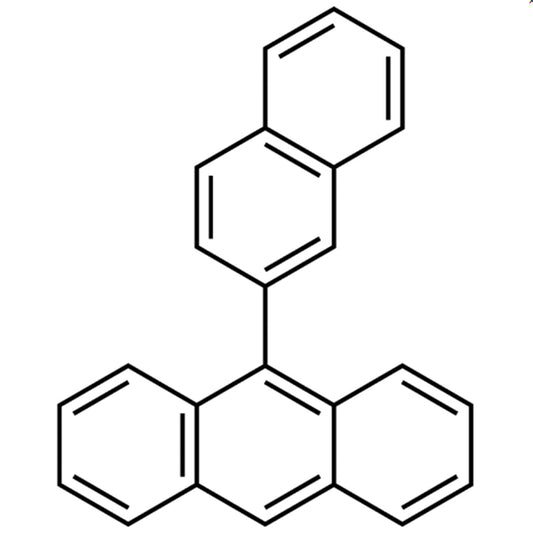
- TCI N1130 7424-72-8 9-(2-Naphthyl)anthracene
- TCI N0994 7424-70-6 9-(1-Naphthyl)anthracene
- OLED material development for efficient and sustainable light-emitting devices due to its light-emitting properties and molecular structure.
- Organic semiconductor research for applications in display technologies and photovoltaic systems because of its electronic conductivity and thermal stability.
- Thin film formation studies for uniform and high-quality coatings used in optoelectronic devices due to its ability to form homogenous layers.
- Optical material characterization for testing light emission properties at specific wavelengths in material science experiments.
- Research in renewable energy technologies for creating advanced light-emitting materials that support energy-efficient lighting solutions.
| Brand | TCI |
|---|---|
| CAS number | 24672-76-2 |
| Molecular formula | — |
| Purity | — |
| Category | Materials Science > Electronic Materials > Organic Light-Emitting Diode (OLED) Materials |
| Pack sizes | — |
| Physical form | — |
| Storage | Store in a cool, dry place away from light and moisture |
This compound should be stored in a cool, dry environment, away from direct light and moisture to maintain its chemical stability. It is recommended to use airtight containers made of materials that are chemically inert, such as glass or high-density polyethylene, to prevent contamination and degradation. In laboratory settings, it should be handled with appropriate personal protective equipment, including gloves and safety goggles, to ensure safety during use and storage. It is important to keep the compound in a well-ventilated area to minimize exposure to vapors. Regular checks on storage conditions should be conducted to ensure that the material remains in optimal condition for research applications.
—
Product Categories
Produk Terkait
-
9,10-Bis(4,4,5,5-tetramethyl-1,3,2-dioxaborolan-2-yl)anthracene TCI B4562
Regular price From Rp 13.963.950,00Regular priceRp 9.780.750,00Sale price From Rp 13.963.950,00 -
Anthracene-9,10-dicarboxaldehyde TCI A2664
Regular price From Rp 4.081.350,00Regular priceRp 2.853.900,00Sale price From Rp 4.081.350,00 -
9,10-Bis(phenylethynyl)anthracene TCI P1137
Regular price From Rp 1.035.300,00Regular priceRp 723.450,00Sale price From Rp 1.035.300,00 -
9-[4-(Naphthalen-1-yl)phenyl]-10-(naphthalen-2-yl)anthracene TCI N1295
Regular price From Rp 2.545.200,00Regular priceRp 1.779.750,00Sale price From Rp 2.545.200,00 -
9-(2-Naphthyl)anthracene TCI N1130
Regular price From Rp 1.510.950,00Regular priceRp 1.056.300,00Sale price From Rp 1.510.950,00 -
9-(1-Naphthyl)anthracene TCI N0994
Regular price From Rp 743.400,00Regular priceRp 519.750,00Sale price From Rp 743.400,00 -
9,10-Di(2-naphthyl)anthracene(purifiedbysublimation) TCI D5066
Regular price Rp 1.881.600,00Regular priceRp 1.315.650,00Sale price Rp 1.881.600,00 -
9,10-Di(1-naphthyl)anthracene(purifiedbysublimation) TCI D5065
Regular price Rp 3.498.600,00Regular priceRp 2.446.500,00Sale price Rp 3.498.600,00