

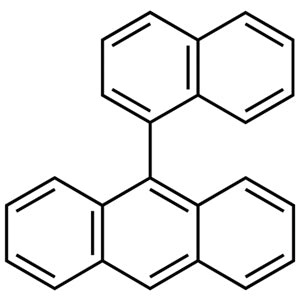
9-(1-Naphthyl)anthracene is a chemical compound widely used in various chemical experiments and scientific research. It belongs to the category of building blocks, which are essential for the synthesis of more complex compounds. In the laboratory, this compound serves as a foundational material in chemical reactions that require specific aromatic structures. Its stability and ability to interact with different functional groups make it a key component in organic synthesis studies. This compound is particularly favored for its predictable behavior in chemical reactions due to its non-heterocyclic nature, which simplifies its handling and application in research settings.
The compound's molecular structure consists of two aromatic rings connected, contributing to its unique chemical properties. Its non-reactive nature allows it to be used in controlled environments where precise chemical behavior is required. The absence of heterocyclic components enhances its predictability, making it a reliable choice for synthetic chemists. Its chemical stability and structural complexity make it suitable for a wide range of laboratory applications, especially in fields such as pharmaceutical research and material science.
In Indonesian laboratories, 9-(1-Naphthyl)anthracene is commonly used in organic chemistry research, particularly in pharmaceutical and material development. Many research institutions and universities rely on this compound for experiments that require a stable and predictable starting material. Its role in the synthesis of complex organic molecules makes it an essential tool for scientists working in both academic and industrial research environments.
TCI brochures (PDF)
- Building Blocks for Organic Semiconductor 2026-03-24 · p. 10
Related TCI products
- Organic synthesis research as a stable and predictable building block for complex molecule creation.
- Pharmaceutical development for the synthesis of drug-related compounds with specific aromatic structures.
- Material science experiments to create new polymers and functional materials with desired properties.
- Analytical chemistry applications for use in spectroscopic and chromatographic studies.
- Educational purposes in university laboratories for teaching organic chemistry principles and synthesis techniques.
| Brand | TCI |
|---|---|
| CAS number | 7424-70-6 |
| Molecular formula | — |
| Purity | — |
| Category | Chemistry > Building Blocks > Non-Heterocyclic Building Blocks |
| Pack sizes | Available in standard laboratory quantities as per supplier specifications |
| Physical form | Solid, typically in crystalline or powder form |
| Storage | Store in a cool, dry place away from direct sunlight and moisture |
This compound should be stored in a cool, dry environment to maintain its chemical stability. It is recommended to keep it in a tightly sealed container to prevent exposure to moisture and air. Due to its non-reactive nature, it does not require special handling under normal laboratory conditions. However, it is advisable to use appropriate personal protective equipment when handling it to ensure safety. The compound should be stored away from incompatible materials to avoid any potential chemical interactions. Proper labeling of storage containers is essential for safe handling and easy identification.
—
Produk Terkait
-
9-(1-Naphthyl)-10-(2-naphthyl)anthracene TCI N1135
Regular price From Rp 2.121.000,00Regular price -
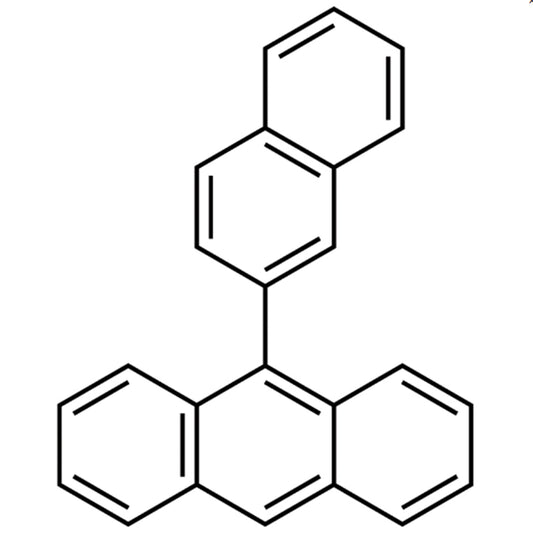
9-(2-Naphthyl)anthracene TCI N1130
Regular price From Rp 1.510.950,00Regular price -
9,10-Di(1-naphthyl)anthracene TCI D3975
Regular price From Rp 1.538.250,00Regular price -
Anthracene-9,10-dicarboxaldehyde TCI A2664
Regular price From Rp 4.081.350,00Regular price -
Anthracene TCI A0495
Regular price From Rp 584.850,00Regular price -
9,10-Bis(4-methoxyphenyl)anthracene TCI B5022
Regular price From Rp 1.961.400,00Regular price -
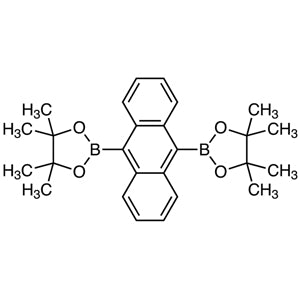
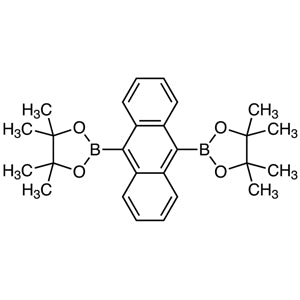
9,10-Bis(4,4,5,5-tetramethyl-1,3,2-dioxaborolan-2-yl)anthracene TCI B4562
Regular price From Rp 13.911.450,00Regular price -
Benz[a]anthracene TCI B0017
Regular price From Rp 1.458.450,00Regular price




![56-55-3 Benz[a]anthracene - AMI Scientific](http://amiscientific.com/cdn/shop/files/TCI2510B0017.jpg?v=1767084973&width=533)