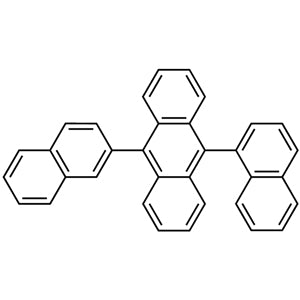
9-(1-Naphthyl)-10-(2-naphthyl)anthracene is a complex chemical compound that plays a significant role in laboratory settings, particularly in chemical synthesis and research. It belongs to the category of non-heterocyclic building blocks, making it a valuable tool for chemists working on the development of new compounds. This compound is often used as a foundational material in reactions that require a stable and complex aromatic structure. Its unique molecular architecture allows it to be a key component in various synthetic pathways, supporting both academic and industrial research.
The compound's molecular structure is highly symmetrical and stable, which contributes to its reliability in chemical reactions. Its non-reactive nature under certain conditions makes it a safe and preferred choice for laboratory use. This stability ensures that it maintains its integrity during synthesis processes, reducing the risk of unwanted side reactions. Additionally, its chemical inertness simplifies isolation and purification steps, making it an efficient material for laboratory applications. These properties make it a versatile and dependable option for researchers.
In Indonesian laboratories, 9-(1-Naphthyl)-10-(2-naphthyl)anthracene is widely used in both fundamental and applied chemical research. It is commonly employed in studies related to molecular structure and chemical properties. Many research institutions and universities in Indonesia rely on this compound for its reliability and effectiveness in various experimental setups. Its availability and performance make it a standard material in chemical laboratories across the country.
- Chemical synthesis and compound development due to its stable aromatic structure and non-reactive nature.
- Pharmaceutical research for the creation of complex molecular frameworks and drug candidates.
- Material science studies to investigate molecular interactions and structural properties.
- Organic chemistry experiments requiring a reliable and inert building block for synthetic pathways.
- Analytical research for testing molecular stability and reactivity under different experimental conditions.
| Brand | TCI |
|---|---|
| CAS number | 855828-36-3 |
| Molecular formula | — |
| Purity | — |
| Category | Chemistry > Building Blocks > Non-Heterocyclic Building Blocks |
| Pack sizes | Available in various quantities as per standard laboratory supply formats |
| Physical form | Solid |
| Storage | Store in a cool, dry, and well-ventilated area away from direct sunlight |
This compound should be stored in a cool, dry, and well-ventilated area, away from direct sunlight and sources of heat. It is recommended to use airtight containers to prevent exposure to moisture and air, which could potentially affect its stability. Due to its non-reactive nature, it is generally safe to handle with standard laboratory precautions. However, it is advisable to wear appropriate personal protective equipment, such as gloves and safety goggles, when handling it to ensure safety. Proper storage conditions help maintain its chemical integrity and ensure its effectiveness in laboratory applications.
—
Produk Terkait
-
TCI B5774 5,10-Bis(4,4,5,5-tetramethyl-1,3,2-dioxaborolan-2-yl)naphtho[1,2-c:5,6-c']bis([1,2,5]oxadiazole)
Regular price Rp 10.255.350,00Regular price -
Dihydroiodide TCI B6569
Regular price From Rp 1.936.200,00Regular price -
Trifluoromethanesulfonate TCI B7003
Regular price From Rp 1.936.200,00Regular price
![5,10-Bis(4,4,5,5-tetramethyl-1,3,2-dioxaborolan-2-yl)naphtho[1,2-c:5,6-c']bis([1,2,5]oxadiazole) - TCI B5774 - AMI Scientific](http://amiscientific.com/cdn/shop/files/TCI2510B5774.jpg?v=1769180228&width=533)