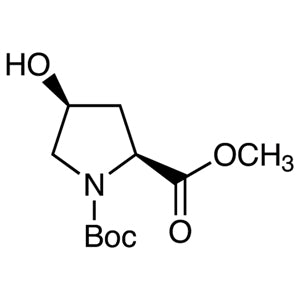
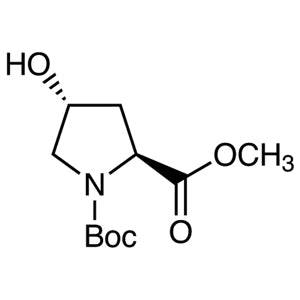
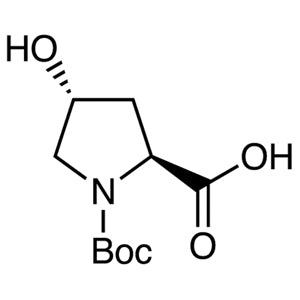
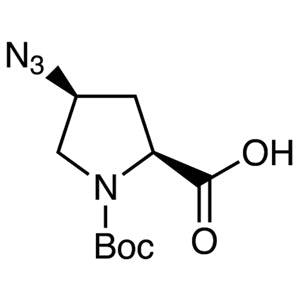
N-(tert-Butoxycarbonyl)-cis-4-hydroxy-D-proline Methyl Ester is a chemical compound widely used in organic and biochemical research, particularly in peptide chemistry. This compound serves as a key building block in the synthesis of complex peptides and proteins, playing a crucial role in the development of bioactive molecules. Its structural complexity makes it an essential tool for scientists working on drug discovery and biotechnology applications. In laboratory settings, it is frequently employed to create modified amino acids that are integral to the design of therapeutic agents and functional biomolecules.
This compound is valued for its chemical stability under controlled conditions and its reactivity with various reagents during synthesis processes. Its ability to participate in specific chemical reactions makes it a preferred choice for researchers aiming to achieve precise modifications in peptide structures. The compound's high reactivity also allows for efficient and reproducible results in synthetic pathways, which is critical in both academic and industrial research environments. Its purity and consistent quality ensure reliable outcomes in experimental procedures, making it a trusted material in advanced chemical synthesis.
In Indonesian laboratories, this compound is commonly used in pharmaceutical research, biotechnology, and biochemical analysis. It is particularly relevant in studies related to protein structure and function, as well as in the development of new therapeutic agents. Its availability in pure form and suitable packaging makes it accessible for a wide range of experimental applications, supporting innovation in both academic and industrial research sectors.
TCI brochures (PDF)
- Amino Acids and Peptide Synthesis Reagents 2025-08-14 · p. 15
Related TCI products
- TCI B4141 84348-37-8 N-(tert-Butoxycarbonyl)-4-oxo-L-proline
- TCI B3987 102195-79-9 N-(tert-Butoxycarbonyl)-cis-4-hydroxy-L-proline Methyl Ester
- TCI B3843 74844-91-0 N-(tert-Butoxycarbonyl)-trans-4-hydroxy-L-proline Methyl Ester
- TCI B1635 13726-69-7 trans-N-(tert-Butoxycarbonyl)-4-hydroxy-L-proline
- TCI A3129 132622-65-2 cis-4-Azido-N-(tert-butoxycarbonyl)-L-proline
- TCI C2506 13504-85-3 trans-N-Carbobenzoxy-4-hydroxy-L-proline
- Peptide Synthesis: This compound is ideal for synthesizing complex peptides due to its reactivity and structural versatility, enabling the creation of bioactive molecules.
- Drug Discovery: It is used in the development of therapeutic agents, as it allows for the modification of amino acid sequences to enhance drug efficacy.
- Biochemical Analysis: Its role in protein structure studies makes it valuable for understanding molecular interactions and functional properties.
- Biotechnology Research: It supports the creation of modified amino acids, which are essential in the development of novel biotechnological applications.
- Organic Chemistry Studies: Its chemical stability and reactivity make it a key reagent in synthetic pathways for advanced organic chemistry experiments.
| Brand | TCI |
|---|---|
| CAS number | 114676-69-6 |
| Molecular formula | — |
| Purity | — |
| Category | Chemistry > Chemical Biology > Peptide Chemistry |
| Pack sizes | Available in various quantities as per supplier specifications |
| Physical form | Solid, crystalline or powder depending on packaging |
| Storage | Store in a cool, dry place away from moisture and direct sunlight |
This compound should be stored in a cool, dry environment to maintain its chemical stability and prevent degradation. It is recommended to keep it in airtight containers to minimize exposure to moisture and air, which can affect its reactivity. Due to its high reactivity, it should be handled with care in a well-ventilated laboratory setting, using appropriate personal protective equipment such as gloves and safety goggles. Avoid direct contact with skin and eyes, and ensure proper disposal of any unused material in accordance with local safety regulations. Proper storage and handling are essential to ensure the compound remains effective and safe for use in laboratory applications.
—
Product Categories
- Chemical BiologyPeptide ChemistryAmino Acid Derivatives [Peptide Chemistry]
- Chemical BiologyPeptide ChemistryUnnatural Amino Acid Derivatives
- Pharmaceutical Development and Drug Discovery Research ReagentsPeptide ChemistryAmino Acid Derivatives [Peptide Chemistry]
- Pharmaceutical Development and Drug Discovery Research ReagentsPeptide ChemistryUnnatural Amino Acid Derivatives
Produk Terkait
-
N-(tert-Butoxycarbonyl)-4-oxo-L-proline TCI B4141
Regular price From Rp 1.351.350,00Regular priceRp 960.750,00Sale price From Rp 1.351.350,00 -
N-(tert-Butoxycarbonyl)-cis-4-hydroxy-L-prolineMethylEster TCI B3987
Regular price From Rp 742.350,00Regular priceRp 534.450,00Sale price From Rp 742.350,00 -
N-(tert-Butoxycarbonyl)-trans-4-hydroxy-L-prolineMethylEster TCI B3843
Regular price From Rp 822.150,00Regular priceRp 590.100,00Sale price From Rp 822.150,00 -
trans-N-(tert-Butoxycarbonyl)-4-hydroxy-L-proline TCI B1635
Regular price Rp 1.829.100,00Regular priceRp 1.294.650,00Sale price Rp 1.829.100,00 -
cis-4-Azido-N-(tert-butoxycarbonyl)-L-proline TCI A3129
Regular price From Rp 1.167.600,00Regular priceRp 831.600,00Sale price From Rp 1.167.600,00 -
trans-N-Carbobenzoxy-4-hydroxy-L-proline TCI C2506
Regular price From Rp 822.150,00Regular priceRp 590.100,00Sale price From Rp 822.150,00 -
cis-N-(tert-Butoxycarbonyl)-4-hydroxy-L-proline TCI B5887
Regular price From Rp 1.220.100,00Regular priceRp 868.350,00Sale price From Rp 1.220.100,00 -
N-(tert-Butoxycarbonyl)-trans-4-(p-toluenesulfonyloxy)-L-prolineMethylEster TCI B5247
Regular price From Rp 610.050,00Regular priceRp 442.050,00Sale price From Rp 610.050,00