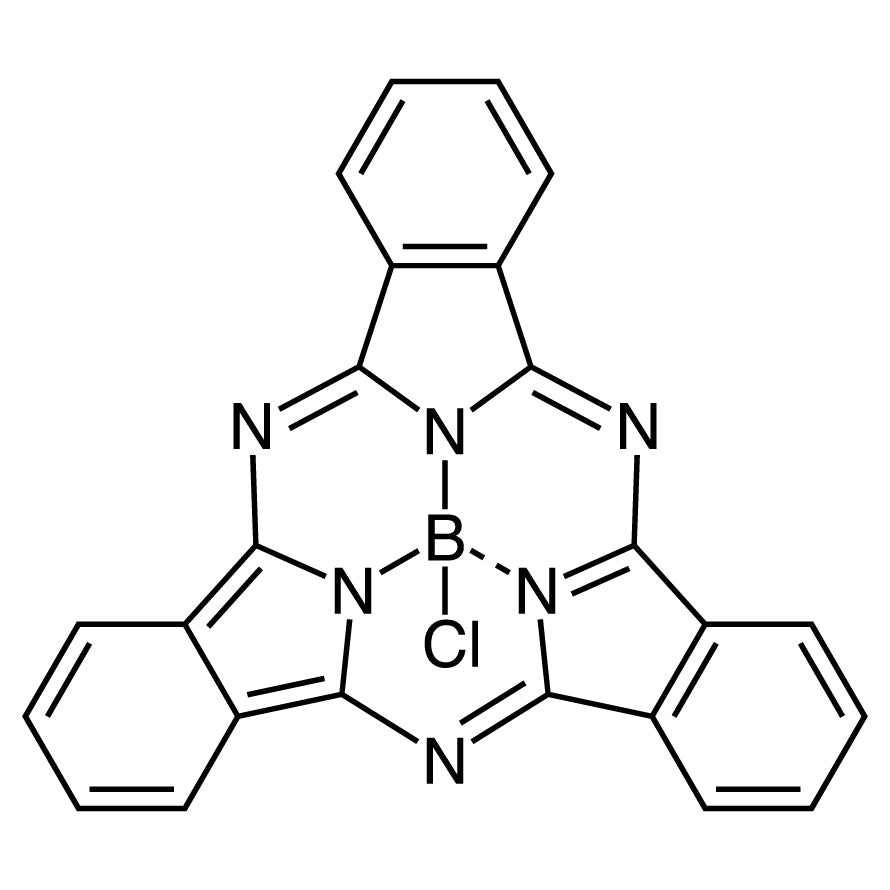
Boron Subphthalocyanine Chloride, commonly abbreviated as SubPc-Cl, is a boron-centred macrocyclic compound belonging to the phthalocyanine family, but built from only three isoindole units instead of four. As a result, the molecule is not planar but cone-shaped, with the boron atom sitting at the apex where it binds a single axial chlorine atom. In materials science laboratories, this compound serves as an organic semiconductor material that can be evaporated in vacuum deposition systems to form thin films on organic electronic devices. The variant purified by sublimation is intended specifically for device fabrication work.
The properties that make this material a frequent choice are its strong light absorption in the visible region, its characteristic magenta to purple colour, and orbital energy levels that pair well with a range of other donor and acceptor materials. Its cone shape prevents excessive molecular stacking, so the thin films that form possess a morphology distinct from that of conventional planar phthalocyanines. Purification by sublimation removes non-volatile impurities and residual solvent, which matters greatly because even trace quantities of impurity can affect the electrical behaviour of a finished device.
In Indonesian laboratories, this material is typically encountered in university and institutional research groups working on organic electronics and thin-film materials, where vacuum evaporation equipment is available. It is handled as a research-scale consumable rather than a bulk chemical, drawn on for device fabrication runs, film deposition trials, and optical characterisation studies. The sublimation-purified grade is usually reserved for work where device-level performance is being measured.
TCI brochures (PDF)
- Chemical Compounds Purified by Sublimation 2025-05-07 · p. 5
- Molecular Conductors 2025-11-13 · p. 5
- Solar Cell Materials 2026-04-21 · p. 11
- Boron Compounds 2025-10-07 · p. 28
Related TCI products
- TCI Z0037 14320-04-8 Zinc Phthalocyanine (purified by sublimation)
- TCI T2272 26201-32-1 Titanyl Phthalocyanine (purified by sublimation)
- TCI I0783 132-16-1 Iron(II) Phthalocyanine (purified by sublimation)
- TCI P1006 147-14-8 Copper(II) Phthalocyanine (beta-form)
- TCI S0504 88493-55-4 alpha-Sexithiophene (purified by sublimation)
- TCI P1629 198-55-0 Perylene (purified by sublimation)
- Organic photovoltaic device fabrication — the material evaporates cleanly in vacuum systems and its orbital energy levels can be matched against donor or acceptor partners in the active layer.
- Organic light-emitting device research — strong visible-region absorption and well-defined energy levels make it a workable component in layered device architectures built by thermal evaporation.
- Thin-film morphology studies — the non-planar cone geometry suppresses excessive molecular stacking, producing films whose structure differs measurably from those of conventional flat phthalocyanines.
- Optical and spectroscopic characterisation — the distinctive magenta to purple colour and strong absorption in the visible range give clear, readily measured spectral features for film and solution work.
- Vacuum evaporation process development — the sublimation-purified grade is free of non-volatile impurities and residual solvent, giving more reproducible deposition behaviour during process optimisation runs.
| Brand | TCI |
|---|---|
| CAS number | 36530-06-0 |
| Molecular formula | — |
| Purity | — |
| Category | Materials Science > Electronic Materials > Molecular Conductors |
| Pack sizes | — |
| Physical form | — |
| Storage | keep in a cool, dry place, protected from light; pack sizes available on request |
- Product code: B6296
- Grade: purified by sublimation, intended for device fabrication use
Store the container in a cool, dry place away from direct light, and keep it tightly closed to limit exposure to moisture and air. The original supplier container is the most suitable storage vessel; if transfer is necessary, use a clean, dry, well-sealed glass or amber container and label it clearly. Handle the solid in a fume hood or a well-ventilated area, wearing gloves, safety glasses, and a laboratory coat, and avoid generating or inhaling dust. Use clean, dry spatulas when weighing to prevent contamination that could compromise device-grade material. Consult the manufacturer's safety data sheet before use and follow institutional procedures for chemical waste disposal.
—
Product Categories
- Electronic MaterialsMolecular ConductorsDonor Molecules [Molecular Conductors]
- Electronic MaterialsOrganic Solar Cell (OPV) MaterialsDonor Materials [Organic Solar Cell (OPV) Materials]
- High Purity CompoundsCompounds Purified by SublimationOrganic Semiconductors [Compounds Purified by Sublimation]
- Photonic Materials and Optical MaterialsPhthalocyanine Dyes, Porphyrin Dyes
Produk Terkait
-
ZincPhthalocyanine(purifiedbysublimation) TCI Z0037
Regular price Rp 4.954.950,00Regular priceRp 3.480.750,00Sale price Rp 4.954.950,00 -
TitanylPhthalocyanine(purifiedbysublimation) TCI T2272
Regular price From Rp 2.702.700,00Regular priceRp 1.905.750,00Sale price From Rp 2.702.700,00 -
Iron(II)Phthalocyanine(purifiedbysublimation) TCI I0783
Regular price From Rp 2.411.850,00Regular priceRp 1.702.050,00Sale price From Rp 2.411.850,00 -
Copper(II)Phthalocyanine(beta-form) TCI P1006
Regular price From Rp 717.150,00Regular priceRp 500.850,00Sale price From Rp 717.150,00 -
alpha-Sexithiophene(purifiedbysublimation) TCI S0504
Regular price Rp 1.298.850,00Regular priceRp 924.000,00Sale price Rp 1.298.850,00 -
Perylene(purifiedbysublimation) TCI P1629
Regular price Rp 2.359.350,00Regular priceRp 1.649.550,00Sale price Rp 2.359.350,00 -
Pentacene(purifiedbysublimation) TCI P0030
Regular price From Rp 1.087.800,00Regular priceRp 760.200,00Sale price From Rp 1.087.800,00 -
Naphthacene(purifiedbysublimation) TCI N0951
Regular price From Rp 2.439.150,00Regular priceRp 1.705.200,00Sale price From Rp 2.439.150,00