

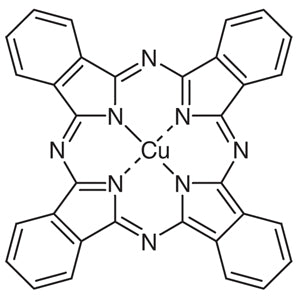
Copper(II) Phthalocyanine (beta-form) from TCI is a metal complex with a copper(II) ion at the center of a large, conjugated phthalocyanine macrocyclic ring. It is well known as a very stable blue pigment and is widely used in the ink, paint, and plastics industries. The beta-form is one of its most thermodynamically stable crystal polymorphs. In modern laboratories, copper phthalocyanine is also known as a p-type organic semiconductor and as a transition-metal-based catalyst. Its role therefore reaches from inorganic chemistry to organic electronics, which makes it a useful reference compound for both research and teaching.
Researchers choose this compound because it is very stable to heat, light, acids, and bases. Its flat macrocyclic structure and extended π-electron system give it strong absorption in the red and near-infrared regions. In the solid state, the molecules stack closely together, which lets the material conduct positive charge carriers (holes). The copper ion at the center of the ring provides redox activity that is used in catalytic oxidation reactions and in electrocatalysis. Because it is very poorly soluble, the material is usually processed by vacuum thermal evaporation to make thin films. Access to a specific polymorph also helps researchers get consistent, reproducible results when studying structure-property relationships.
In Indonesian laboratories, Copper(II) Phthalocyanine (beta-form) is typically used in university chemistry and physics departments, materials science research groups, and industrial quality-control laboratories. Research teams working on organic semiconductors, thin-film devices, and electrocatalysts use it as a well-characterized model compound. Pigment and coatings laboratories use it as a reference material when evaluating ink, paint, and plastic formulations. Its stability also makes it suitable for long-term projects and for teaching laboratories that demonstrate coordination chemistry and transition-metal complexes.
- Organic semiconductor research: As a p-type organic semiconductor whose closely stacked molecules conduct holes, it suits studies of charge transport in thin films.
- Thin-film fabrication by vacuum thermal evaporation: Its very low solubility and high thermal stability make it a good fit for vacuum deposition instead of solution processing.
- Catalytic oxidation and electrocatalysis: The redox-active copper(II) center inside the stable macrocycle supports catalytic oxidation reactions and electrocatalytic studies in inorganic chemistry laboratories.
- Optical and spectroscopic studies: Its extended π-electron system absorbs red and near-infrared light strongly, which makes it useful for absorption studies and light-harvesting research.
- Pigment and coatings reference work: As a very stable blue pigment that resists heat, light, acids, and bases, it serves as a benchmark in ink, paint, and plastics testing.
| Brand | TCI (product code P1006) |
|---|---|
| CAS number | 147-14-8 |
| Molecular formula | — |
| Purity | — |
| Category | Chemistry > Catalysis and Inorganic Chemistry > Transition Elements |
| Pack sizes | Available in the pack sizes listed in the TCI catalog |
| Physical form | Solid blue pigment, beta-form crystal polymorph |
| Storage | Keep tightly closed in a cool, dry place away from incompatible materials |
Store Copper(II) Phthalocyanine (beta-form) in its original, tightly sealed container in a cool, dry, well-ventilated area, away from strong oxidizing agents and sources of contamination. Glass or chemically resistant plastic containers with secure caps are suitable for longer storage. Handle the material in a fume hood or a well-ventilated area to avoid breathing in fine dust. Wear standard personal protective equipment, including gloves, safety glasses, and a laboratory coat. Avoid creating dust when weighing or transferring the material, and clean up spills promptly with suitable methods. Always check the Safety Data Sheet from TCI before use, and follow your institution's chemical hygiene and waste disposal procedures.
—