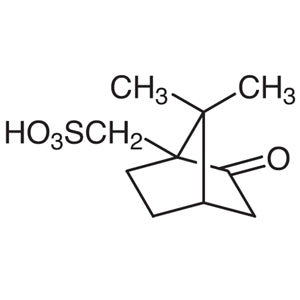
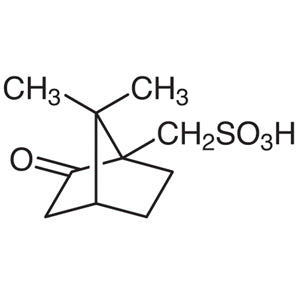
(+/-)-10-Camphorsulfonic Acid, commonly abbreviated as CSA, is an organic sulfonic acid derived from camphor and supplied in its racemic form. It is a strong acid, yet unlike many strong acids it is a solid and dissolves in a wide range of organic solvents. That combination makes it a practical acid catalyst for synthetic work. In glycoscience and carbohydrate chemistry, CSA is a well-known catalyst for acetal and ketal formation, including the installation of benzylidene and isopropylidene protecting groups on the hydroxyl groups of sugars.
Researchers choose CSA because it pairs strong acidity with easy handling. Because it is a solid, it can be weighed more accurately than liquid mineral acids, which helps when catalyst loading has to be controlled closely. Its solubility in organic solvents lets it work as an effective homogeneous catalyst, so the reaction mixture stays uniform. Compared with some other sulfonic acids, CSA is often regarded as mild enough for sensitive substrates. It also forms salts with amines, so it is useful as a counterion, including as a dopant for polyaniline in conductive polymer research. Note that CSA is hygroscopic.
In Indonesia, CSA is useful to laboratories working in synthetic organic chemistry, carbohydrate chemistry, natural product chemistry, and materials science at universities and research institutions. Carbohydrate chemists use it for routine protecting group steps in multistep syntheses of sugar derivatives. Natural product groups use it as a convenient acid catalyst during the modification of isolated compounds. Materials science laboratories use it when preparing doped conductive polymers for electronic and sensing studies.
TCI brochures (PDF)
- Terpenes 2025-09-22 · p. 5
- Reagents for Glyco Chemistry & Biology 5th Edition · p. 132
Related TCI products
- Acetal and ketal formation: CSA is a strong acid that dissolves in organic solvents, so it catalyzes acetal and ketal formation efficiently under homogeneous conditions.
- Carbohydrate protecting group chemistry: CSA is widely used to install benzylidene and isopropylidene protecting groups on sugar hydroxyl groups, which is a routine step in glycoscience synthesis.
- Acid catalysis for sensitive substrates: CSA is often considered milder than some other sulfonic acids, so it suits reactions where delicate functional groups must survive acidic conditions.
- Precise catalyst dosing in synthesis: As a solid, CSA can be weighed more accurately than liquid mineral acids, which makes catalyst loading easier to control and reproduce between runs.
- Conductive polymer research: CSA forms salts with amines and works as a counterion, which makes it useful as a dopant for polyaniline in conductive polymer studies.
| Brand | TCI (product code C0016) |
|---|---|
| CAS number | 5872-08-2 |
| Molecular formula | — |
| Purity | — |
| Category | Chemistry > Chemical Biology > Glycoscience |
| Pack sizes | refer to the available options on the product listing |
| Physical form | solid, racemic (+/-) form |
| Storage | hygroscopic, so keep the container tightly closed and protect it from moisture |
Store (+/-)-10-Camphorsulfonic Acid in its original tightly sealed container in a cool, dry, well-ventilated area. Because the material is hygroscopic, keep it away from humid air and close the container promptly after each use. A desiccator is a good choice for opened containers. Use chemically resistant containers suitable for strong acids, and keep the material away from bases and incompatible substances. CSA is a strong acid, so handle it with gloves, safety glasses, and a lab coat, and avoid creating or breathing dust. Weigh and transfer it in a fume hood or another well-ventilated area. Always follow the supplier's Safety Data Sheet and your institution's chemical safety procedures.
—
Product Categories
Produk Terkait
-
(-)-10-CamphorsulfonicAcid TCI C0972
Regular price From Rp 1.351.350,00Regular priceRp 960.750,00Sale price From Rp 1.351.350,00 -
(+)-10-CamphorsulfonicAcid TCI C0015
Regular price From Rp 848.400,00Regular priceRp 609.000,00Sale price From Rp 848.400,00 -
(-)-10-Camphorsulfonimine TCI C1393
Regular price Rp 2.411.850,00Regular priceRp 1.702.050,00Sale price Rp 2.411.850,00 -
(+)-10-Camphorsulfonimine TCI C1391
Regular price Rp 2.677.500,00Regular priceRp 1.887.900,00Sale price Rp 2.677.500,00 -
(-)-10-CamphorsulfonylChloride TCI C1308
Regular price From Rp 1.881.600,00Regular priceRp 1.331.400,00Sale price From Rp 1.881.600,00 -
(+)-10-CamphorsulfonylChloride TCI C0998
Regular price From Rp 1.140.300,00Regular priceRp 812.700,00Sale price From Rp 1.140.300,00 -
Sodium(+/-)-10-Camphorsulfonate TCI C0017
Regular price Rp 2.757.300,00Regular priceRp 1.943.550,00Sale price Rp 2.757.300,00 -
SilverTrifluoromethanesulfonate TCI T1331
Regular price From Rp 610.050,00Regular priceRp 426.300,00Sale price From Rp 610.050,00