cis-3-Hexen-1-yl Hexanoate from TCI, product code C0917, is an ester formed from cis-3-hexen-1-ol, widely known as "leaf alcohol", and hexanoic acid. It belongs to the non-heterocyclic building block group. In the laboratory, this ester is best known for its role in aroma and flavor chemistry, because it gives a green, fruity odor that recalls freshly cut leaves or fruit that is not yet fully ripe. Researchers can use it as a reference compound, as an ingredient in experimental formulations, or as a substrate in studies of ester and alkene reactions.
Its structure combines two useful features: a cis-configured double bond on the hexenyl chain and an ester group that can be hydrolyzed or transesterified readily. The cis configuration has a strong influence on the compound's aroma character, so it is useful in research that compares how molecular geometry affects odor perception. Because it is a liquid, it dissolves and dilutes easily for gas chromatography analysis and sensory testing. Detailed purity data is given in TCI's analytical documentation. Its well-defined structure also makes it a good model compound for teaching and method development.
The food, beverage, cosmetics, and fragrance industries in Indonesia continue to grow. University research groups, quality control laboratories, and product development teams working on flavors and fragrances can use this ester as an analytical reference when identifying volatile compounds in natural extracts or finished products. Synthetic chemistry laboratories can also use it as a starting material or model substrate when studying reactions that involve esters and cis-alkenes.
Related TCI products
- TCI B1039 25152-85-6 cis-3-Hexen-1-yl Benzoate
- TCI T0934 67883-79-8 cis-3-Hexen-1-yl Tiglate
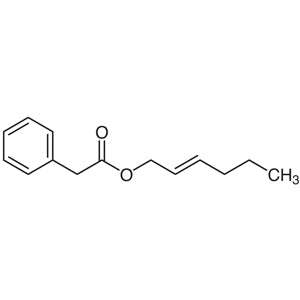
- TCI P1045 68133-78-8 trans-2-Hexen-1-yl Phenylacetate
- TCI M2366 5166-53-0 5-Methyl-3-hexen-2-one (contains 5-Methyl-4-hexen-2-one)
- TCI M0734 53398-85-9 cis-3-Hexen-1-yl 2-Methylbutyrate
- TCI H1735 50396-87-7 (E)-4-Hexen-3-one
- Flavor and fragrance research: its green, fruity aroma makes it a relevant reference material for studying leafy and unripe-fruit notes in experimental flavor and fragrance formulations.
- Gas chromatography reference standard: as a liquid ester it dilutes easily in common solvents, so it helps with retention-time comparison and identification of volatile compounds in GC analysis.
- Structure–odor relationship studies: its cis-configured double bond lets researchers examine how molecular geometry affects odor perception when they compare it with related isomers or analogues.
- Ester hydrolysis and transesterification studies: its readily reactive ester group makes it a practical model substrate for studying reaction conditions, catalysts, and the kinetics of ester transformations.
- Alkene reaction research: the cis double bond on the hexenyl chain gives a defined site for studying addition, isomerization, or other alkene reactions in synthetic chemistry work.
| Brand | TCI (product code C0917) |
|---|---|
| CAS number | 31501-11-8 |
| Molecular formula | — |
| Purity | — |
| Category | Chemistry > Building Blocks > Non-Heterocyclic Building Blocks |
| Pack sizes | see the current product listing for available sizes |
| Physical form | liquid |
| Storage | keep the container tightly closed in a cool, dry, well-ventilated place; follow the storage conditions on the TCI label and safety data sheet |
Store cis-3-Hexen-1-yl Hexanoate in its original, tightly sealed container, in a cool, dry, well-ventilated area away from direct sunlight, heat sources, and ignition sources. Keep it apart from strong oxidizing agents, strong acids, and strong bases, which could react with the ester or the double bond. Glass containers with chemically resistant caps are suitable for any portion you transfer out of the original pack. Handle it in a fume hood or well-ventilated area, and wear safety glasses, chemical-resistant gloves, and a lab coat. Because the compound has a noticeable odor, keep containers closed when not in use to avoid cross-contamination of nearby samples, especially in sensory or trace analysis work. Always check the safety data sheet from TCI for specific hazard, handling, and disposal information before use.
—
Produk Terkait
-
cis-3-Hexen-1-ylBenzoate TCI B1039
Regular price Rp 2.227.050,00Regular priceRp 1.572.900,00Sale price Rp 2.227.050,00 -
cis-3-Hexen-1-ylTiglate TCI T0934
Regular price Rp 2.041.200,00Regular priceRp 1.442.700,00Sale price Rp 2.041.200,00 -
trans-2-Hexen-1-ylPhenylacetate TCI P1045
Regular price Rp 1.351.350,00Regular priceRp 960.750,00Sale price Rp 1.351.350,00 -
5-Methyl-3-hexen-2-one(contains5-Methyl-4-hexen-2-one) TCI M2366
Regular price From Rp 1.670.550,00Regular priceRp 1.167.600,00Sale price From Rp 1.670.550,00 -
cis-3-Hexen-1-yl2-Methylbutyrate TCI M0734
Regular price Rp 1.618.050,00Regular priceRp 1.130.850,00Sale price Rp 1.618.050,00 -
(E)-4-Hexen-3-one TCI H1735
Regular price From Rp 875.700,00Regular priceRp 612.150,00Sale price From Rp 875.700,00 -
2-Hexen-1-ylsuccinicAnhydride(cis-andtrans-mixture) TCI H0616
Regular price Rp 4.266.150,00Regular priceRp 2.998.800,00Sale price Rp 4.266.150,00 -
5-Hexen-2-one TCI H0125
Regular price From Rp 875.700,00Regular priceRp 612.150,00Sale price From Rp 875.700,00