

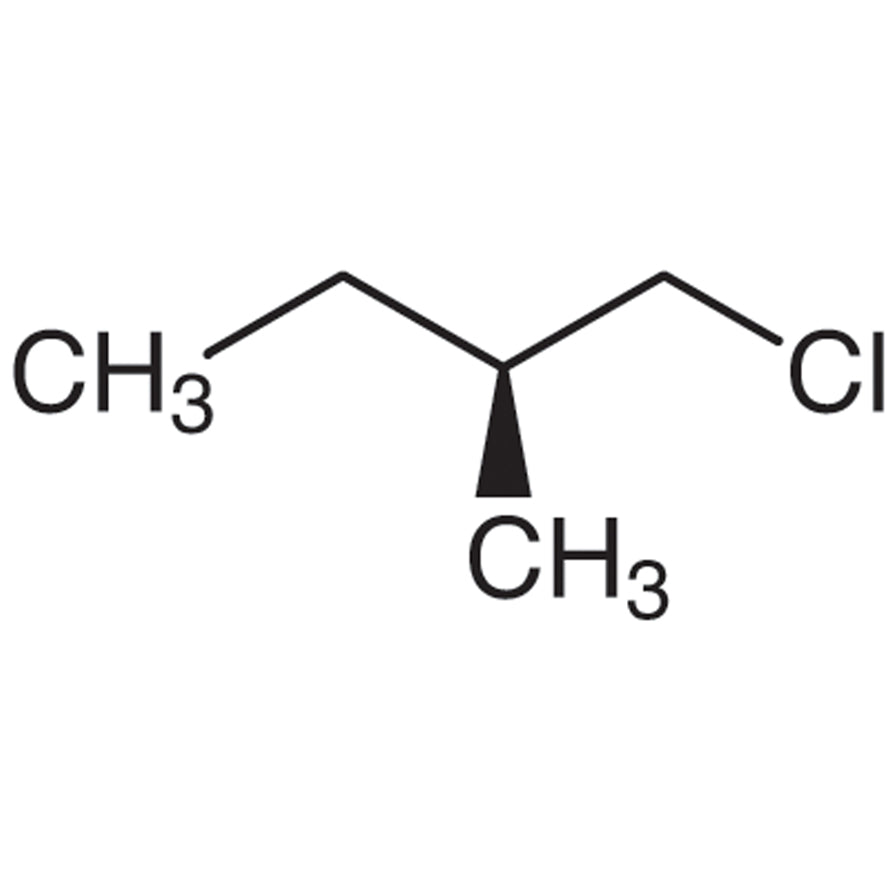
(S)-(+)-1-Chloro-2-methylbutane from TCI, product code C1188, is a chiral alkyl halide with a single stereogenic centre at the second carbon of the butane chain. It belongs to the chiral building block category used in asymmetric synthesis. In the laboratory, chemists use it to attach an optically active (S)-2-methylbutyl group to a target molecule. This carries chirality into the final product without needing a resolution step or a complicated asymmetric catalysis procedure, which makes it a simple and direct way to build stereochemically defined compounds.
Chemists choose this compound because it pairs configurational purity with the reactivity of a primary chloride. The chlorine atom sits on a primary carbon, so nucleophilic substitution and the formation of organometallic reagents can take place without acting directly on the chiral centre. As a result, the (S) configuration tends to be preserved through these transformations. The (+) sign shows the direction of its optical rotation. The material is a liquid, so it can be measured out by volume easily. For the exact optical rotation value and purity, refer to the TCI certificate of analysis supplied with each lot.
The chiral 2-methylbutyl group has long been used in research on chiral liquid crystals, optically active polymers, and pheromones and other natural products. For organic chemistry and materials laboratories in Indonesia, including university research groups, institutes, and industrial R&D teams, this reagent is a practical starting point for building stereodefined side chains. It is useful wherever a research programme needs a reliable source of a small chiral alkyl fragment for synthesis, method development, or structure–property studies.
TCI brochures (PDF)
- Chiral Building Blocks 2025-04-14 · p. 15
- Introducing a chiral side chain: the primary chloride lets chemists attach the optically active (S)-2-methylbutyl group to target molecules through standard nucleophilic substitution, without directly disturbing the stereocentre.
- Preparing organometallic reagents: because the chlorine sits on a primary carbon, the compound can be converted into organometallic reagents that carry the chiral fragment into carbon–carbon bond-forming reactions.
- Chiral liquid crystal research: the 2-methylbutyl group is a classic chiral tail in liquid crystal studies, so this building block helps researchers make mesogens with defined stereochemistry.
- Optically active polymer synthesis: adding the (S)-2-methylbutyl unit to monomers or side chains gives polymers optical activity, which supports studies of chiral materials and how they behave.
- Pheromone and natural product synthesis: as a ready-made chiral fragment, it lets synthetic chemists build stereodefined segments of pheromones and natural products without a separate resolution step.
| Brand | TCI (product code C1188) |
|---|---|
| CAS number | 40560-29-0 |
| Molecular formula | — |
| Purity | — |
| Category | Chemistry > Asymmetric Synthesis > Chiral Building Blocks |
| Pack sizes | see the available options on the product page |
| Physical form | liquid |
| Storage | follow the TCI label and safety data sheet; see the certificate of analysis for optical rotation and purity |
Keep (S)-(+)-1-Chloro-2-methylbutane in its original, tightly closed TCI container, and follow the storage conditions on the product label and safety data sheet. Store it in a cool, dry, well-ventilated chemical storage area, away from heat, ignition sources, and incompatible materials such as strong oxidisers and strong bases. Reseal the container promptly after each use to protect the liquid from moisture and evaporation. Handle it in a fume hood and wear suitable gloves, safety glasses, and a laboratory coat. Use clean, dry glassware for volumetric measurement, and dispose of waste according to institutional and local chemical waste rules. Read the safety data sheet before first use.
—
Produk Terkait
-
(R)-2-Hydroxy-3-methylbutanoicAcid TCI H1810
Regular price From Rp 2.464.350,00Regular priceRp 1.738.800,00Sale price From Rp 2.464.350,00 -
1-Chloro-2-methylbutane TCI C1459
Regular price Rp 637.350,00Regular priceRp 445.200,00Sale price Rp 637.350,00 -
2-Chloro-2-methylbutane TCI C0200
Regular price From Rp 1.538.250,00Regular priceRp 1.075.200,00Sale price From Rp 1.538.250,00 -
1-Chloro-3-methylbutane TCI C0199
Regular price From Rp 1.485.750,00Regular priceRp 1.038.450,00Sale price From Rp 1.485.750,00 -
Methyl2-Chloro-L-mandelate TCI M2383
Regular price Rp 1.801.800,00Regular priceRp 1.275.750,00Sale price Rp 1.801.800,00 -
Methyl2-Chloro-D-mandelate TCI M2382
Regular price From Rp 1.696.800,00Regular priceRp 1.202.250,00Sale price From Rp 1.696.800,00 -
(R)-(-)-3-Chloro-1,2-propanediol TCI M0967
Regular price From Rp 1.749.300,00Regular priceRp 1.223.250,00Sale price From Rp 1.749.300,00 -
Ethyl(R)-4-Chloro-3-hydroxybutanoate TCI E1527
Regular price From Rp 980.700,00Regular priceRp 701.400,00Sale price From Rp 980.700,00


