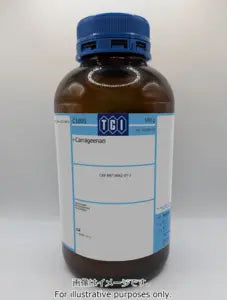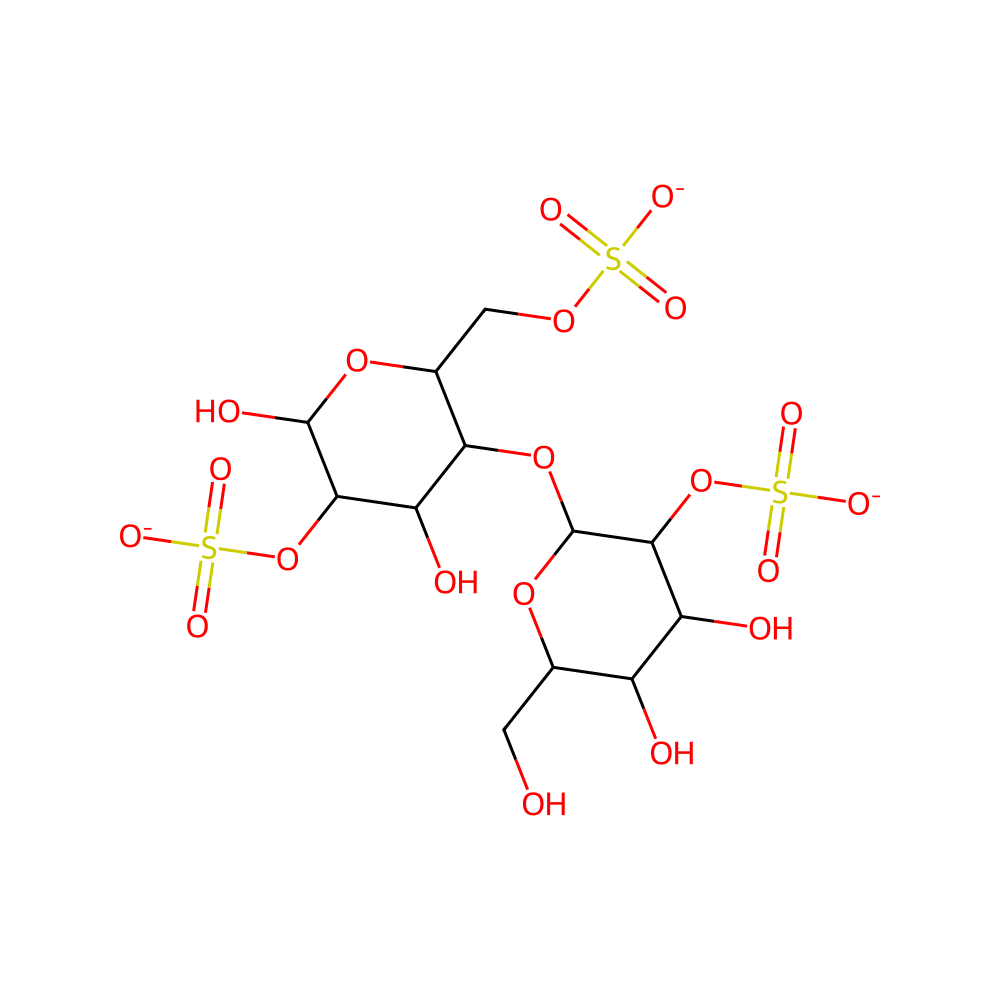
lambda-Carrageenan (Low-viscosity) from TCI, product code C2871, is a sulfated polysaccharide extracted from red seaweed. Its molecules are built from galactose units that carry many sulfate groups. The material belongs to glycoscience and chemical biology. In research laboratories it is used to study the behaviour of charged polysaccharides and how carbohydrates interact with proteins. In pharmacology it is widely used to induce inflammation in experimental animal models, which makes it an important tool for testing the anti-inflammatory and analgesic effects of drug candidates and natural product extracts.
There are three main types of carrageenan: kappa, iota, and lambda. Lambda-carrageenan does not form a gel, which sets it apart from the other two. Its high degree of sulfation makes it more readily soluble, and it produces viscous solutions without gelling. This low-viscosity grade is easier to dissolve, pipette, and inject, which matters when a solution must be homogeneous and dosed at a precise volume. Because carrageenan comes from a natural polymer, consistency between lots is a key concern. Sourcing it from an established reagent manufacturer such as TCI helps keep research results reproducible.
In Indonesian laboratories, lambda-carrageenan is mainly used in pharmacology and pharmacy departments, natural product research groups, and biomedical laboratories. Researchers there evaluate the anti-inflammatory and analgesic potential of synthetic compounds and plant extracts. Glycoscience and biochemistry groups also use it to study polysaccharide properties and carbohydrate–protein interactions. Each of these settings needs a reagent from a recognised manufacturer with reliable lot-to-lot consistency. This low-viscosity grade also simplifies routine solution preparation for teaching and research.
TCI brochures (PDF)
- Polysaccharides 2025-02-13 · p. 1
- Drug Delivery System (DDS) Research Reagents 2025-01-29 · p. 1
- Plant Research Reagents 2026-02-24 · p. 15
- Reagents for Glyco Chemistry & Biology 5th Edition · p. 114
- Biomaterials Research Reagents 2025-02-19 · p. 4
- Reagents for Biological Research 2025-03-11 · p. 54
- Inflammation induction in animal models: as a well-established inflammatory agent, lambda-carrageenan creates a reproducible inflammatory response for testing drug candidates in preclinical pharmacology studies.
- Anti-inflammatory screening of natural product extracts: it provides a standard inflammation challenge, so researchers can compare plant extracts and isolated compounds under consistent experimental conditions.
- Analgesic activity testing: carrageenan-induced models let researchers assess how well a test substance reduces pain-related responses, which supports early-stage evaluation of analgesic candidates.
- Studies of charged polysaccharides: the many sulfate groups make it a useful model for investigating the solution behaviour and physicochemical properties of highly charged, non-gelling polysaccharides.
- Carbohydrate–protein interaction research: as a sulfated galactose-based polymer, it is suitable for studying how proteins bind or respond to charged carbohydrate structures in glycoscience and chemical biology.
| Brand | TCI (product code C2871) |
|---|---|
| CAS number | 9064-57-7 |
| Molecular formula | — |
| Purity | — |
| Category | Chemistry > Chemical Biology > Glycoscience |
| Pack sizes | please confirm available pack sizes with AMI Scientific |
| Physical form | — |
| Storage | follow the storage conditions on the TCI label and Safety Data Sheet |
- Grade: Low-viscosity lambda-carrageenan (non-gelling, highly sulfated polysaccharide)
Keep lambda-carrageenan in its original, tightly closed container in a cool, dry place away from moisture and direct sunlight, unless the TCI label or Safety Data Sheet gives specific conditions. Polysaccharides take up moisture readily, so reseal the container promptly after each use and avoid leaving it open in humid air. Use clean, dry spatulas when weighing to prevent contamination. Wear standard laboratory protective equipment, including gloves, a lab coat, and safety glasses. Avoid creating or inhaling dust. Prepare solutions fresh where practical, and handle and dispose of all material in line with your institution's safety procedures and the product Safety Data Sheet.
—
Product Categories
- GlycoscienceApplications Using Glyco-materialsGlyco-chemical Analysis [Applications Using Glyco-materials]
- GlycosciencePolysaccharides [Glycoscience]
- Biochemicals and ReagentsCarbohydrates
- Molecular BiologyPlant BiotechnologyPlant Tissue Culture
- Pharmaceutical Development and Drug Discovery ResearchDrug Delivery Systems (DDS)Natural Polymers (for DDS)
Produk Terkait
-
kappa-Carrageenan TCI C1804
Regular price From Rp 1.008.000,00Regular priceRp 720.300,00Sale price From Rp 1.008.000,00 -
lambda-Carrageenan(High-viscosity) TCI C3313
Regular price From Rp 1.033.200,00Regular priceRp 738.150,00Sale price From Rp 1.033.200,00 -
iota-Carrageenan TCI C1805
Regular price From Rp 848.400,00Regular priceRp 609.000,00Sale price From Rp 848.400,00 -
XylanfromCornCore TCI X0078
Regular price From Rp 1.458.450,00Regular priceRp 1.035.300,00Sale price From Rp 1.458.450,00 -
(+)-ArabinogalactanfromLarchWood TCI A1328
Regular price From Rp 1.246.350,00Regular priceRp 887.250,00Sale price From Rp 1.246.350,00 -
PectinfromCitrus TCI P0024
Regular price From Rp 637.350,00Regular priceRp 460.950,00Sale price From Rp 637.350,00 -
GuarGum TCI G0478
Regular price From Rp 662.550,00Regular priceRp 478.800,00Sale price From Rp 662.550,00 -
Dextrin TCI D4657
Regular price From Rp 743.400,00Regular priceRp 519.750,00Sale price From Rp 743.400,00