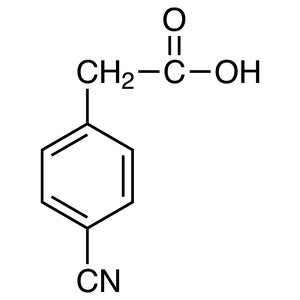
(4-Cyanophenyl)acetic Acid is a versatile chemical compound widely used in organic synthesis as a building block for creating complex molecular structures. This compound contains both a carboxylic acid group and a cyanide group attached to a phenyl ring, which contributes to its high reactivity. Its unique molecular structure makes it an essential tool for chemists and researchers in the development of new compounds, particularly in pharmaceutical and organic chemistry applications. In laboratory settings, it is valued for its ability to participate in various reaction types, including substitution and condensation reactions, which are fundamental to synthetic chemistry.
The compound is known for its polar nature and good solubility in organic solvents such as ethyl acetate and ethanol. These properties make it easy to handle and integrate into different synthetic protocols, enhancing the efficiency of laboratory processes. Its solid form also facilitates accurate weighing and use in both small-scale and large-scale experiments. The combination of solubility, reactivity, and ease of handling ensures that it remains a preferred choice for researchers working on complex molecular synthesis.
In Indonesian laboratories, (4-Cyanophenyl)acetic Acid is commonly used in chemical and pharmaceutical research. It is a key component in experiments that require the synthesis of complex organic molecules. Many educational and research institutions rely on this compound for its reliability and effectiveness in various synthetic processes. Its availability and consistent performance make it an essential material for advancing scientific research in the region.
Related TCI products
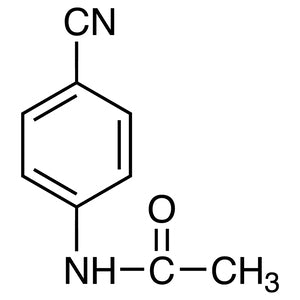
- TCI A2173 35704-19-9 N-(4-Cyanophenyl)acetamide
- TCI E1080 49744-93-6 Ethyl 3-(4-Cyanophenyl)-3-oxopropionate
- TCI B4362 39255-60-2 N'-(4-Bromo-2-cyanophenyl)-N,N-dimethylformamidine
- TCI B4079 50916-55-7 3-Cyanophenacyl Bromide
- TCI B2790 6508-04-9 Bis(4-cyanophenyl) Ether
- TCI C3794 38690-77-6 4-Cyanophenyl 4-Butylbenzoate
- Organic synthesis is a primary application where this compound serves as a building block for creating complex molecular structures due to its reactive functional groups.
- Pharmaceutical research benefits from its use in the development of new drugs, as it can be incorporated into various synthetic pathways to produce bioactive compounds.
- Analytical chemistry applications utilize its solubility and reactivity for preparing standards and conducting chemical analysis in laboratory settings.
- Teaching laboratories use it to demonstrate fundamental reaction mechanisms and synthetic strategies in undergraduate and graduate courses.
- Industrial research and development incorporate it in the design of new chemical processes and materials for commercial applications.
| Brand | TCI |
|---|---|
| CAS number | 5462-71-5 |
| Molecular formula | — |
| Purity | — |
| Category | Chemistry > Building Blocks > Non-Heterocyclic Building Blocks |
| Pack sizes | Available in various quantities as per standard laboratory supply |
| Physical form | Solid |
| Storage | Store in a cool, dry place away from direct sunlight and moisture |
This compound should be stored in a cool, dry environment to maintain its stability and prevent degradation. It is recommended to keep it in a sealed container to avoid exposure to moisture and air, which could affect its purity and reactivity. As a solid, it is easy to handle and measure, making it suitable for routine laboratory use. When working with this material, it is important to follow standard laboratory safety protocols, including the use of personal protective equipment. Its polar nature means it is soluble in organic solvents, so proper ventilation should be maintained during handling. The compound is generally stable under normal storage conditions, making it a reliable choice for research and educational purposes.
—
Produk Terkait
-
N-(4-Cyanophenyl)acetamide TCI A2173
Regular price From Rp 1.035.300,00Regular price -
Ethyl3-(4-Cyanophenyl)-3-oxopropionate TCI E1080
Regular price From Rp 1.298.850,00Regular price -
N'-(4-Bromo-2-cyanophenyl)-N,N-dimethylformamidine TCI B4362
Regular price From Rp 4.161.150,00Regular price -
3-CyanophenacylBromide TCI B4079
Regular price Rp 7.049.700,00Regular price -
Bis(4-cyanophenyl)Ether TCI B2790
Regular price From Rp 3.419.850,00Regular price -
4-Cyanophenyl4-Butylbenzoate TCI C3794
Regular price From Rp 848.400,00Regular price -
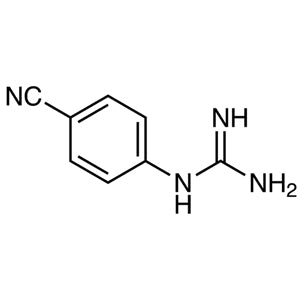
1-(4-Cyanophenyl)guanidine TCI C3387
Regular price From Rp 717.150,00Regular price -
2-Cyanophenylacetonitrile TCI C2247
Regular price Rp 477.750,00Regular price