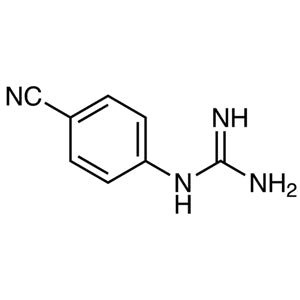
1-(4-Cyanophenyl)guanidine is a chemical compound widely used as a building block in the synthesis of complex molecules. Its unique molecular structure combines guanidine with a cyanide group attached to a phenyl ring, making it a versatile reagent in organic chemistry. In the laboratory, this compound serves as a key component in reactions that require both stability and reactivity. Its ability to interact with a variety of reagents makes it an essential tool for chemists working on diverse synthetic pathways.
The compound's chemical properties, including its stability under certain conditions and reactivity in appropriate environments, make it a preferred choice for researchers. Its molecular complexity allows it to act as a helper in the synthesis of heterocyclic compounds, such as amines and amides. The compound's ability to form bonds with various functional groups enhances its utility in a wide range of chemical applications. This makes it particularly valuable for both fundamental and applied research in Indonesian laboratories.
In Indonesian laboratories, 1-(4-Cyanophenyl)guanidine is commonly used in pure and applied chemical research. It plays a significant role in the development of new compounds, drug discovery, and material characterization. Many research institutions and universities incorporate this compound into their projects, highlighting its importance in advancing scientific knowledge and innovation.
Related TCI products
- TCI B4362 39255-60-2 N'-(4-Bromo-2-cyanophenyl)-N,N-dimethylformamidine
- TCI B2790 6508-04-9 Bis(4-cyanophenyl) Ether
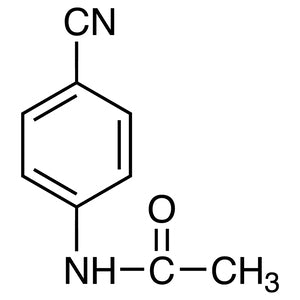
- TCI A2173 35704-19-9 N-(4-Cyanophenyl)acetamide
- TCI E1080 49744-93-6 Ethyl 3-(4-Cyanophenyl)-3-oxopropionate
- TCI C3794 38690-77-6 4-Cyanophenyl 4-Butylbenzoate
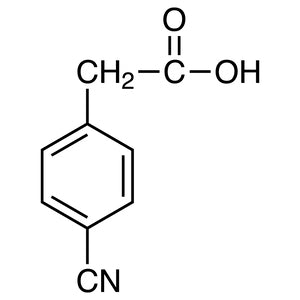
- TCI C3095 5462-71-5 (4-Cyanophenyl)acetic Acid
- Organic synthesis of heterocyclic compounds due to its ability to form stable intermediates and react with various functional groups.
- Drug development and pharmaceutical research for its potential role in the synthesis of bioactive molecules and therapeutic agents.
- Material characterization studies where its chemical stability and reactivity aid in the analysis of new materials and polymers.
- Chemical reaction optimization in research settings where controlled reactivity and molecular versatility are required.
- Academic research in chemistry departments for teaching and experimental purposes involving complex molecular structures.
| Brand | TCI |
|---|---|
| CAS number | 5637-42-3 |
| Molecular formula | — |
| Purity | — |
| Category | Chemistry > Building Blocks > Non-Heterocyclic Building Blocks |
| Pack sizes | Available in various quantities as per supplier specifications |
| Physical form | Solid |
| Storage | Store in a cool, dry place away from moisture and direct sunlight |
This compound should be stored in a cool, dry environment, away from moisture and direct sunlight to maintain its chemical integrity. It is recommended to use airtight containers to prevent exposure to air and humidity. Due to its reactivity, it should be handled with care, using appropriate personal protective equipment such as gloves and safety goggles. It is important to ensure that the storage area is well-ventilated to minimize the risk of inhalation of any vapors. The compound should not be stored near incompatible materials to avoid any potential chemical interactions. Always follow standard laboratory safety protocols when handling and storing this substance.
—
Produk Terkait
-
N'-(4-Bromo-2-cyanophenyl)-N,N-dimethylformamidine TCI B4362
Regular price From Rp 4.161.150,00Regular price -
Bis(4-cyanophenyl)Ether TCI B2790
Regular price From Rp 3.419.850,00Regular price -
N-(4-Cyanophenyl)acetamide TCI A2173
Regular price From Rp 1.035.300,00Regular price -
Ethyl3-(4-Cyanophenyl)-3-oxopropionate TCI E1080
Regular price From Rp 1.298.850,00Regular price -
4-Cyanophenyl4-Butylbenzoate TCI C3794
Regular price From Rp 848.400,00Regular price -
(4-Cyanophenyl)aceticAcid TCI C3095
Regular price From Rp 1.167.600,00Regular price -
2-Cyanophenylacetonitrile TCI C2247
Regular price Rp 477.750,00Regular price -
1-(tert-Butoxycarbonyl)guanidine TCI B5001
Regular price From Rp 1.298.850,00Regular price