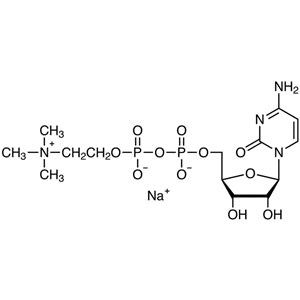
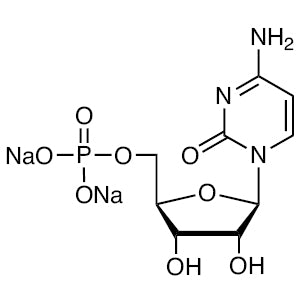
Cytidine 5'-Diphosphocholine (CDP-choline) is a chemical compound widely used in biochemical and neuroscience research. It serves as a key precursor in the synthesis of molecules involved in cellular metabolism, particularly in the formation of cell membranes and intercellular communication. In the laboratory, CDP-choline functions as a reagent for studying neuronal function, drug development, and lipid metabolism. Its molecular structure combines nucleotide and phosphate components, enabling it to participate in various biochemical pathways.
CDP-choline is valued for its chemical stability and ability to engage in specific reactions with diverse substrates. Its high purity ensures reliable results in sensitive experiments, making it a preferred choice for researchers requiring precision. The compound’s molecular complexity allows it to be a versatile tool in both basic and applied research. Its consistent performance across different experimental conditions further enhances its reliability in laboratory settings.
In Indonesian laboratories, CDP-choline is commonly used in health sciences, pharmaceutical development, and biotechnology research. It supports studies on neurodegenerative diseases, vaccine development, and the effects of drugs on the nervous system. Its availability facilitates advanced research in these fields, contributing to scientific innovation and medical advancements in Indonesia.
TCI brochures (PDF)
- Nucleosides, Nucleotides, Nucleic Acids and Related Reagents 2026-03-23 · p. 7
- Pharmaceutical Ingredients for Research and Experimental Use 2026-03-09 · p. 26
Related TCI products
- TCI C3445 33818-15-4 Cytidine 5'-Diphosphocholine Sodium Salt
- TCI C1675 63-37-6 Cytidine 5'-Monophosphate
- TCI C0524 6757-06-8 Cytidine 5'-Monophosphate Disodium Salt
- TCI C0523 34393-59-4 Cytidine 5'-Diphosphate Trisodium Salt
- TCI A0626 16178-48-6 Adenosine 5'-Diphosphate Disodium Salt
- TCI D4250 4235-95-4 1,2-Dioleoyl-sn-glycero-3-phosphocholine
- Neurodegenerative disease research benefits from CDP-choline’s role in studying membrane formation and neuronal communication, aiding in the development of therapeutic strategies.
- Pharmaceutical research utilizes CDP-choline to investigate lipid metabolism and its impact on drug efficacy and cellular function.
- Vaccine development incorporates CDP-choline to explore its involvement in immune response mechanisms and cellular signaling pathways.
- Biotransformation studies rely on CDP-choline to analyze metabolic pathways and the breakdown of complex molecules in biological systems.
- Toxicology research employs CDP-choline to assess its effects on cell membranes and neurotransmitter activity under various experimental conditions.
| Brand | TCI |
|---|---|
| CAS number | 987-78-0 |
| Molecular formula | — |
| Purity | — |
| Category | Life Science > Biochemicals and Reagents > Nucleosides, Nucleotides, Oligonucleotides |
| Pack sizes | Available in standard laboratory quantities |
| Physical form | Solid powder |
| Storage | Store in a cool, dry place away from light and moisture |
CDP-choline should be stored in a cool, dry place, away from light and moisture to maintain its stability and purity. It is recommended to use airtight containers to prevent exposure to humidity and contaminants. Due to its chemical nature, it should be handled with care, using appropriate personal protective equipment such as gloves and safety goggles. Storage conditions should avoid extreme temperatures to prevent degradation. Proper labeling of containers is essential for safe handling and to ensure correct identification in a laboratory setting. Regular monitoring of storage conditions helps maintain the integrity of the compound for reliable experimental results.
—
Product Categories
- Biochemicals and ReagentsNucleosides, Nucleotides, OligonucleotidesNucleotide Analogs
- Biochemicals and ReagentsNucleosides, Nucleotides, OligonucleotidesNucleotides
- Biochemicals and ReagentsPharmaceutical Research Reagents (for Experimental Use)Neurotransmitter Agent Ingredients (for Research and Experimental Use)
- Cell BiologyCell Signaling and NeuroscienceLipids in Cell Signaling
- Pharmaceutical Development and Drug Discovery ResearchPharmaceutical Research Reagents (for Experimental Use)Neurotransmitter Agent Ingredients (for Research and Experimental Use)
Produk Terkait
-
Cytidine5'-DiphosphocholineSodiumSalt TCI C3445
Regular price From Rp 1.431.150,00Regular priceRp 1.016.400,00Sale price From Rp 1.431.150,00 -
Cytidine5'-Monophosphate TCI C1675
Regular price From Rp 662.550,00Regular priceRp 478.800,00Sale price From Rp 662.550,00 -
Cytidine5'-MonophosphateDisodiumSalt TCI C0524
Regular price From Rp 689.850,00Regular priceRp 497.700,00Sale price From Rp 689.850,00 -
Cytidine5'-DiphosphateTrisodiumSalt TCI C0523
Regular price From Rp 530.250,00Regular priceRp 386.400,00Sale price From Rp 530.250,00 -
Adenosine5'-DiphosphateDisodiumSalt TCI A0626
Regular price From Rp 822.150,00Regular priceRp 590.100,00Sale price From Rp 822.150,00 -
1,2-Dioleoyl-sn-glycero-3-phosphocholine TCI D4250
Regular price From Rp 2.384.550,00Regular priceRp 1.683.150,00Sale price From Rp 2.384.550,00 -
1,2-Distearoyl-sn-glycero-3-phosphocholine TCI D3926
Regular price From Rp 2.757.300,00Regular priceRp 1.943.550,00Sale price From Rp 2.757.300,00 -
1,2-Dipalmitoyl-sn-glycero-3-phosphocholine TCI D3925
Regular price From Rp 2.252.250,00Regular priceRp 1.590.750,00Sale price From Rp 2.252.250,00