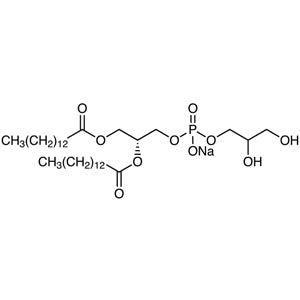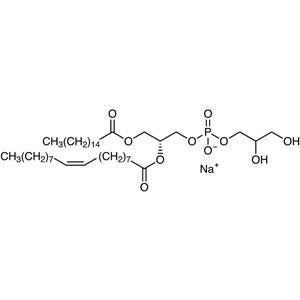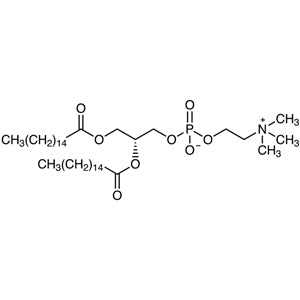
TCI D3925, 1,2-Dipalmitoyl-sn-glycero-3-phosphocholine (commonly abbreviated DPPC), is a saturated phospholipid built from two sixteen-carbon palmitic acid chains esterified to an sn-configured glycerol backbone and capped with a phosphocholine head group. It is one of the most extensively studied lipids in membrane science, in part because it is also a principal component of mammalian pulmonary surfactant. In the laboratory, DPPC serves as a building block for liposomes, vesicles, monolayers at the air–water interface, and supported bilayers used as model biological membranes in drug delivery and biophysics research.
The properties that make DPPC a preferred choice begin with its medium-length saturated acyl chains, which produce a tightly packed, well-ordered bilayer whose phase transition temperature sits slightly above body temperature. This behaviour is particularly useful because researchers can design liposomes that remain tight and non-leaky at physiological temperature yet release their payload when warmed a little further, which is the foundation of the thermosensitive liposome concept. Its phosphocholine head group is zwitterionic, so the resulting vesicles carry a low surface charge, while the saturation of the acyl chains makes this lipid considerably more resistant to oxidation than unsaturated phospholipids.
In Indonesian laboratories, DPPC is typically used within pharmaceutical development, drug discovery, and drug delivery system (DDS) research programmes at universities, research institutes, and formulation laboratories. It supports work on liposomal carriers, membrane models, and interfacial studies where a reproducible, well-characterised saturated phospholipid is required. Because it is supplied as a defined research reagent from TCI, it fits laboratories that need consistent lipid quality across repeated preparations and long-running experimental series.
TCI brochures (PDF)
- Phospholipid for siRNA-Delivering Charge-reversible Lipid Nanoparticles 2024-02-15 · p. 1
- Lipid Mixture for Easy Preparation of Liposomes Presome® 2024-04-22 · p. 1
- Phospholipids 2024-02-20 · p. 2
- Arginine-Inspired Ligand Guanidine Lipid 2025-11-28 · p. 2
- Drug Delivery System (DDS) Research Reagents 2025-01-29 · p. 1
- Quaternary Ammonium Salts 2025-11-10 · p. 7
Related TCI products
- TCI D4250 4235-95-4 1,2-Dioleoyl-sn-glycero-3-phosphocholine
- TCI D3924 18194-24-6 1,2-Dimyristoyl-sn-glycero-3-phosphocholine
- TCI D3926 816-94-4 1,2-Distearoyl-sn-glycero-3-phosphocholine
- TCI D3946 200880-40-6 1,2-Dimyristoyl-sn-glycero-3-phospho-rac-(1-glycerol) Sodium Salt
- TCI P2694 17364-16-8 1-Palmitoyl-sn-glycero-3-phosphocholine
- TCI D5319 51779-95-4 1,2-Dierucoyl-sn-glycero-3-phosphocholine
- Liposome preparation for drug delivery research: the ordered, tightly packed bilayer formed by DPPC gives vesicles good retention of encapsulated payloads at physiological temperature.
- Thermosensitive liposome development: because the phase transition temperature lies slightly above body temperature, formulations can be designed to release contents on mild heating.
- Model biological membrane studies: supported bilayers and vesicles built from DPPC provide a reproducible, well-characterised membrane mimic for biophysical investigation of lipid behaviour.
- Langmuir monolayer experiments at the air–water interface: the saturated palmitoyl chains form stable, well-ordered monolayers suitable for surface pressure and packing studies.
- Pulmonary surfactant research: DPPC is a principal component of mammalian lung surfactant, making it the natural reference lipid for surfactant model systems and interfacial work.
| Brand | TCI |
|---|---|
| CAS number | 63-89-8 |
| Molecular formula | — |
| Purity | — |
| Category | Chemistry > Pharmaceutical Development and Drug Discovery Research Reagents > Drug Delivery Systems (DDS) |
| Pack sizes | available in standard TCI research-scale packaging; please confirm the required size when ordering |
| Physical form | — |
| Storage | keep refrigerated or frozen in a tightly closed container, protected from moisture, in line with the manufacturer's label |
- Chemical name: 1,2-Dipalmitoyl-sn-glycero-3-phosphocholine (DPPC)
Store the container closed tightly at low temperature as indicated on the manufacturer's label, keeping the material away from moisture, direct sunlight, and sources of heat. Phospholipids readily take up water, so allow sealed containers to reach room temperature before opening to prevent condensation on the powder. Use clean, dry glass or chemically compatible containers for weighing and lipid film preparation, and avoid plastics that may be attacked by organic solvents used during dissolution. Handle in a well-ventilated area or fume hood, wear a laboratory coat, gloves, and safety glasses, and follow standard laboratory hygiene practices. Refer to the manufacturer's safety data sheet before use and dispose of residues according to institutional chemical waste procedures.
—
Product Categories
Produk Terkait
-
1,2-Dioleoyl-sn-glycero-3-phosphocholine TCI D4250
Regular price From Rp 2.384.550,00Regular priceRp 1.683.150,00Sale price From Rp 2.384.550,00 -
1,2-Dimyristoyl-sn-glycero-3-phosphocholine TCI D3924
Regular price From Rp 2.702.700,00Regular priceRp 1.905.750,00Sale price From Rp 2.702.700,00 -
1,2-Distearoyl-sn-glycero-3-phosphocholine TCI D3926
Regular price From Rp 2.757.300,00Regular priceRp 1.943.550,00Sale price From Rp 2.757.300,00 -
1,2-Dimyristoyl-sn-glycero-3-phospho-rac-(1-glycerol)SodiumSalt TCI D3946
Regular price Rp 9.009.000,00Regular priceRp 6.315.750,00Sale price Rp 9.009.000,00 -
1-Palmitoyl-sn-glycero-3-phosphocholine TCI P2694
Regular price Rp 8.427.300,00Regular priceRp 5.908.350,00Sale price Rp 8.427.300,00 -
1,2-Dierucoyl-sn-glycero-3-phosphocholine TCI D5319
Regular price Rp 4.796.400,00Regular priceRp 3.369.450,00Sale price Rp 4.796.400,00 -
1-Palmitoyl-2-oleyl-sn-glycero-3-phospho-rac-(1-glycerol)SodiumSalt TCI P2522
Regular price Rp 6.784.050,00Regular priceRp 4.743.900,00Sale price Rp 6.784.050,00 -
1,2-Dioleoyl-sn-glycero-3-phospho-rac-(1-glycerol)SodiumSalt TCI D5318
Regular price Rp 5.300.400,00Regular priceRp 3.706.500,00Sale price Rp 5.300.400,00