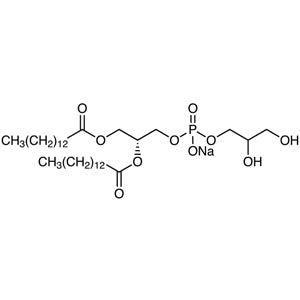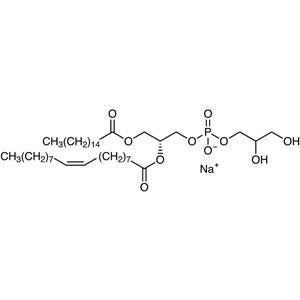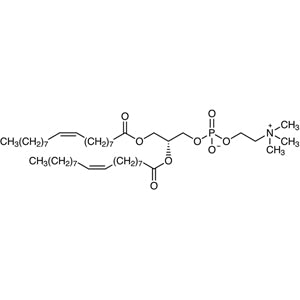
TCI D4250 1,2-Dioleoyl-sn-glycero-3-phosphocholine (CAS 4235-95-4), more widely known as DOPC, is a synthetic phospholipid built on a glycerol backbone carrying two unsaturated oleic acid chains and a phosphocholine head group. It has become one of the most important lipids in drug delivery research because of its ability to spontaneously form lipid bilayers and vesicles in water. In the laboratory, DOPC is used to assemble liposomes, model membranes, and a wide range of nanocarriers designed to transport active compounds toward specific biological targets.
The advantage of DOPC comes from the unsaturation of its oleate chains, which adopt a cis configuration. These double bonds introduce a kink in the acyl chains, so the resulting bilayer sits in the liquid-disordered phase at common laboratory working temperatures. The membranes formed this way are flexible, readily fusogenic, and very well suited to simulating the dynamic character of biological membranes. The zwitterionic phosphocholine head group gives the vesicle surface a charge-neutral character, so unintended interactions with proteins and nucleic acids can be minimised. The point requiring attention is that the unsaturated chains demand careful handling.
In Indonesian laboratories, DOPC of this grade is typically found in pharmaceutical development groups, formulation laboratories, and university research units working on drug delivery systems. It serves as the base lipid for preparing liposomes and model membranes in studies of encapsulation, membrane behaviour, and targeted carrier design. Because the material supports both routine formulation work and more exploratory membrane biophysics, it fits research programmes at academic institutions as well as pharmaceutical and biotechnology development settings.
TCI brochures (PDF)
- Phospholipid for siRNA-Delivering Charge-reversible Lipid Nanoparticles 2024-02-15 · p. 1
- Lipid Mixture for Easy Preparation of Liposomes Presome® 2024-04-22 · p. 1
- Phospholipids 2024-02-20 · p. 2
- Arginine-Inspired Ligand Guanidine Lipid 2025-11-28 · p. 2
- Drug Delivery System (DDS) Research Reagents 2025-01-29 · p. 1
- Quaternary Ammonium Salts 2025-11-10 · p. 7
Related TCI products
- TCI D3925 63-89-8 1,2-Dipalmitoyl-sn-glycero-3-phosphocholine
- TCI D3924 18194-24-6 1,2-Dimyristoyl-sn-glycero-3-phosphocholine
- TCI D3926 816-94-4 1,2-Distearoyl-sn-glycero-3-phosphocholine
- TCI D3946 200880-40-6 1,2-Dimyristoyl-sn-glycero-3-phospho-rac-(1-glycerol) Sodium Salt
- TCI P2694 17364-16-8 1-Palmitoyl-sn-glycero-3-phosphocholine
- TCI D5319 51779-95-4 1,2-Dierucoyl-sn-glycero-3-phosphocholine
- Liposome preparation: DOPC forms bilayer vesicles spontaneously in aqueous media, making it a dependable base lipid for building liposomal carriers that encapsulate active compounds.
- Model membrane construction: the liquid-disordered bilayer formed by DOPC reproduces the flexible, dynamic character of biological membranes, supporting realistic membrane behaviour studies in vitro.
- Nanocarrier development: DOPC serves as a structural lipid in nanoscale carriers designed to transport active compounds toward defined biological targets within drug delivery research.
- Drug delivery systems (DDS) research: its established role as a core phospholipid makes DOPC a standard component for formulation studies exploring encapsulation and release behaviour.
- Membrane interaction studies: the charge-neutral zwitterionic phosphocholine surface minimises unintended binding of proteins and nucleic acids, giving cleaner interaction experiments with fewer artefacts.
| Brand | TCI |
|---|---|
| CAS number | 4235-95-4 |
| Molecular formula | — |
| Purity | — |
| Category | Chemistry > Pharmaceutical Development and Drug Discovery Research Reagents > Drug Delivery Systems (DDS) |
| Pack sizes | available in the packaging options offered by the manufacturer for this catalogue item |
| Physical form | — |
| Storage | — |
- Chemical name: 1,2-Dioleoyl-sn-glycero-3-phosphocholine (DOPC)
- Catalogue reference: D4250
Because DOPC contains unsaturated oleate chains, it should be handled with care and kept under the storage conditions specified by the manufacturer on the product label and safety data sheet. Store the material in its original tightly closed container, protected from air, moisture, light, and heat, and keep it in a cool place designated for lipid reagents. Allow sealed containers to equilibrate to room temperature before opening to limit condensation. Handle the material in a clean laboratory area with adequate ventilation, using gloves, safety glasses, and a laboratory coat, and use clean dry glassware or compatible solvent-resistant labware when preparing solutions. Minimise repeated opening of the stock container and follow institutional procedures for chemical waste disposal.
—
Product Categories
Produk Terkait
-
1,2-Dipalmitoyl-sn-glycero-3-phosphocholine TCI D3925
Regular price From Rp 2.252.250,00Regular priceRp 1.590.750,00Sale price From Rp 2.252.250,00 -
1,2-Dimyristoyl-sn-glycero-3-phosphocholine TCI D3924
Regular price From Rp 2.702.700,00Regular priceRp 1.905.750,00Sale price From Rp 2.702.700,00 -
1,2-Distearoyl-sn-glycero-3-phosphocholine TCI D3926
Regular price From Rp 2.757.300,00Regular priceRp 1.943.550,00Sale price From Rp 2.757.300,00 -
1,2-Dimyristoyl-sn-glycero-3-phospho-rac-(1-glycerol)SodiumSalt TCI D3946
Regular price Rp 9.009.000,00Regular priceRp 6.315.750,00Sale price Rp 9.009.000,00 -
1-Palmitoyl-sn-glycero-3-phosphocholine TCI P2694
Regular price Rp 8.427.300,00Regular priceRp 5.908.350,00Sale price Rp 8.427.300,00 -
1,2-Dierucoyl-sn-glycero-3-phosphocholine TCI D5319
Regular price Rp 4.796.400,00Regular priceRp 3.369.450,00Sale price Rp 4.796.400,00 -
1,2-Dioleoyl-sn-glycero-3-phospho-rac-(1-glycerol)SodiumSalt TCI D5318
Regular price Rp 5.300.400,00Regular priceRp 3.706.500,00Sale price Rp 5.300.400,00 -
1-Palmitoyl-2-oleyl-sn-glycero-3-phospho-rac-(1-glycerol)SodiumSalt TCI P2522
Regular price Rp 6.784.050,00Regular priceRp 4.743.900,00Sale price Rp 6.784.050,00