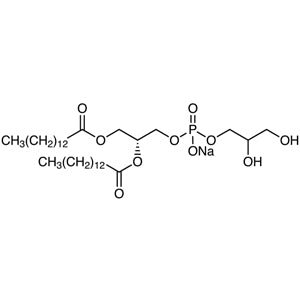
1-Palmitoyl-2-oleyl-sn-glycero-3-phospho-rac-(1-glycerol) Sodium Salt is a specialized chemical compound used in pharmaceutical research and drug development. As a key component of Drug Delivery Systems (DDS), it plays a crucial role in enhancing the efficacy and safety of drug formulations. This compound is widely utilized in laboratories for its ability to facilitate targeted drug delivery, ensuring that therapeutic agents reach their intended sites of action with greater precision. Its structural similarity to natural membrane components makes it an ideal candidate for mimicking biological systems, enabling more effective interactions with cellular structures.
This compound is preferred due to its stable chemical properties and solubility in organic solvents, which are essential for formulation development. Its complex molecular structure allows for efficient binding of active pharmaceutical ingredients, improving drug absorption and distribution. Additionally, its compatibility with various biological systems makes it suitable for a wide range of research applications. These characteristics make it a valuable tool for researchers aiming to develop more effective and targeted drug delivery solutions.
In Indonesian laboratories, this compound is commonly used in pharmaceutical and chemical research settings. It is frequently employed in studies related to drug formulation, delivery mechanisms, and bioavailability enhancement. Researchers rely on this material to test new drug delivery concepts and to develop safer, more effective therapeutic options. Its presence in Indonesian labs underscores its importance in advancing pharmaceutical innovation and improving healthcare outcomes.
TCI brochures (PDF)
- Phospholipid for siRNA-Delivering Charge-reversible Lipid Nanoparticles 2024-02-15 · p. 1
- Lipid Mixture for Easy Preparation of Liposomes Presome® 2024-04-22 · p. 1
- Phospholipids 2024-02-20 · p. 2
- Arginine-Inspired Ligand Guanidine Lipid 2025-11-28 · p. 2
- Drug Delivery System (DDS) Research Reagents 2025-01-29 · p. 1
- Lipids 2025-12-17 · p. 17
Related TCI products
- TCI P2694 17364-16-8 1-Palmitoyl-sn-glycero-3-phosphocholine
- TCI D5318 67254-28-8 1,2-Dioleoyl-sn-glycero-3-phospho-rac-(1-glycerol) Sodium Salt
- TCI D3946 200880-40-6 1,2-Dimyristoyl-sn-glycero-3-phospho-rac-(1-glycerol) Sodium Salt
- TCI D5319 51779-95-4 1,2-Dierucoyl-sn-glycero-3-phosphocholine
- TCI D4250 4235-95-4 1,2-Dioleoyl-sn-glycero-3-phosphocholine
- TCI D3926 816-94-4 1,2-Distearoyl-sn-glycero-3-phosphocholine
- Pharmaceutical Development: This compound is used to design and optimize drug delivery systems that improve the bioavailability and targeting of therapeutic agents.
- Drug Formulation Research: It supports the development of lipid-based drug carriers, enhancing the stability and solubility of poorly water-soluble compounds.
- Biocompatibility Studies: Its structural similarity to natural phospholipids makes it ideal for assessing the biocompatibility of drug delivery systems in vitro.
- Targeted Drug Delivery: It enables the creation of liposomal formulations that can deliver drugs to specific tissues or cells, improving treatment efficacy.
- Drug Stability Testing: Its chemical stability under controlled conditions makes it suitable for evaluating the long-term stability of pharmaceutical formulations.
| Brand | TCI |
|---|---|
| CAS number | 268550-95-4 |
| Molecular formula | — |
| Purity | — |
| Category | Chemistry > Pharmaceutical Development and Drug Discovery Research Reagents > Drug Delivery Systems (DDS) |
| Pack sizes | Available in various quantities as per standard laboratory supply |
| Physical form | Solid powder |
| Storage | Store in a cool, dry place away from moisture and direct sunlight |
This compound should be stored in a cool, dry environment to maintain its chemical stability and prevent degradation. It is recommended to keep it in a tightly sealed container to avoid exposure to moisture and air. Due to its organic nature, it is best stored in a desiccator or airtight containers to ensure long-term integrity. Laboratory personnel should handle the compound with appropriate personal protective equipment, such as gloves and safety goggles, to ensure safety during handling. It is important to avoid contact with incompatible substances and to follow standard laboratory safety protocols when working with this material. Proper storage and handling are essential to preserve its effectiveness and ensure safe usage in research applications.
—
Product Categories
Produk Terkait
-
1-Palmitoyl-sn-glycero-3-phosphocholine TCI P2694
Regular price Rp 8.427.300,00Regular priceRp 5.908.350,00Sale price Rp 8.427.300,00 -
1,2-Dioleoyl-sn-glycero-3-phospho-rac-(1-glycerol)SodiumSalt TCI D5318
Regular price Rp 5.300.400,00Regular priceRp 3.706.500,00Sale price Rp 5.300.400,00 -
1,2-Dimyristoyl-sn-glycero-3-phospho-rac-(1-glycerol)SodiumSalt TCI D3946
Regular price Rp 9.009.000,00Regular priceRp 6.315.750,00Sale price Rp 9.009.000,00 -
1,2-Dierucoyl-sn-glycero-3-phosphocholine TCI D5319
Regular price Rp 4.796.400,00Regular priceRp 3.369.450,00Sale price Rp 4.796.400,00 -
1,2-Dioleoyl-sn-glycero-3-phosphocholine TCI D4250
Regular price From Rp 2.384.550,00Regular priceRp 1.683.150,00Sale price From Rp 2.384.550,00 -
1,2-Distearoyl-sn-glycero-3-phosphocholine TCI D3926
Regular price From Rp 2.757.300,00Regular priceRp 1.943.550,00Sale price From Rp 2.757.300,00 -
1,2-Dipalmitoyl-sn-glycero-3-phosphocholine TCI D3925
Regular price From Rp 2.252.250,00Regular priceRp 1.590.750,00Sale price From Rp 2.252.250,00 -
1,2-Dimyristoyl-sn-glycero-3-phosphocholine TCI D3924
Regular price From Rp 2.702.700,00Regular priceRp 1.905.750,00Sale price From Rp 2.702.700,00