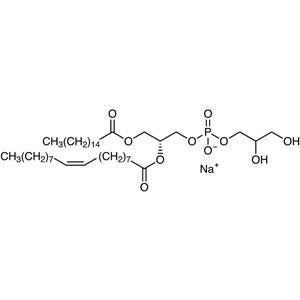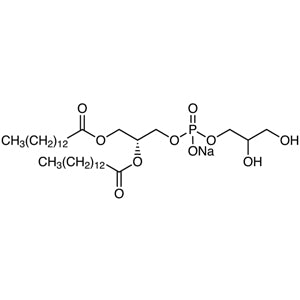
1,2-Dimyristoyl-sn-glycero-3-phospho-rac-(1-glycerol) Sodium Salt, commonly abbreviated as DMPG sodium salt, is a negatively charged synthetic phospholipid built from two fourteen-carbon myristoyl acyl chains and a polar glycerophosphoglycerol head group. In the laboratory it serves as a key component in the assembly of liposomes, lipid vesicles, and a wide range of drug delivery systems. Pharmaceutical researchers use it to control the surface charge of carrier particles, improve colloidal stability, and study the interactions between lipid carriers and proteins, nucleic acids, and cell membranes during formulation development research.
The characteristics that make this material a preferred choice begin with the anionic charge contributed by the phosphoglycerol group, which provides electrostatic repulsion between vesicles so that liposome suspensions do not aggregate easily. The saturated and uniform myristoyl chains produce bilayers with sharp, predictable phase transition behaviour, making experiments straightforward to repeat and to compare across batches. Because the chains are saturated, the material is also more resistant to oxidation than phospholipids carrying unsaturated chains. When combined with neutral phospholipids such as the phosphatidylcholine class, it allows researchers to tune bilayer composition in a controlled manner.
In Indonesian laboratories, DMPG sodium salt is typically used in pharmaceutical formulation groups, university research centres, and drug delivery development units that prepare liposomal and vesicle-based carriers. It is generally handled in small, carefully weighed quantities as part of defined lipid mixtures, then hydrated or dissolved according to the chosen preparation protocol. Its reproducible behaviour makes it well suited to teaching laboratories and research programmes where consistent results across repeated preparations are required.
TCI brochures (PDF)
- Phospholipid for siRNA-Delivering Charge-reversible Lipid Nanoparticles 2024-02-15 · p. 1
- Lipid Mixture for Easy Preparation of Liposomes Presome® 2024-04-22 · p. 1
- Phospholipids 2024-02-20 · p. 2
- Arginine-Inspired Ligand Guanidine Lipid 2025-11-28 · p. 2
- Drug Delivery System (DDS) Research Reagents 2025-01-29 · p. 1
- Lipids 2025-12-17 · p. 17
Related TCI products
- TCI D3924 18194-24-6 1,2-Dimyristoyl-sn-glycero-3-phosphocholine
- TCI D4250 4235-95-4 1,2-Dioleoyl-sn-glycero-3-phosphocholine
- TCI D3926 816-94-4 1,2-Distearoyl-sn-glycero-3-phosphocholine
- TCI D3925 63-89-8 1,2-Dipalmitoyl-sn-glycero-3-phosphocholine
- TCI P2522 268550-95-4 1-Palmitoyl-2-oleyl-sn-glycero-3-phospho-rac-(1-glycerol) Sodium Salt
- TCI D5318 67254-28-8 1,2-Dioleoyl-sn-glycero-3-phospho-rac-(1-glycerol) Sodium Salt
- Liposome preparation — the anionic head group supplies electrostatic repulsion that keeps vesicle suspensions dispersed and reduces the tendency of liposomes to aggregate during storage and handling.
- Drug delivery system development — researchers incorporate this phospholipid to adjust the surface charge of carrier particles, which influences colloidal stability and the overall behaviour of the formulation.
- Lipid bilayer and membrane model studies — the uniform saturated myristoyl chains give sharp, predictable phase transition behaviour, making it suitable for controlled investigations of bilayer properties.
- Lipid carrier interaction research — it is used to examine how lipid carriers interact with proteins, nucleic acids, and cell membranes under defined and reproducible experimental conditions.
- Formulation development and optimisation — combining it with neutral phospholipids such as the phosphatidylcholine class lets researchers tune bilayer composition systematically across successive formulation trials.
| Brand | TCI |
|---|---|
| CAS number | 200880-40-6 |
| Molecular formula | — |
| Purity | — |
| Category | Chemistry > Pharmaceutical Development and Drug Discovery Research Reagents > Drug Delivery Systems (DDS) |
| Pack sizes | available in the manufacturer's standard research packaging; please refer to the listed pack options |
| Physical form | — |
| Storage | — |
- Product code: D3946
- Chemical name: 1,2-Dimyristoyl-sn-glycero-3-phospho-rac-(1-glycerol) Sodium Salt
Store this phospholipid in its original tightly closed container, kept cold and protected from light and moisture in line with the manufacturer's stated storage conditions on the product label. Suitable containers are the supplied glass vial or an equivalent chemically resistant, well-sealed vessel; avoid leaving the material exposed to open air. Although the saturated myristoyl chains give better oxidation resistance than unsaturated phospholipids, the material should still be handled promptly and returned to storage after weighing. Allow containers to reach room temperature before opening to limit moisture condensation. Work in a well-ventilated area, wear a laboratory coat, gloves, and eye protection, and follow the safety data sheet together with your institution's standard laboratory practices.
—
Product Categories
Produk Terkait
-
1,2-Dimyristoyl-sn-glycero-3-phosphocholine TCI D3924
Regular price From Rp 2.702.700,00Regular priceRp 1.905.750,00Sale price From Rp 2.702.700,00 -
1,2-Dioleoyl-sn-glycero-3-phosphocholine TCI D4250
Regular price From Rp 2.384.550,00Regular priceRp 1.683.150,00Sale price From Rp 2.384.550,00 -
1,2-Distearoyl-sn-glycero-3-phosphocholine TCI D3926
Regular price From Rp 2.757.300,00Regular priceRp 1.943.550,00Sale price From Rp 2.757.300,00 -
1,2-Dipalmitoyl-sn-glycero-3-phosphocholine TCI D3925
Regular price From Rp 2.252.250,00Regular priceRp 1.590.750,00Sale price From Rp 2.252.250,00 -
1-Palmitoyl-2-oleyl-sn-glycero-3-phospho-rac-(1-glycerol)SodiumSalt TCI P2522
Regular price Rp 6.784.050,00Regular priceRp 4.743.900,00Sale price Rp 6.784.050,00 -
1,2-Dioleoyl-sn-glycero-3-phospho-rac-(1-glycerol)SodiumSalt TCI D5318
Regular price Rp 5.300.400,00Regular priceRp 3.706.500,00Sale price Rp 5.300.400,00 -
1-Palmitoyl-sn-glycero-3-phosphocholine TCI P2694
Regular price Rp 8.427.300,00Regular priceRp 5.908.350,00Sale price Rp 8.427.300,00 -
1,2-Dierucoyl-sn-glycero-3-phosphocholine TCI D5319
Regular price Rp 4.796.400,00Regular priceRp 3.369.450,00Sale price Rp 4.796.400,00