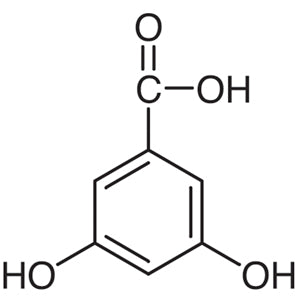
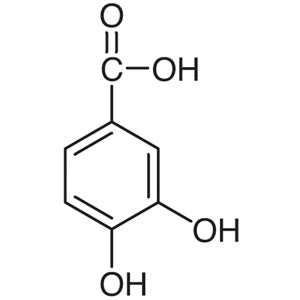
2,4-Dihydroxybenzoic Acid is a chemical compound widely used in various laboratory experiments and analytical processes. It is a key component in organic chemistry, particularly in the synthesis of complex molecules. Its aromatic structure, with hydroxyl groups at positions 2 and 4 on the benzene ring, makes it a versatile building block for chemical reactions. This compound is commonly found in research settings where precise chemical interactions are required. Its role extends beyond synthesis, as it is also used as a standard in chromatographic and spectroscopic analyses.
The compound is preferred due to its high purity and stability under certain conditions. It does not degrade easily, ensuring consistent results in experiments. Its stable melting point simplifies handling and storage, making it a reliable choice for laboratory use. Additionally, its solubility in organic solvents such as ethyl acetate and ethanol enhances its utility in a wide range of chemical applications. These properties make it a valuable tool in both academic and industrial research.
In Indonesian laboratories, 2,4-Dihydroxybenzoic Acid is frequently used in organic chemistry research, qualitative and quantitative analysis, and the development of pharmaceutical and industrial chemical products. Its diverse applications have made it a staple in many research facilities across the country. The compound’s reliability and versatility support a broad spectrum of scientific investigations, contributing to the advancement of chemical sciences in Indonesia.
Related TCI products
- TCI B1425 16534-12-6 4-Bromo-3,5-dihydroxybenzoic Acid
- TCI R0011 303-07-1 2,6-Dihydroxybenzoic Acid
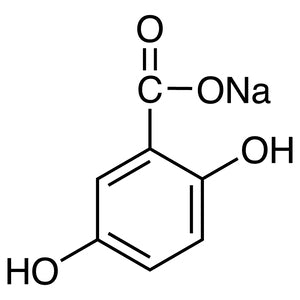
- TCI D4893 4955-90-2 2,5-Dihydroxybenzoic Acid Sodium Salt
- TCI D2933 490-79-9 2,5-Dihydroxybenzoic Acid [Matrix for MALDI-TOF/MS]
- TCI D0570 99-10-5 3,5-Dihydroxybenzoic Acid
- TCI D0569 490-79-9 2,5-Dihydroxybenzoic Acid
- Organic synthesis applications benefit from its aromatic structure and hydroxyl groups, enabling the creation of complex molecules with high precision.
- Chromatographic analysis relies on its stability and purity, making it an ideal standard for accurate separation and identification of compounds.
- Spectroscopic studies utilize its well-defined spectral properties for identifying molecular structures and functional groups.
- Pharmaceutical research incorporates it in the development of new drugs, as it serves as a building block for various bioactive compounds.
- Industrial chemical production uses it as a precursor in the synthesis of dyes, pesticides, and other specialty chemicals due to its reactivity and solubility.
| Brand | TCI |
|---|---|
| CAS number | 89-86-1 |
| Molecular formula | — |
| Purity | — |
| Category | Chemistry > Building Blocks > Non-Heterocyclic Building Blocks |
| Pack sizes | Available in various quantities as per supplier specifications |
| Physical form | Solid |
| Storage | Store in a cool, dry place away from direct sunlight |
This compound should be stored in a cool, dry environment to maintain its stability and prevent degradation. It is recommended to keep it in a tightly sealed container to avoid moisture absorption and contamination. Due to its solid form, it is best stored in glass or plastic containers that are resistant to chemical reactions. Laboratory personnel should handle it with care, using appropriate personal protective equipment such as gloves and safety goggles. It is not classified as hazardous under standard laboratory conditions, but proper handling procedures should still be followed to ensure safe usage and storage.
—
Produk Terkait
-
4-Bromo-3,5-dihydroxybenzoicAcid TCI B1425
Regular price From Rp 2.466.450,00Regular price -
2,6-DihydroxybenzoicAcid TCI R0011
Regular price Rp 1.485.750,00Regular price -
2,5-DihydroxybenzoicAcidSodiumSalt TCI D4893
Regular price From Rp 1.246.350,00Regular price -
2,5-DihydroxybenzoicAcid[MatrixforMALDI-TOF/MS] TCI D2933
Regular price From Rp 955.500,00Regular price -
3,5-DihydroxybenzoicAcid TCI D0570
Regular price From Rp 928.200,00Regular price -
2,5-DihydroxybenzoicAcid TCI D0569
Regular price From Rp 1.246.350,00Regular price -
3,4-DihydroxybenzoicAcid TCI C0055
Regular price From Rp 2.386.650,00Regular price -
2,3-DihydroxybenzoicAcid TCI C0054
Regular price From Rp 1.298.850,00Regular price


![2,5-Dihydroxybenzoic Acid [Matrix for MALDI-TOF/MS] (CAS 490-79-9) - TCI D2933 - AMI Scientific](http://amiscientific.com/cdn/shop/files/TCI2510D2933.jpg?v=1767105578&width=533)