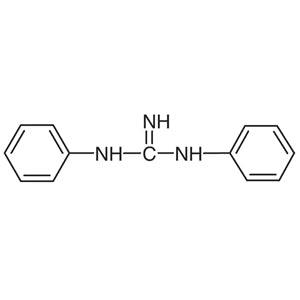
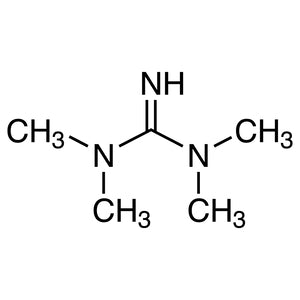
TCI D0723 1,3-Diphenylguanidine, often abbreviated as DPG, is a guanidine derivative carrying two phenyl groups on its nitrogen atoms. It is classed as a non-heterocyclic building block and is best known in the rubber industry as a vulcanization accelerator, mainly as a secondary accelerator used alongside thiazole or sulfenamide types. In the laboratory, DPG also serves as an organic base, as a primary standard in acid titrations, and as a starting material for synthesizing other guanidine derivatives.
The guanidine group is strongly basic because the positive charge of its protonated form is delocalized over three nitrogen atoms. In DPG the two phenyl groups lower the basicity compared with simple guanidine, but the compound remains basic enough to neutralize acids with a clear endpoint. It is a stable solid that can be weighed accurately, which makes it a good material for standardizing acid solutions. In vulcanization, the same basicity helps activate sulfur accelerator systems. Because one compound covers analytical, synthetic, and rubber-processing work, many laboratories keep it on hand.
Indonesia is one of the world's largest producers of natural rubber, so DPG is highly relevant to rubber research laboratories, quality control laboratories at tire and rubber goods factories, and chemical engineering and polymer study programs. Researchers use it to study accelerator combinations and cure behavior. Analytical laboratories use it to standardize acid titrants, and university teaching laboratories use it to demonstrate organic base chemistry and guanidine synthesis. The 25 gram pack suits research and teaching work that needs a reliable, well-characterized reagent in modest quantities.
- Rubber vulcanization studies: DPG is a well-established secondary accelerator used with thiazole or sulfenamide accelerators, so it fits research on cure systems and compound formulation.
- Acid titrant standardization: as a stable solid that weighs accurately and neutralizes acids clearly, DPG works as a primary standard for setting the concentration of acid solutions.
- Organic base in synthesis: the guanidine group stays strongly basic despite the phenyl substitution, so DPG can serve as an organic base in laboratory reactions.
- Synthesis of guanidine derivatives: as a non-heterocyclic building block with a guanidine core, DPG is a practical starting material for preparing related substituted guanidine compounds.
- Teaching in chemical engineering and polymer programs: DPG shows charge delocalization, basicity, and accelerator chemistry in one compound, which makes it useful for student practicals.
| Brand | TCI (product code D0723) |
|---|---|
| CAS number | 102-06-7 |
| Molecular formula | — |
| Purity | — |
| Category | Chemistry > Building Blocks > Non-Heterocyclic Building Blocks |
| Pack sizes | 25 g |
| Physical form | Solid |
| Storage | Keep tightly closed in a cool, dry place; follow the TCI label and Safety Data Sheet |
Store 1,3-Diphenylguanidine in its original, tightly closed container in a cool, dry, well-ventilated area, away from direct sunlight, moisture, and strong acids or oxidizing agents. Because it may be used as a weighing standard, keep the container sealed between uses so it stays dry and accurate. Handle the powder in a fume hood or well-ventilated area to avoid breathing dust. Wear gloves, safety glasses, and a lab coat, and avoid contact with skin and eyes. Clean up spills promptly without raising dust, wash hands after handling, and check the TCI Safety Data Sheet for full hazard, first-aid, and disposal guidance.
—
Produk Terkait
-
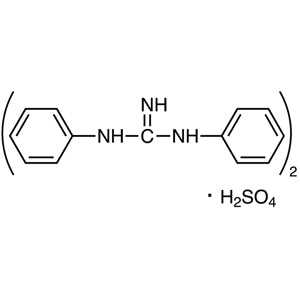
1,3-DiphenylguanidineSulfate TCI D1348
Regular price From Rp 1.881.600,00Regular priceRp 1.331.400,00Sale price From Rp 1.881.600,00 -
1,3-Diphenylguanidine TCI D0892
Regular price From Rp 530.250,00Regular priceRp 386.400,00Sale price From Rp 530.250,00 -
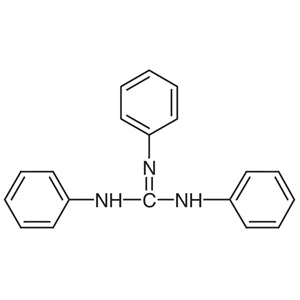
1,2,3-Triphenylguanidine TCI T1316
Regular price Rp 5.803.350,00Regular priceRp 4.074.000,00Sale price Rp 5.803.350,00 -
1,3-Di-o-tolylguanidine TCI D0953
Regular price From Rp 557.550,00Regular priceRp 405.300,00Sale price From Rp 557.550,00 -
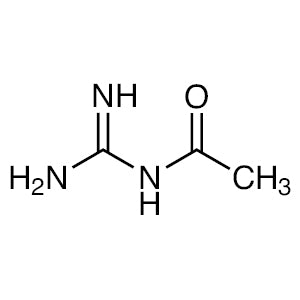
1-Acetylguanidine TCI A3124
Regular price From Rp 1.351.350,00Regular priceRp 960.750,00Sale price From Rp 1.351.350,00 -
1-MethylguanidineSulfate TCI M1691
Regular price Rp 2.306.850,00Regular priceRp 1.628.550,00Sale price Rp 2.306.850,00 -
1,1,3,3-Tetramethylguanidine TCI T0148
Regular price From Rp 742.350,00Regular priceRp 534.450,00Sale price From Rp 742.350,00 -
1,1-DiethylguanidineSulfate TCI D2035
Regular price From Rp 2.809.800,00Regular priceRp 1.980.300,00Sale price From Rp 2.809.800,00