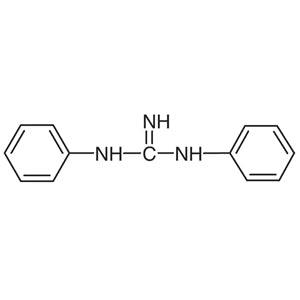
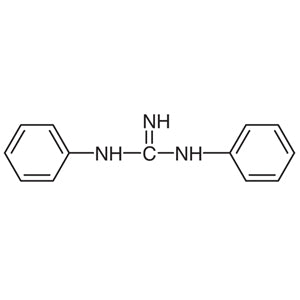
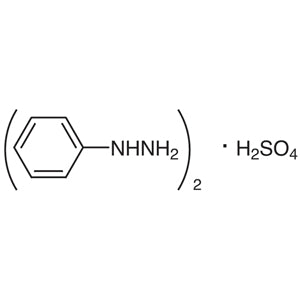
1,3-Diphenylguanidine Sulfate is the sulfate salt of 1,3-diphenylguanidine (DPG), a guanidine compound that carries two phenyl rings on its nitrogen atoms. DPG is well known in the rubber industry as a vulcanization accelerator. In analytical chemistry, the free base has been used as a standard for acid titration. TCI supplies this sulfate salt as a practical solid alternative for laboratories that need a source of the diphenylguanidinium cation for synthesis, analysis, or formulation research.
The guanidine group is one of the strongest neutral organic bases. When it is protonated, the positive charge is delocalized across three nitrogen atoms, so guanidinium salts tend to be stable and easy to handle. Because DPG has two phenyl rings, it is more lipophilic than simple guanidine and behaves differently in polymer matrices and organic solvents. When the free base is needed, the sulfate salt can be neutralized with a base to release DPG. This lets laboratories store and weigh a convenient salt form and still generate the active base whenever an experiment calls for it.
In Indonesia, this material is relevant to research and quality control laboratories in the rubber and tire industry, which is an important part of the national manufacturing sector. University polymer technology laboratories can use it to study vulcanization chemistry and how accelerators behave in rubber compounds. Synthetic chemistry groups that work with guanidine-based building blocks may also find it a useful starting material. Analytical laboratories that develop methods to identify and quantify rubber additives can use it as well.
- Rubber vulcanization research: DPG is a well-known vulcanization accelerator, so this salt gives a convenient source of it for studying cure behavior in rubber compounds.
- Analytical reference work: the free base has been used as a standard for acid titration, so the salt suits laboratories building or checking related analytical procedures.
- Organic synthesis: as a non-heterocyclic building block, it provides the diphenylguanidinium cation for making guanidine derivatives and related nitrogen-containing compounds.
- Polymer formulation studies: its two phenyl rings make it more lipophilic than simple guanidine, which is useful for studying additive behavior in polymer matrices and organic media.
- Free-base generation: the sulfate salt can be neutralized with a base to release DPG, so laboratories can keep a stable salt and prepare the base only when needed.
| Brand | TCI (product code D1348) |
|---|---|
| CAS number | 32514-47-9 |
| Molecular formula | — |
| Purity | — |
| Category | Chemistry > Building Blocks > Non-Heterocyclic Building Blocks |
| Pack sizes | available in the standard pack sizes offered by TCI |
| Physical form | solid salt |
| Storage | keep tightly closed in a cool, dry place, and follow the TCI label and Safety Data Sheet |
Store 1,3-Diphenylguanidine Sulfate in its original, tightly sealed container in a cool, dry, well-ventilated area. Keep it away from moisture, direct sunlight, strong bases, and strong oxidizing agents. Glass or chemically compatible plastic containers with secure closures work well for any portions you transfer. When handling it, wear nitrile gloves, safety glasses, and a lab coat. Weigh and transfer the powder in a fume hood or a ventilated balance enclosure so you don't breathe in dust. Avoid contact with skin and eyes, and wash your hands after use. Label every secondary container clearly. Before first use, read the Safety Data Sheet supplied with the product for specific hazards, first-aid measures, and disposal requirements, and dispose of waste according to local regulations.
—
Produk Terkait
-
1,3-Diphenylguanidine TCI D0892
Regular price From Rp 530.250,00Regular priceRp 386.400,00Sale price From Rp 530.250,00 -
1,3-Diphenylguanidine TCI D0723
Regular price From Rp 530.250,00Regular priceRp 386.400,00Sale price From Rp 530.250,00 -
1,2,3-Triphenylguanidine TCI T1316
Regular price Rp 5.803.350,00Regular priceRp 4.074.000,00Sale price Rp 5.803.350,00 -
1-AdamantanamineSulfate TCI A1319
Regular price Rp 1.220.100,00Regular priceRp 868.350,00Sale price Rp 1.220.100,00 -
PhenylhydrazineSulfate TCI P0186
Regular price Rp 1.298.850,00Regular priceRp 924.000,00Sale price Rp 1.298.850,00 -
1,4-PhenylenediamineSulfate TCI P0175
Regular price Rp 530.250,00Regular priceRp 370.650,00Sale price Rp 530.250,00 -
1,3-PhenylenediamineSulfate TCI P0174
Regular price Rp 505.050,00Regular priceRp 352.800,00Sale price Rp 505.050,00