

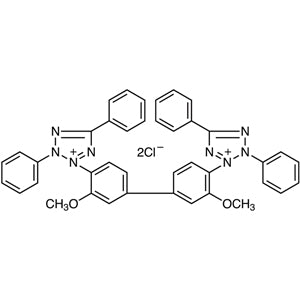
Blue Tetrazolium, with CAS number 1871-22-3, is a chemical compound widely used in biochemical and detection applications within laboratory settings. It plays a crucial role in luminescent detection systems, where it serves as a key component in reactions that produce light signals. This compound is commonly found in laboratory reagents, particularly in assays involving redox reactions. Its ability to participate in light-emitting reactions makes it an essential tool for researchers seeking accurate and reliable results in various analytical processes.
Blue Tetrazolium is valued for its chemical stability under controlled conditions, making it a preferred choice for precise experimental setups. However, it is sensitive to environmental factors such as pH and temperature, which require careful handling to maintain its effectiveness. These properties make it suitable for applications that demand high accuracy and reproducibility. Its solid form also facilitates easy storage and use across different experimental scales, enhancing its versatility in laboratory environments.
In Indonesian laboratories, Blue Tetrazolium is commonly used in biochemical research, molecular detection, and biological analysis. It is particularly relevant for institutions focused on life sciences and environmental studies. Its reliability and broad applicability make it a preferred choice for both research and educational purposes, supporting a wide range of experimental needs in local laboratories.
Related TCI products
- TCI B3581 1871-22-3 Blue Tetrazolium [for Biochemical Research]
- TCI I0067 146-68-9 2-(4-Iodophenyl)-3-(4-nitrophenyl)-5-phenyltetrazolium Chloride
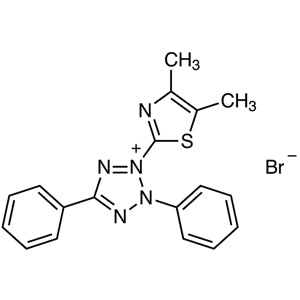
- TCI D0801 298-93-1 3-(4,5-Dimethyl-2-thiazolyl)-2,5-diphenyltetrazolium Bromide
- TCI H1343 23491-45-4 Bisbenzimide H 33258 [for Biochemical Research]
- TCI D3757 868272-85-9 3,3'-Diaminobenzidine Tetrahydrochloride Hydrate [for Biochemical Research]
- TCI D3756 91-95-2 3,3'-Diaminobenzidine [for Biochemical Research]
- Molecular detection assays benefit from Blue Tetrazolium's role in luminescent reactions, providing clear and measurable signals for accurate analysis.
- Biochemical research utilizes this compound in redox-based experiments, where its reactivity supports the detection of various chemical interactions.
- Environmental studies employ Blue Tetrazolium in assays that monitor pollutant levels, leveraging its sensitivity to chemical changes in samples.
- Biological analysis relies on its ability to participate in light-emitting reactions, aiding in the study of cellular processes and metabolic pathways.
- Educational institutions use Blue Tetrazolium in teaching labs to demonstrate luminescent detection techniques and redox chemistry principles.
| Brand | TCI |
|---|---|
| CAS number | 1871-22-3 |
| Molecular formula | — |
| Purity | — |
| Category | Life Science > Biochemicals and Reagents > Luminescent Compounds/Detection |
| Pack sizes | Available in various quantities as per standard laboratory supply |
| Physical form | Solid |
| Storage | Store in a cool, dry place away from direct light and moisture |
Blue Tetrazolium should be stored in a cool, dry environment, away from direct light and moisture to maintain its chemical stability. It is recommended to use airtight containers to prevent exposure to humidity and contaminants. Due to its sensitivity to pH and temperature, it is important to handle the compound with care during preparation and use. Laboratory personnel should ensure that storage conditions are consistent and that the material is kept in a secure location to avoid accidental exposure. Proper labeling and adherence to standard safety protocols are essential when working with this compound to ensure safe and effective use in experimental settings.
—
Produk Terkait
-
BlueTetrazolium[forBiochemicalResearch] TCI B3581
Regular price Rp 1.298.850,00Regular priceRp 924.000,00Sale price Rp 1.298.850,00 -
2-(4-Iodophenyl)-3-(4-nitrophenyl)-5-phenyltetrazoliumChloride TCI I0067
Regular price Rp 1.220.100,00Regular priceRp 868.350,00Sale price Rp 1.220.100,00 -
3-(4,5-Dimethyl-2-thiazolyl)-2,5-diphenyltetrazoliumBromide TCI D0801
Regular price Rp 2.199.750,00Regular priceRp 1.554.000,00Sale price Rp 2.199.750,00 -
BisbenzimideH33258[forBiochemicalResearch] TCI H1343
Regular price Rp 1.510.950,00Regular priceRp 1.072.050,00Sale price Rp 1.510.950,00 -
3,3'-DiaminobenzidineTetrahydrochlorideHydrate[forBiochemicalResearch] TCI D3757
Regular price Rp 1.326.150,00Regular priceRp 942.900,00Sale price Rp 1.326.150,00 -
3,3'-Diaminobenzidine[forBiochemicalResearch] TCI D3756
Regular price Rp 795.900,00Regular priceRp 572.250,00Sale price Rp 795.900,00 -
3,3'-DiaminobenzidineTetrahydrochlorideHydrate TCI D0078
Regular price Rp 2.862.300,00Regular priceRp 2.017.050,00Sale price Rp 2.862.300,00 -
4-Chloro-1-naphthol[forBiochemicalResearch] TCI C2291
Regular price Rp 689.850,00Regular priceRp 481.950,00Sale price Rp 689.850,00
![1871-22-3 Blue Tetrazolium [for Biochemical Research] - AMI Scientific](http://amiscientific.com/cdn/shop/files/TCI2510B3581_25792e25-dbc5-4e62-a711-c5f5176b1b02.jpg?v=1767433226&width=533)

![23491-45-4 Bisbenzimide H 33258 [for Biochemical Research] - AMI Scientific](http://amiscientific.com/cdn/shop/files/TCI2510H1343.jpg?v=1767117845&width=533)
![3,3'-Diaminobenzidine Tetrahydrochloride Hydrate [for Biochemical Research] (CAS 868272-85-9) - TCI D3757 - AMI Scientific](http://amiscientific.com/cdn/shop/files/TCI2510D3757.jpg?v=1767106514&width=533)
![3,3'-Diaminobenzidine [for Biochemical Research] (CAS 91-95-2) - TCI D3756 - AMI Scientific](http://amiscientific.com/cdn/shop/files/TCI2510D3756.jpg?v=1767106510&width=533)

![4-Chloro-1-naphthol [for Biochemical Research] (CAS 604-44-4) - TCI C2291 - AMI Scientific](http://amiscientific.com/cdn/shop/files/TCI2510C2291.jpg?v=1767098083&width=533)