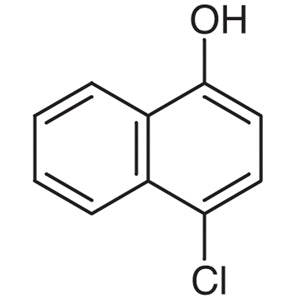
![4-Chloro-1-naphthol [for Biochemical Research] (CAS 604-44-4) - TCI C2291 - AMI Scientific](http://amiscientific.com/cdn/shop/files/TCI2510C2291.jpg?v=1767098083&width=1946)
![4-Chloro-1-naphthol [for Biochemical Research] (CAS 604-44-4) - TCI C2291 - AMI Scientific](http://amiscientific.com/cdn/shop/files/TCI2510C2291.jpg?v=1767098083&width=1445)
4-Chloro-1-naphthol is a chemical compound widely used in biochemical research. It is a key reagent in laboratory settings where precise chemical reactions are required. This compound features an aromatic structure with a chlorine substituent at the C-4 position, which enhances its reactivity in various chemical processes. Its versatility makes it a valuable tool for researchers working on enzyme reactions and analytical methods. Due to its stability and reactivity, it is frequently used in experiments that demand accuracy and reproducibility.
The compound's chemical properties make it a preferred choice for laboratory applications. It exhibits solubility in organic solvents such as ethyl acetate and ethanol, allowing for easy incorporation into reaction mixtures. Its ability to participate in electrophilic substitution reactions further expands its utility in synthetic chemistry. Additionally, its resistance to degradation under standard laboratory conditions ensures long-term stability and reliability of experimental results. These characteristics make it a reliable and effective reagent for biochemical research.
In Indonesian laboratories, 4-Chloro-1-naphthol is commonly used in biochemical research, including enzyme studies and analytical method development. Its role is crucial in experiments that require precise chemical interactions and stable reagents. Researchers in Indonesia rely on this compound for its consistent performance and compatibility with various experimental protocols. Its widespread use highlights its importance in both academic and industrial research settings.
- Enzyme Kinetics Studies: This compound is ideal for enzyme reaction experiments due to its reactivity and stability, allowing accurate measurement of enzyme activity.
- Quantitative Analysis Development: Its solubility and chemical behavior make it suitable for creating reagents used in quantitative testing methods.
- Synthetic Organic Chemistry: The compound's ability to undergo electrophilic substitution reactions makes it a valuable reagent in organic synthesis.
- Biochemical Assay Preparation: It is commonly used in preparing substrates for biochemical assays that require controlled chemical reactions.
- Spectroscopic Analysis: Its distinct chemical properties make it useful in spectroscopic studies for identifying and analyzing molecular structures.
| Brand | TCI |
|---|---|
| CAS number | 604-44-4 |
| Molecular formula | — |
| Purity | — |
| Category | Life Science > Antibodies > Antibody Supplementary Products |
| Pack sizes | Available in various quantities as per standard laboratory supply |
| Physical form | Solid, crystalline |
| Storage | Store in a cool, dry place away from light |
This compound should be stored in a cool, dry place away from direct light to maintain its stability and effectiveness. It is recommended to use airtight containers to prevent moisture absorption, which can affect its chemical properties. Due to its reactivity, it should be handled with care, using appropriate personal protective equipment such as gloves and safety goggles. It is important to ensure good ventilation when working with this material to avoid inhalation of vapors. Proper storage and handling practices help preserve the compound's integrity and ensure safe laboratory operations.
—
Produk Terkait
-
3,3'-DiaminobenzidineTetrahydrochlorideHydrate[forBiochemicalResearch] TCI D3757
Regular price From Rp 1.273.650,00Regular price -
3,3'-Diaminobenzidine[forBiochemicalResearch] TCI D3756
Regular price From Rp 743.400,00Regular price -
BlueTetrazolium[forBiochemicalResearch] TCI B3581
Regular price From Rp 1.246.350,00Regular price -
1-Naphthol[forBiochemicalResearch] TCI N0864
Regular price From Rp 477.750,00Regular price -
BisbenzimideH33258[forBiochemicalResearch] TCI H1343
Regular price Rp 1.458.450,00Regular price -
DAPI2HCl[forBiochemicalResearch] TCI A2412
Regular price Rp 1.590.750,00Regular price -
NewFuchsin[forBiochemicalResearch] TCI N0873
Regular price Rp 664.650,00Regular price -
4-Chloro-1-naphthol TCI C0570
Regular price Rp 2.571.450,00Regular price
![3,3'-Diaminobenzidine Tetrahydrochloride Hydrate [for Biochemical Research] (CAS 868272-85-9) - TCI D3757 - AMI Scientific](http://amiscientific.com/cdn/shop/files/TCI2510D3757.jpg?v=1767106514&width=533)
![3,3'-Diaminobenzidine [for Biochemical Research] (CAS 91-95-2) - TCI D3756 - AMI Scientific](http://amiscientific.com/cdn/shop/files/TCI2510D3756.jpg?v=1767106510&width=533)
![1871-22-3 Blue Tetrazolium [for Biochemical Research] - AMI Scientific](http://amiscientific.com/cdn/shop/files/TCI2510B3581_25792e25-dbc5-4e62-a711-c5f5176b1b02.jpg?v=1767433226&width=533)
![90-15-3 1-Naphthol [for Biochemical Research] - AMI Scientific](http://amiscientific.com/cdn/shop/files/TCI2510N0864.jpg?v=1767130445&width=533)
![23491-45-4 Bisbenzimide H 33258 [for Biochemical Research] - AMI Scientific](http://amiscientific.com/cdn/shop/files/TCI2510H1343.jpg?v=1767117845&width=533)
![28718-90-3 DAPI 2HCl [for Biochemical Research] - AMI Scientific](http://amiscientific.com/cdn/shop/files/TCI2510A2412.jpg?v=1767082817&width=533)
![3248-91-7 New Fuchsin [for Biochemical Research] - AMI Scientific](http://amiscientific.com/cdn/shop/files/TCI2510N0873.jpg?v=1767130476&width=533)