

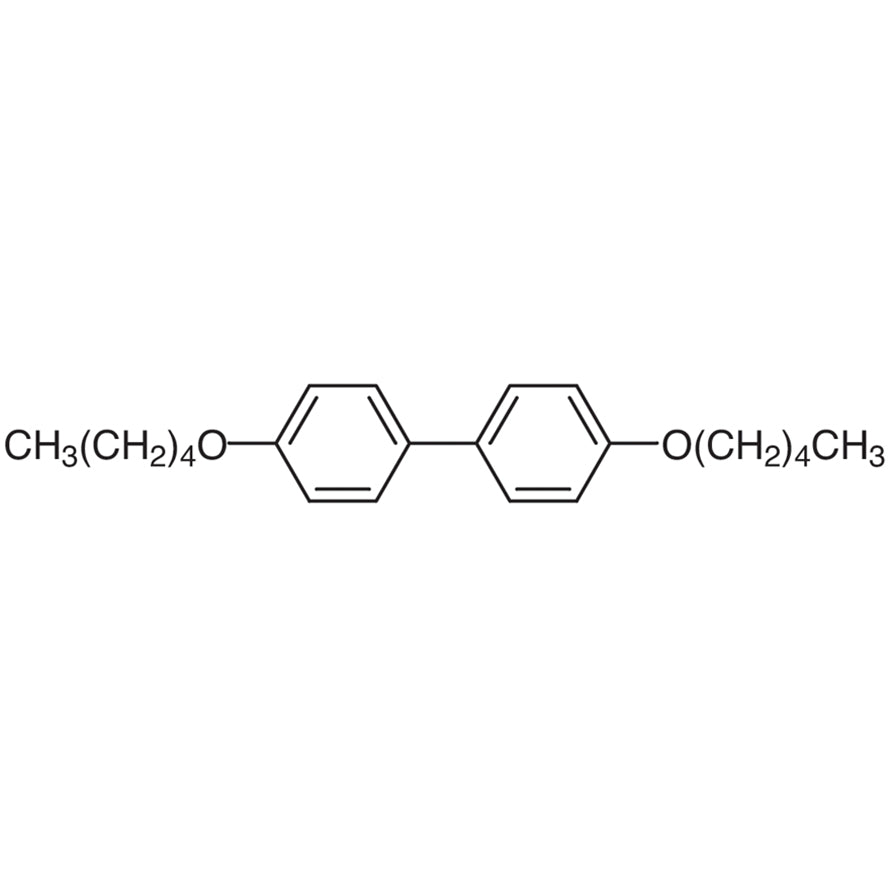
4,4'-Diamyloxybiphenyl is a chemical compound widely used in materials science, particularly in the study of liquid crystals (LC). This compound plays a crucial role in laboratory research by serving as a foundational material for developing liquid crystal systems with specific optical and mechanical properties. Its unique molecular structure enables it to exhibit anisotropic behavior, making it essential for creating materials that respond dynamically to external stimuli such as temperature or electric fields. In the context of Indonesian laboratories, this compound is frequently utilized in research aimed at advancing material science and optical technologies.
The compound’s molecular structure, featuring long alkyl chains, contributes to its favorable solubility in organic solvents, which simplifies its use in synthesis and characterization processes. Its stability and reactivity make it ideal for experiments requiring precise control over molecular architecture. Additionally, its liquid form facilitates ease of handling and integration into various experimental setups, enhancing its utility in both academic and industrial research environments.
In Indonesian laboratories, 4,4'-Diamyloxybiphenyl is commonly employed in the development of advanced materials for display technologies, optical sensors, and other applications that rely on liquid crystal properties. Its presence in research projects underscores its importance in the pursuit of innovative material solutions with tailored optical and mechanical characteristics.
Related TCI products
- Liquid Crystal Research – This compound is ideal for studying the behavior and properties of liquid crystals, which are essential in display technologies and optical devices.
- Optical Sensor Development – Its anisotropic properties make it suitable for creating sensors that respond to environmental changes, enhancing detection accuracy.
- Material Synthesis – The compound’s solubility in organic solvents allows for easy incorporation into synthetic processes, supporting the creation of new material formulations.
- Display Technology Innovation – Its role in liquid crystal systems makes it a key component in the development of advanced display technologies, such as LCDs and OLEDs.
- Optical Device Fabrication – The compound’s unique molecular structure enables its use in the production of optical components that require precise light manipulation and response.
| Brand | TCI |
|---|---|
| CAS number | 21470-41-7 |
| Molecular formula | — |
| Purity | — |
| Category | Materials Science > Material Building Blocks > Liquid Crystal (LC) Building Blocks |
| Pack sizes | — |
| Physical form | Liquid |
| Storage | Store in a cool, dry place away from direct sunlight |
This compound should be stored in a cool, dry environment, away from direct sunlight and sources of heat to maintain its stability. It is recommended to use airtight containers made of glass or high-density polyethylene to prevent contamination and evaporation. Due to its liquid form, it is important to handle it with care to avoid spills and ensure proper ventilation in the laboratory. Always wear appropriate personal protective equipment, such as gloves and safety goggles, when handling this material. Regular monitoring of storage conditions is advised to ensure the compound remains in optimal condition for use in research applications.
—
Produk Terkait
-
4'-Decyloxybiphenyl-4-carboxylicAcid TCI D2041
Regular price Rp 3.446.100,00Regular price -
4-Octadecyloxybiphenyl TCI B1924
Regular price From Rp 1.326.150,00Regular price -
4,4'-Dihexyloxybiphenyl TCI D1089
Regular price Rp 2.704.800,00Regular price -
4-Hydroxy-4'-methoxybiphenyl TCI H0819
Regular price From Rp 1.881.600,00Regular price -
4-Bromo-4'-hydroxybiphenyl TCI H0690
Regular price From Rp 1.590.750,00Regular price -
4-Cyano-4'-hydroxybiphenyl TCI H0523
Regular price From Rp 1.193.850,00Regular price -
4-Fluoro-4'-hydroxybiphenyl TCI F0704
Regular price Rp 1.167.600,00Regular price -
4-Chloro-4'-hydroxybiphenyl TCI C1239
Regular price From Rp 3.525.900,00Regular price


