

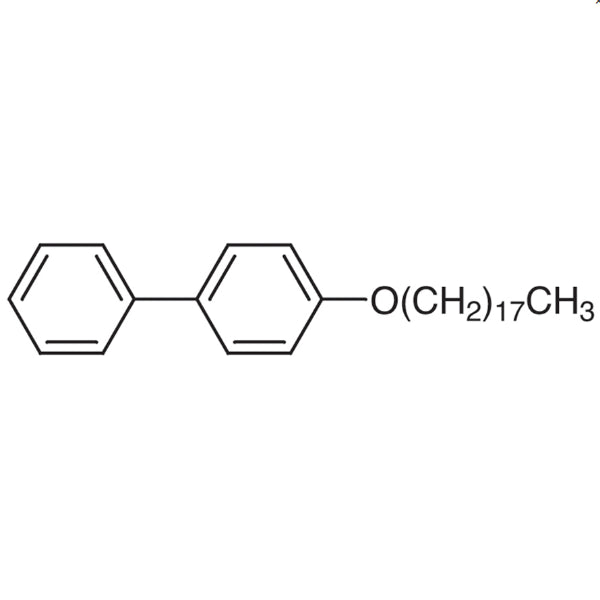
4-Octadecyloxybiphenyl is a chemical compound widely utilized in scientific material research, particularly in the field of liquid crystals. This compound plays a crucial role in laboratories where the study of optical and thermal properties of materials is essential. Its molecular structure, composed of two benzene rings connected by a long hydrocarbon chain, enables it to function as a building block for advanced materials with unique characteristics. Due to its stability and versatility, it is a key component in the development of new materials with specialized applications in various scientific domains.
The compound is preferred for its thermal and optical stability, which are critical in maintaining consistent performance under varying experimental conditions. Its low viscosity allows for easy manipulation during research processes, making it ideal for precise control over material properties. These properties make it a reliable choice for researchers aiming to explore the behavior of liquid crystals in different environments. The compound’s predictable behavior and consistent performance contribute to its popularity in both academic and industrial research settings.
In Indonesian laboratories, 4-Octadecyloxybiphenyl is commonly used in material science research, especially in institutions focused on developing advanced materials. It is frequently found in projects related to display technology and optical devices, where its unique properties are leveraged to achieve desired outcomes. Its presence in these research contexts highlights its importance in advancing scientific innovation within the region.
Related TCI products
- Liquid Crystal Research - This compound is ideal for studying the phase behavior and alignment properties of liquid crystals due to its stable molecular structure and optical characteristics.
- Display Technology Development - Its optical properties make it suitable for use in the creation of advanced display materials, contributing to improved performance in liquid crystal displays.
- Optical Sensor Fabrication - The compound's thermal stability and low viscosity support the development of sensitive optical sensors with precise response characteristics.
- Material Science Education - It is commonly used in academic settings to teach students about the properties and applications of liquid crystal materials.
- Advanced Material Synthesis - Its role as a building block allows researchers to create new materials with tailored optical and thermal properties for specialized applications.
| Brand | TCI |
|---|---|
| CAS number | 376609-78-8 |
| Molecular formula | — |
| Purity | — |
| Category | Materials Science > Material Building Blocks > Liquid Crystal (LC) Building Blocks |
| Pack sizes | Available in various quantities as per standard laboratory supply options |
| Physical form | Liquid |
| Storage | Store in a cool, dry place away from direct sunlight |
This compound should be stored in a cool, dry environment, away from direct sunlight and sources of heat to maintain its stability and prevent degradation. It is recommended to use airtight containers made of glass or high-density polyethylene to minimize exposure to moisture and contaminants. Due to its low viscosity, it is easy to handle, but researchers should wear appropriate personal protective equipment, such as gloves and safety goggles, to ensure safe handling. The compound is non-hazardous under normal conditions, but proper ventilation should be maintained in the laboratory to ensure a safe working environment. Regular monitoring of storage conditions is advised to maintain the integrity of the material for research applications.
—
Produk Terkait
-
4'-Decyloxybiphenyl-4-carboxylicAcid TCI D2041
Regular price Rp 3.498.600,00Regular priceRp 2.462.250,00Sale price Rp 3.498.600,00 -
4,4'-Diamyloxybiphenyl TCI D1090
Regular price Rp 3.763.200,00Regular priceRp 2.631.300,00Sale price Rp 3.763.200,00 -
4-Hydroxy-4'-methoxybiphenyl TCI H0819
Regular price From Rp 1.934.100,00Regular priceRp 1.368.150,00Sale price From Rp 1.934.100,00 -
4-Bromo-4'-hydroxybiphenyl TCI H0690
Regular price From Rp 1.590.750,00Regular priceRp 1.111.950,00Sale price From Rp 1.590.750,00 -
4-Cyano-4'-hydroxybiphenyl TCI H0523
Regular price From Rp 1.246.350,00Regular priceRp 887.250,00Sale price From Rp 1.246.350,00 -
4-Fluoro-4'-hydroxybiphenyl TCI F0704
Regular price Rp 1.167.600,00Regular priceRp 815.850,00Sale price Rp 1.167.600,00 -
4,4'-Dihexyloxybiphenyl TCI D1089
Regular price Rp 2.704.800,00Regular priceRp 1.891.050,00Sale price Rp 2.704.800,00 -
4-Chloro-4'-hydroxybiphenyl TCI C1239
Regular price From Rp 3.525.900,00Regular priceRp 2.465.400,00Sale price From Rp 3.525.900,00


