

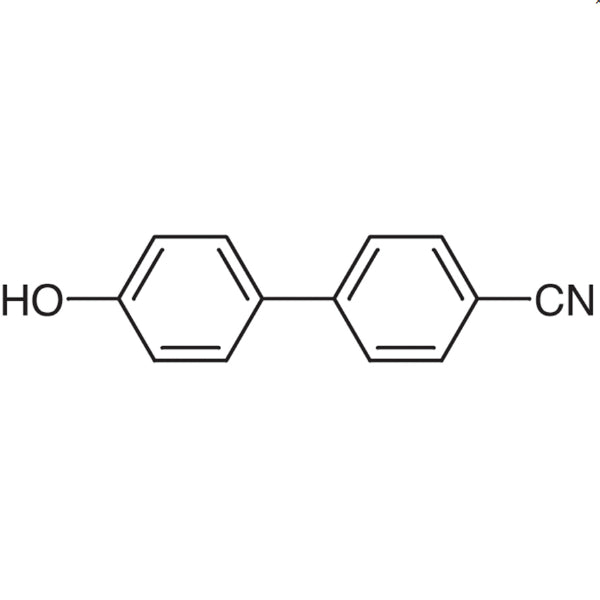
4-Cyano-4'-hydroxybiphenyl is a chemical compound widely used in scientific research, particularly in the field of materials science. It plays a crucial role in the development of liquid crystal materials, which are essential for various advanced technologies. This compound is valued for its unique molecular structure, consisting of two benzene rings connected by hydroxyl and cyano groups, enabling it to exhibit specific optical and electronic properties. Its presence in laboratory settings supports the creation of materials with tailored characteristics for specialized applications.
The compound’s chemical stability and optical properties make it a preferred choice for researchers. Its ability to respond to electromagnetic fields and its compatibility with a wide range of reaction conditions contribute to its versatility. Additionally, its thermal stability ensures consistent performance under controlled laboratory environments. These attributes make it an ideal component for synthesizing complex materials and modifying existing ones with high precision.
In Indonesian laboratories, 4-Cyano-4'-hydroxybiphenyl is commonly used in research related to display technologies, optical devices, and sensor development. Its role in creating materials with specific optical and electrical responses is critical for advancing scientific innovation in these areas. Researchers rely on its predictable behavior to achieve reliable results in their experiments.
Related TCI products
- Liquid Crystal Material Synthesis: This compound is essential for creating liquid crystals with tunable optical and electrical properties, making it ideal for display technologies and optical devices.
- Optical Sensor Development: Its unique molecular structure allows it to be used in the fabrication of sensors that respond to light or electromagnetic fields, enhancing sensitivity and accuracy.
- Display Technology Research: The compound is used in the development of advanced display materials, contributing to the creation of high-performance liquid crystal displays.
- Material Modification Studies: Its chemical stability and reactivity make it a valuable component in modifying existing materials for enhanced performance in various applications.
- Thermal Stability Testing: Its consistent behavior under controlled temperature conditions makes it suitable for experiments requiring precise thermal control in material science research.
| Brand | TCI |
|---|---|
| CAS number | 19812-93-2 |
| Molecular formula | — |
| Purity | — |
| Category | Materials Science > Material Building Blocks > Liquid Crystal (LC) Building Blocks |
| Pack sizes | Available in various quantities as per supplier specifications |
| Physical form | Liquid or solid, depending on formulation |
| Storage | Store in a cool, dry place away from direct sunlight |
This compound should be stored in a cool, dry environment to maintain its chemical stability. It is recommended to use airtight containers to prevent exposure to moisture and air, which could affect its properties. Due to its potential reactivity, it should be handled with appropriate personal protective equipment, such as gloves and safety goggles. Storage should be in a well-ventilated area to minimize any risk of inhalation. Avoid contact with incompatible substances to ensure safe handling and long-term stability. Regular inspection of storage conditions is advised to maintain the integrity of the material.
—
Produk Terkait
-
4-Bromo-4'-hydroxybiphenyl TCI H0690
Regular price From Rp 1.590.750,00Regular price -
4-Fluoro-4'-hydroxybiphenyl TCI F0704
Regular price Rp 1.167.600,00Regular price -
4-Chloro-4'-hydroxybiphenyl TCI C1239
Regular price From Rp 3.525.900,00Regular price -
4-Octadecyloxybiphenyl TCI B1924
Regular price From Rp 1.326.150,00Regular price -
4-Hydroxy-4'-methoxybiphenyl TCI H0819
Regular price From Rp 1.881.600,00Regular price -
4-(6-Hydroxyhexyloxy)-4'-methoxybiphenyl TCI H0767
Regular price Rp 1.405.950,00Regular price -
4'-Decyloxybiphenyl-4-carboxylicAcid TCI D2041
Regular price Rp 3.446.100,00Regular price -
4,4'-Diethoxybiphenyl TCI D1127
Regular price Rp 2.650.200,00Regular price


