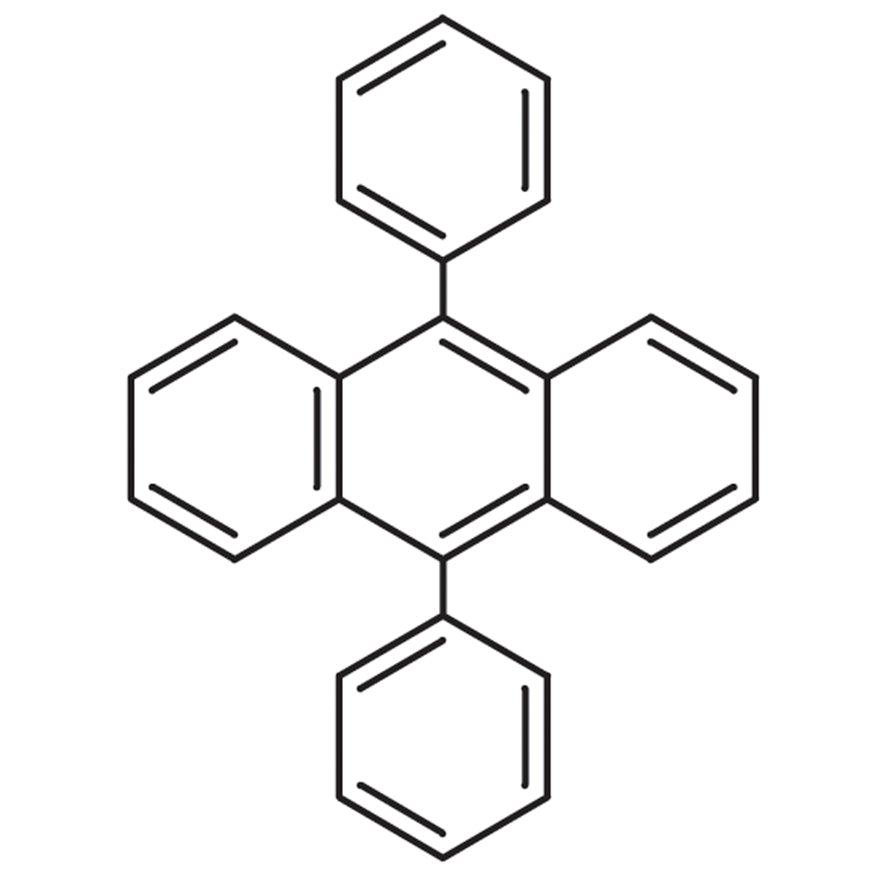
9,10-Diphenylanthracene is an organic compound widely utilized in electronic materials research, particularly in the development of Organic Light-Emitting Diode (OLED) materials. This compound plays a crucial role in laboratory settings where researchers are working on advanced optoelectronic devices. Its molecular structure is designed to facilitate efficient light emission, making it a key component in the creation of active layers within OLEDs. These layers are responsible for producing light through stimulated emission processes, which are essential for the functionality of OLED technology.
The compound is favored for its high chemical stability, thermal resistance, and ability to emit light with high efficiency. These properties make it a preferred choice for researchers aiming to develop materials with long-lasting performance and high brightness. Its chemical structure also allows for further modification, enabling customization of optical and electronic properties to meet specific application requirements. This adaptability enhances its utility across various research fields.
In Indonesian laboratories, 9,10-Diphenylanthracene is commonly used by researchers in educational and research institutions. It is an essential material for those working on OLED development, material science, and optoelectronic applications. Its availability and reliability make it a standard component in the toolkit of many scientists and engineers in the region.
- OLED Material Development: This compound is ideal for creating active layers in OLEDs due to its efficient light-emitting properties and stability.
- Organic Electronics Research: It is used in studies focused on organic semiconductors and their applications in display technologies.
- Photoluminescence Studies: Its high photoluminescence efficiency makes it suitable for experiments analyzing light emission characteristics.
- Material Modification Studies: Its molecular structure allows for chemical modifications, supporting research into tunable optical properties.
- Thin Film Deposition: It is used in the fabrication of thin films for use in electronic devices and optoelectronic components.
| Brand | TCI |
|---|---|
| CAS number | 1499-10-1 |
| Molecular formula | — |
| Purity | — |
| Category | Materials Science > Electronic Materials > Organic Light-Emitting Diode (OLED) Materials |
| Pack sizes | Available in various quantities as per standard laboratory supply |
| Physical form | Solid |
| Storage | Store in a cool, dry place away from direct light |
This compound should be stored in a cool, dry environment, away from direct sunlight and sources of heat. It is recommended to use airtight containers to prevent exposure to moisture and air, which could affect its stability. Due to its chemical nature, it should be handled with care, using appropriate personal protective equipment such as gloves and safety goggles. It is important to ensure that the storage area is well-ventilated to minimize any potential risks associated with handling. Proper labeling of containers is essential to ensure safe handling and prevent accidental exposure. Laboratories should maintain good housekeeping practices to avoid contamination and ensure the integrity of the material.
—
Produk Terkait
-
9-([1,1'-Biphenyl]-4-yl)anthracene TCI B5717
Regular price From Rp 1.220.100,00Regular price -
4-(3-Buten-1-yl)-4'-methylbiphenyl TCI B5872
Regular price Rp 2.094.750,00Regular price -
4,4'-Bis(trans-4-propylcyclohexyl)biphenyl TCI B5881
Regular price Rp 1.565.550,00Regular price -
Biphenylene TCI B6284
Regular price From Rp 2.782.500,00Regular price -
Benzo[k]fluoranthene TCI B6317
Regular price From Rp 3.180.450,00Regular price -
Benzo[j]fluoranthene TCI B6424
Regular price From Rp 2.916.900,00Regular price -
Benzo[c]phenanthrene TCI B6541
Regular price From Rp 1.829.100,00Regular price -
1-Benzyl-4-methylbenzene TCI B6623
Regular price From Rp 2.386.650,00Regular price
![9-([1,1'-Biphenyl]-4-yl)anthracene (CAS 323195-31-9) - TCI B5717 - AMI Scientific](http://amiscientific.com/cdn/shop/files/TCI2510B5717.jpg?v=1768815871&width=533)


![Benzo[k]fluoranthene (CAS 207-08-9) - TCI B6317 - AMI Scientific](http://amiscientific.com/cdn/shop/files/TCI2510B6317_9797284f-a326-4c13-8c48-43bc162551a1.jpg?v=1767865252&width=533)
![Benzo[j]fluoranthene (CAS 205-82-3) - TCI B6424 - AMI Scientific](http://amiscientific.com/cdn/shop/files/TCI2510B6424.jpg?v=1768193711&width=533)
![Benzo[c]phenanthrene (CAS 195-19-7) - TCI B6541 - AMI Scientific](http://amiscientific.com/cdn/shop/files/TCI2510B6541.jpg?v=1767093862&width=533)