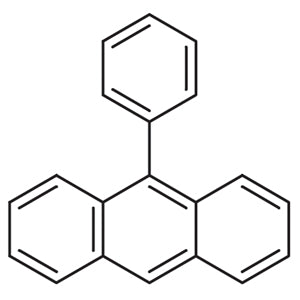
9-Phenylanthracene from TCI is a polycyclic aromatic hydrocarbon. It consists of an anthracene framework with a single phenyl group at the 9-position. In the laboratory it is an important building block for functional organic materials, especially materials linked to photophysics and organic electronics. Aryl-substituted anthracene frameworks often form the core of light-emitting molecules. For this reason, the compound is widely used in optoelectronic materials research and in basic fluorescence studies, where a well-defined aromatic scaffold is needed.
Researchers choose this compound because its extended conjugated π-system gives the characteristic fluorescence of anthracene. The phenyl group is twisted out of the plane of the anthracene, which helps reduce intermolecular stacking in the solid state and in concentrated systems. The 10-position remains open, so the molecule can be halogenated or further functionalised. This lets researchers build more complex, asymmetric molecules step by step. Because it is a hydrocarbon with no heteroatoms, its structure is fairly stable, and it serves as a good model compound for spectroscopic studies.
In Indonesia, this material is relevant to university research groups in materials chemistry, materials physics, and photochemistry. It suits groups that develop OLED materials, fluorescent sensors, or energy transfer studies. Graduate students and lecturers can use it as a starting scaffold for synthesis projects. They can also use it as a reference fluorophore when they characterise new aromatic compounds. Its well-understood anthracene core makes it a practical choice for laboratories building expertise in organic optoelectronic materials.
TCI brochures (PDF)
- Nanocarbon Materials 2026-09-30 · p. 9
Related TCI products
- OLED material research: the aryl-substituted anthracene core is a common motif in light-emitting molecules, so this compound is a useful starting framework for new emitter designs.
- Synthesis of asymmetric anthracene derivatives: the open 10-position allows halogenation or further functionalisation, so researchers can build more complex, asymmetric molecules from a single scaffold.
- Basic fluorescence studies: its extended conjugated π-system gives the characteristic fluorescence of anthracene, which makes it suitable for teaching and research on emission behaviour.
- Spectroscopic model studies: as a stable hydrocarbon with no heteroatoms, it is a clean model compound for comparing the spectra of substituted aromatic systems.
- Fluorescent sensor and energy transfer research: the twisted phenyl group reduces intermolecular stacking, which helps when studying emission and energy transfer in condensed or concentrated systems.
| Brand | TCI (product code P0138) |
|---|---|
| CAS number | 602-55-1 |
| Molecular formula | — |
| Purity | refer to the TCI product specification and certificate of analysis |
| Category | Chemistry > Building Blocks > Non-Heterocyclic Building Blocks |
| Pack sizes | available pack sizes on request; please contact AMI Scientific |
| Physical form | — |
| Storage | keep tightly closed in a cool, dry place, protected from light |
Store 9-Phenylanthracene in its original, tightly closed container in a cool, dry, well-ventilated area. Protect it from direct light, because anthracene derivatives are photoactive, and keep it away from strong oxidising agents. If you transfer the material, use clean, dry glass containers with secure caps, and label them clearly. Handle the compound following standard good laboratory practice: wear safety glasses, gloves, and a lab coat, avoid creating or breathing dust, and work in a fume hood when weighing or preparing solutions. Read the TCI Safety Data Sheet before use, and dispose of waste according to local regulations.
—
Produk Terkait
-
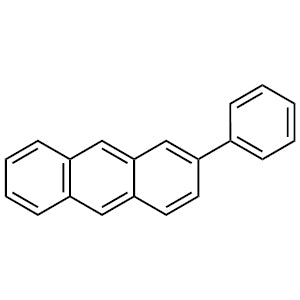
2-Phenylanthracene TCI P2783
Regular price Rp 3.472.350,00Regular priceRp 2.427.600,00Sale price Rp 3.472.350,00 -
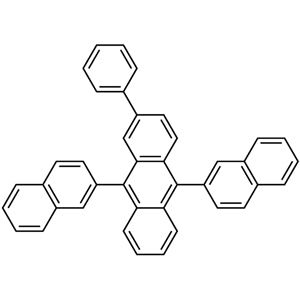
9,10-Di(naphthalen-2-yl)-2-phenylanthracene TCI D5627
Regular price Rp 5.539.800,00Regular priceRp 3.873.450,00Sale price Rp 5.539.800,00 -
9-Vinylanthracene TCI V0130
Regular price From Rp 2.545.200,00Regular priceRp 1.779.750,00Sale price From Rp 2.545.200,00 -
9,10-Diphenylanthracene(purifiedbysublimation) TCI D4401
Regular price Rp 4.347.000,00Regular priceRp 3.039.750,00Sale price Rp 4.347.000,00 -
9,10-Diphenylanthracene TCI D1689
Regular price From Rp 795.900,00Regular priceRp 556.500,00Sale price From Rp 795.900,00 -
2-tert-Butylanthracene TCI B3541
Regular price From Rp 2.227.050,00Regular priceRp 1.557.150,00Sale price From Rp 2.227.050,00 -
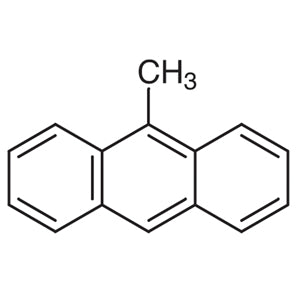
9-Methylanthracene TCI M0153
Regular price From Rp 795.900,00Regular priceRp 556.500,00Sale price From Rp 795.900,00 -
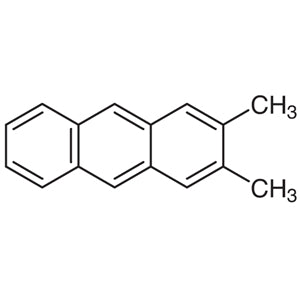
2,3-Dimethylanthracene TCI D2979
Regular price Rp 5.830.650,00Regular priceRp 4.077.150,00Sale price Rp 5.830.650,00