

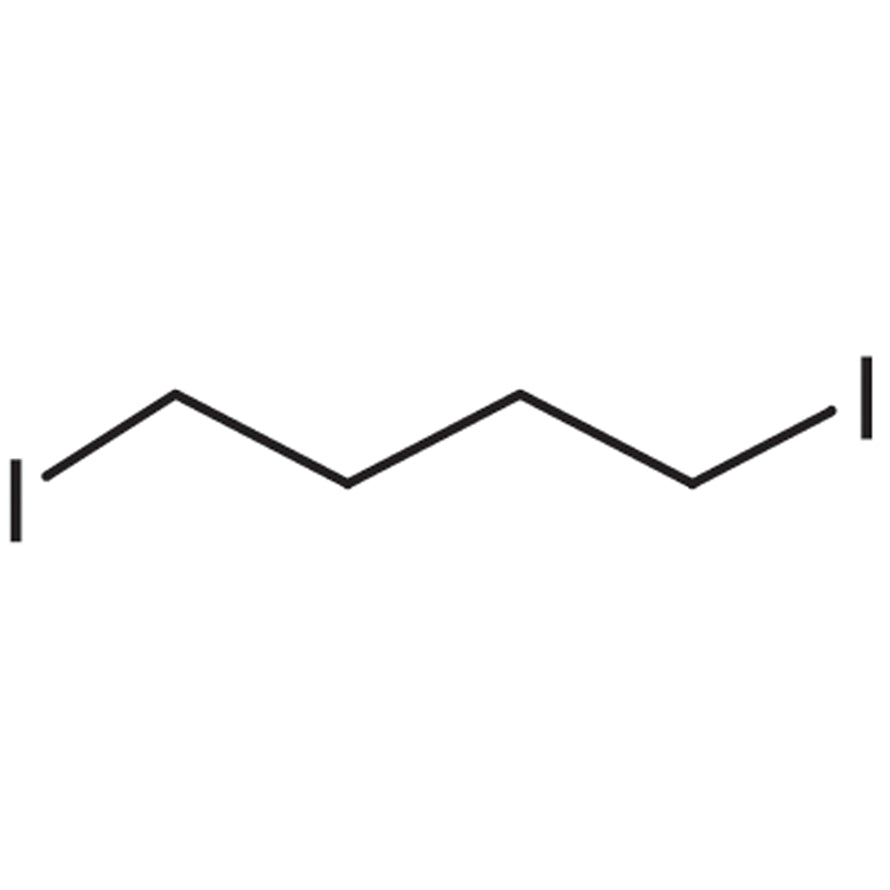
1,4-Diiodobutane is a chemical compound widely used in organic reactions to construct complex molecular structures. It serves as a fundamental building block in the synthesis of various organic compounds, making it an essential material in chemical laboratories. This compound is particularly valuable for its ability to participate in nucleophilic substitution and coupling reactions, which are critical in the development of longer carbon chains. Its role in organic synthesis is well-established, supporting a wide range of chemical processes and research applications.
The stability of 1,4-Diiodobutane is enhanced by the inclusion of a copper chip, which helps maintain its chemical integrity under various laboratory conditions. This makes it a preferred choice for researchers who require reliable performance in both routine and advanced chemical experiments. Its reactivity, while a factor that necessitates careful handling, is also a key attribute that enables it to be a versatile reagent in synthetic pathways. The combination of stability and reactivity ensures that it remains a valuable tool in chemical laboratories.
In Indonesian laboratories, 1,4-Diiodobutane is commonly used in organic chemistry research conducted at universities and research institutions. Its availability and effectiveness in various chemical reactions make it a popular choice for both academic and industrial applications. Local researchers frequently utilize this compound to develop new substances or improve existing synthesis methods. Its widespread use highlights its importance in the chemical research landscape of Indonesia.
Related TCI products
- TCI B1093 513-48-4 2-Iodobutane (stabilized with Copper chip)
- TCI I0055 542-69-8 1-Iodobutane (stabilized with Copper chip)
- TCI B1905 3814-34-4 1-Bromo-2-ethylbutane (stabilized with Copper chip)
- TCI B1412 13294-71-8 2-Bromo-2-butene (stabilized with Copper chip)
- TCI B1289 3377-87-5 3-Bromohexane (contains 2-Bromohexane) (stabilized with Copper chip)
- TCI B1235 3377-86-4 2-Bromohexane (contains 3-Bromohexane) (stabilized with Copper chip)
- Organic synthesis reactions benefit from 1,4-Diiodobutane due to its reactivity and role in coupling processes.
- Nucleophilic substitution reactions often utilize this compound as a versatile intermediate in synthetic pathways.
- Polymer chemistry applications leverage its ability to form longer carbon chains through controlled reactions.
- Research in medicinal chemistry frequently incorporates this compound for the development of new drug molecules.
- Analytical chemistry laboratories use it as a standard reagent for testing and characterizing reaction mechanisms.
| Brand | TCI |
|---|---|
| CAS number | 628-21-7 |
| Molecular formula | — |
| Purity | — |
| Category | Chemistry > Building Blocks > Non-Heterocyclic Building Blocks |
| Pack sizes | Available in standard laboratory quantities |
| Physical form | Liquid |
| Storage | Store in a cool, dry place away from direct sunlight |
1,4-Diiodobutane should be stored in a cool, dry environment to maintain its stability and prevent degradation. It is recommended to use sealed containers to minimize exposure to air and moisture. Due to its reactivity, it should be handled with appropriate personal protective equipment, including gloves and safety goggles. Storage should be away from incompatible materials such as strong oxidizers. Regular inspection of containers is advised to ensure integrity. Proper ventilation is essential in laboratory settings to mitigate potential vapour exposure. Always follow standard chemical safety protocols when working with this compound.
—
Produk Terkait
-
2-Iodobutane(stabilizedwithCopperchip) TCI B1093
Regular price Rp 980.700,00Regular price -
1-Iodobutane(stabilizedwithCopperchip) TCI I0055
Regular price From Rp 557.550,00Regular price -
1-Bromo-2-ethylbutane(stabilizedwithCopperchip) TCI B1905
Regular price From Rp 1.035.300,00Regular price -
2-Bromo-2-butene(stabilizedwithCopperchip) TCI B1412
Regular price From Rp 1.724.100,00Regular price -
3-Bromohexane(contains2-Bromohexane)(stabilizedwithCopperchip) TCI B1289
Regular price Rp 7.023.450,00Regular price -
2-Bromohexane(contains3-Bromohexane)(stabilizedwithCopperchip) TCI B1235
Regular price Rp 3.763.200,00Regular price -
2-Iodo-2-methylpropane(stabilizedwithCopperchip) TCI B1072
Regular price Rp 2.332.050,00Regular price -
1-Iodo-2-methylbutane(stabilizedwithCopperchip) TCI I0530
Regular price Rp 3.021.900,00Regular price


