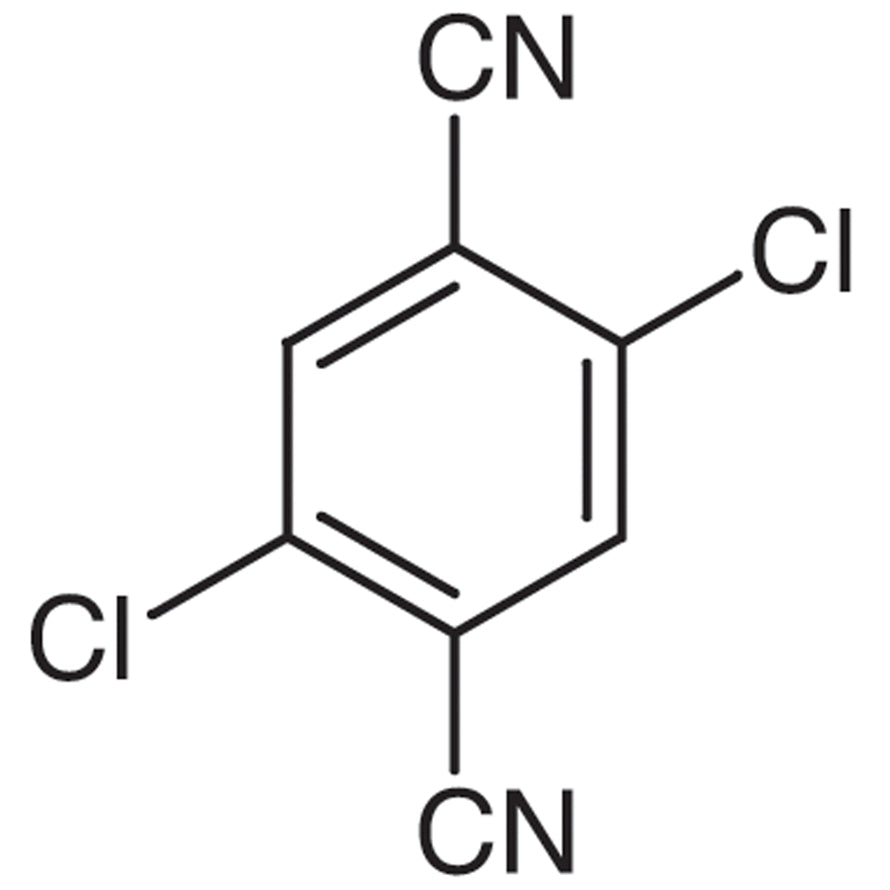
2,5-Dichloroterephthalonitrile is a chemical compound widely used in laboratory settings for the synthesis of complex organic molecules. It serves as a fundamental building block in various chemical reactions, particularly those involving substitution and coupling mechanisms. This compound is derived from terephthalonitrile with two chlorine atoms substituted at the 2- and 5-positions, making it a versatile reagent in synthetic chemistry. Its structural simplicity and functional groups make it a valuable tool for chemists working on the development of new compounds and materials.
The compound's stability and controlled reactivity make it a preferred choice for many laboratory applications. Its nitrile groups and chlorine substituents provide specific reactivity patterns that are useful in electrophilic and nucleophilic substitution reactions. The compound's inertness under normal conditions ensures safe handling and storage, reducing the risk of unintended side reactions. These properties make it a reliable and predictable reagent in both academic and industrial research environments.
In Indonesian laboratories, 2,5-Dichloroterephthalonitrile is commonly used in organic chemistry research, especially in the development of new compounds and modifications of existing ones. It is a key component in the synthesis of polymers, pharmaceuticals, and industrial chemicals. Its role in supporting chemical innovation makes it an essential material for researchers aiming to advance their work in various scientific fields.
- Organic synthesis applications benefit from its nitrile and chloro groups, enabling controlled substitution reactions in complex molecule construction.
- Polymer development relies on its structural versatility, allowing for the creation of functional polymers with tailored properties.
- Pharmaceutical research utilizes its reactivity to design and synthesize novel drug compounds with specific biological activities.
- Industrial chemical production leverages its stability and reactivity for the manufacture of specialty chemicals and intermediates.
- Research into new materials benefits from its ability to participate in coupling reactions, facilitating the development of advanced composite materials.
| Brand | TCI |
|---|---|
| CAS number | 1897-43-4 |
| Molecular formula | — |
| Purity | — |
| Category | Chemistry > Building Blocks > Non-Heterocyclic Building Blocks |
| Pack sizes | Available in various quantities as per supplier specifications |
| Physical form | Solid, typically in crystalline or powder form |
| Storage | Store in a cool, dry place away from moisture and direct sunlight |
2,5-Dichloroterephthalonitrile should be stored in a cool, dry environment to maintain its chemical stability. It is recommended to keep it in airtight containers to prevent exposure to moisture and air, which could lead to degradation. The compound is generally non-hazardous under normal conditions but should be handled with care to avoid direct contact with skin or eyes. Proper ventilation should be maintained in the laboratory when working with this material. Due to its controlled reactivity, it does not require special containment beyond standard chemical storage practices. Always follow standard laboratory safety protocols when handling and storing chemical reagents.
—
Produk Terkait
-
Terephthalonitrile TCI T0016
Regular price From Rp 769.650,00Regular price -
Phthalonitrile TCI P0404
Regular price From Rp 505.050,00Regular price -
Tetrachloroterephthalonitrile TCI T1058
Regular price From Rp 769.650,00Regular price -
Isophthalonitrile TCI I0158
Regular price From Rp 530.250,00Regular price -
4-(2',6'-Dimethylphenoxy)phthalonitrile TCI D1983
Regular price From Rp 2.625.000,00Regular price -
4-Iodophthalonitrile TCI I1050
Regular price Rp 4.823.700,00Regular price -
TCI D2218 2,5-Dimethylterephthalonitrile
Regular price Rp 6.095.250,00Regular price -
4-Bromophthalonitrile TCI B5509
Regular price From Rp 2.094.750,00Regular price