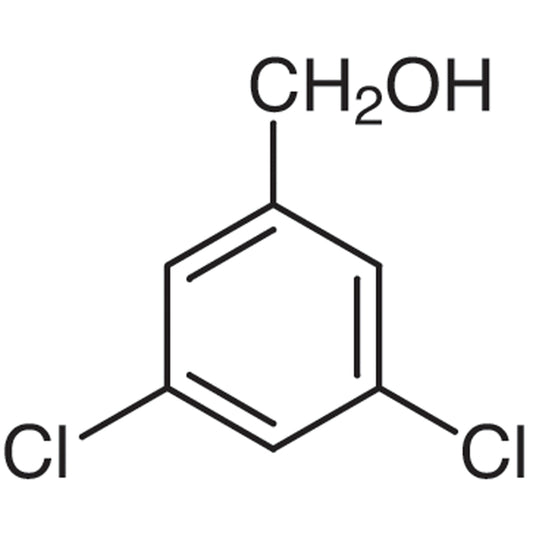
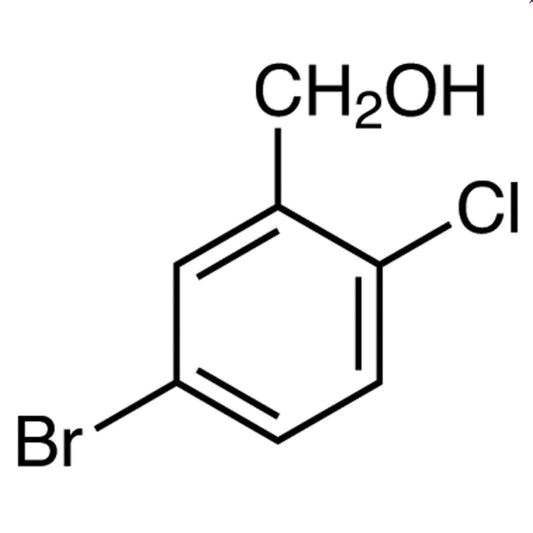
2,6-Dichlorobenzyl Alcohol is a benzylic alcohol with two chlorine atoms in the ortho positions, one on each side of the hydroxymethyl group. Laboratory catalogues classify it as a non-heterocyclic building block, meaning a starting material for assembling more complex chlorinated aromatic molecules. This TCI product, catalogue code D1747, comes in a 25 g pack. That quantity covers a range of synthesis experiments, method development work and laboratory-scale analytical tasks, so researchers can run repeated trials from a single supply.
The compound's character comes from the two chlorine atoms that flank the CH2OH group. This arrangement creates steric hindrance and electronic effects that change how the benzylic alcohol reacts. The hydroxyl group can still be oxidised to the aldehyde or carboxylic acid, converted into a benzylic halide, or turned into esters and ethers. Because the 2,6 substitution pattern is so crowded, the compound is useful to researchers who want to compare reactivity across compounds with different degrees of steric hindrance. TCI brand quality helps keep results consistent from one experiment to the next.
In Indonesian laboratories, 2,6-Dichlorobenzyl Alcohol is relevant to organic chemistry and medicinal chemistry research groups, and to analytical laboratories at universities and research institutions. Synthetic chemists can use it as an entry point to chlorinated aromatic targets. Teaching and research laboratories can use it to study how ortho substitution affects benzylic reactivity, and analytical teams can include it in method development work that calls for a well-defined chlorinated aromatic alcohol from a recognised supplier.
Related TCI products
- Oxidation studies: the benzylic hydroxyl group can be oxidised to the corresponding aldehyde or carboxylic acid, which gives access to further 2,6-dichlorinated aromatic intermediates.
- Benzylic halide preparation: the alcohol can be converted into a benzylic halide, a more reactive intermediate for later substitution and coupling steps in multistep synthesis.
- Ester and ether formation: the hydroxyl group can form esters and ethers, so researchers can attach the 2,6-dichlorobenzyl unit to other molecular frameworks under laboratory conditions.
- Steric hindrance comparison studies: the crowded 2,6 substitution pattern makes the compound a useful reference for comparing reactivity among benzylic alcohols with different levels of steric hindrance.
- Medicinal chemistry and method development: as a non-heterocyclic building block, it supports the assembly of chlorinated aromatic candidates and laboratory-scale analytical method work in research settings.
| Brand | TCI (product code D1747) |
|---|---|
| CAS number | 15258-73-8 |
| Molecular formula | — |
| Purity | — |
| Category | Chemistry > Building Blocks > Non-Heterocyclic Building Blocks |
| Pack sizes | 25 g |
| Physical form | see the manufacturer's label and certificate of analysis |
| Storage | keep tightly closed in a cool, dry, well-ventilated place, following the manufacturer's safety data sheet |
Keep 2,6-Dichlorobenzyl Alcohol in its original, tightly closed container in a cool, dry, well-ventilated area, away from heat sources, direct sunlight and incompatible materials such as strong oxidising agents. Reseal the container promptly after each use so the contents are not exposed to moisture or contaminated. Handle the material in a fume hood or a well-ventilated area, and wear suitable personal protective equipment, including chemical-resistant gloves, safety glasses and a laboratory coat. Avoid inhaling dust or vapour and avoid contact with skin and eyes. Before use, read the manufacturer's safety data sheet for hazard information, first-aid measures and disposal requirements. Dispose of waste according to institutional and local regulations for chlorinated organic compounds.
—
Produk Terkait
-
3,5-DichlorobenzylAlcohol TCI D3791
Regular price From Rp 689.850,00Regular priceRp 481.950,00Sale price From Rp 689.850,00 -
2,3-DichlorobenzylAlcohol TCI D2425
Regular price Rp 1.087.800,00Regular priceRp 760.200,00Sale price Rp 1.087.800,00 -
2,4-DichlorobenzylAlcohol TCI D1837
Regular price Rp 1.035.300,00Regular priceRp 723.450,00Sale price Rp 1.035.300,00 -
3,4-DichlorobenzylAlcohol TCI D1748
Regular price Rp 1.988.700,00Regular priceRp 1.390.200,00Sale price Rp 1.988.700,00 -
5-Bromo-2-chlorobenzylAlcohol TCI B3946
Regular price From Rp 743.400,00Regular priceRp 519.750,00Sale price From Rp 743.400,00 -
2,6-DichlorobenzylMethylEther TCI D2109
Regular price Rp 1.193.850,00Regular priceRp 834.750,00Sale price Rp 1.193.850,00 -
3-ChlorobenzylAlcohol TCI C0650
Regular price Rp 1.510.950,00Regular priceRp 1.056.300,00Sale price Rp 1.510.950,00 -
4-ChlorobenzylAlcohol TCI C0565
Regular price Rp 1.565.550,00Regular priceRp 1.094.100,00Sale price Rp 1.565.550,00