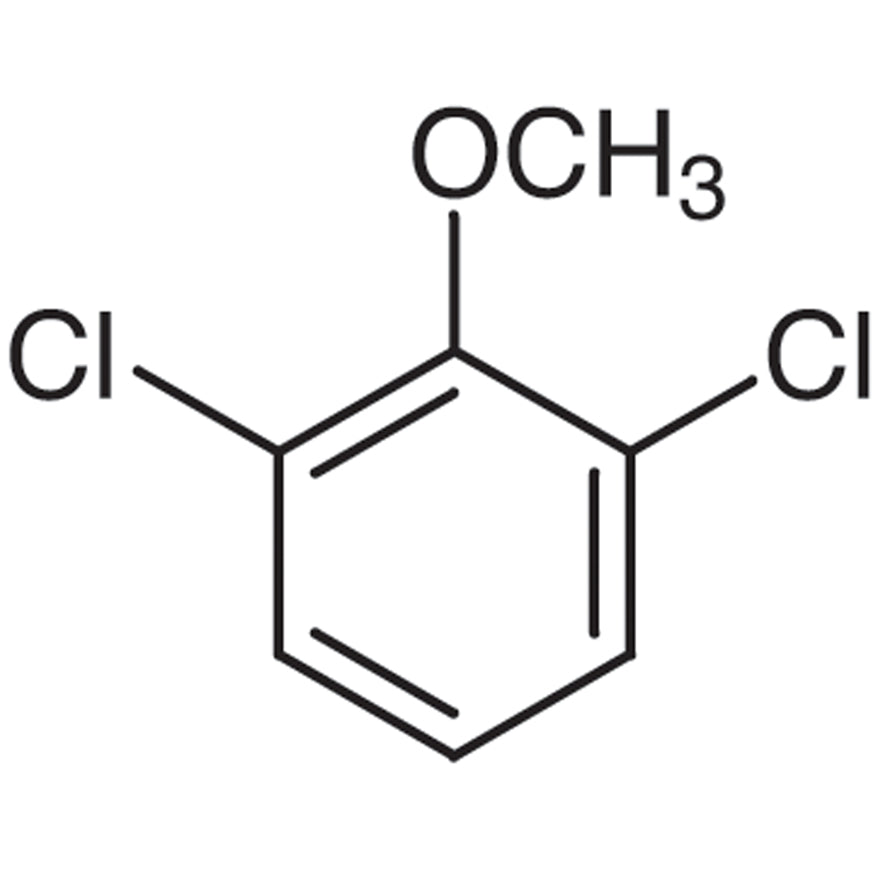
2,6-Dichloroanisole is a chemical compound widely used as a foundational building block in various chemical reactions. It plays a crucial role in organic chemistry laboratories, where it serves as a versatile intermediate for the synthesis of complex molecules. This compound is particularly valuable for its ability to participate in electrophilic substitution and reduction reactions, making it an essential tool for chemists seeking to modify molecular structures. Its presence in non-heterocyclic building blocks highlights its importance in the development of diverse chemical compounds.
The unique properties of 2,6-Dichloroanisole make it a preferred choice for laboratory use. The presence of two chlorine atoms at positions 2 and 6 imparts electron-withdrawing characteristics, enhancing the reactivity of the molecule. This electronic effect allows it to engage in a wide range of chemical transformations, including nucleophilic substitution and aromatic ring modifications. Its stable molecular structure ensures predictable behavior under various reaction conditions, which is vital for reproducibility in scientific research.
In Indonesian laboratories, 2,6-Dichloroanisole is commonly used in scientific research, especially in the fields of organic chemistry and pharmaceutical development. It is a key component in the synthesis of bioactive compounds that require specific structural features. Its availability and reliability make it a staple in both academic and industrial research settings, supporting the creation of new chemical entities and drug candidates.
- Organic synthesis applications benefit from 2,6-Dichloroanisole due to its ability to undergo electrophilic substitution, making it ideal for creating complex molecular structures.
- Pharmaceutical research utilizes this compound for the development of bioactive molecules requiring specific functional groups and structural modifications.
- Chemical modification processes rely on 2,6-Dichloroanisole for its reactivity in reduction and substitution reactions, enabling the synthesis of diverse compounds.
- Analytical chemistry laboratories use it as a reference standard for identifying and quantifying compounds in various samples.
- Industrial chemical production incorporates it as a building block for the creation of specialized chemicals and intermediates.
| Brand | TCI |
|---|---|
| CAS number | 1984-65-2 |
| Molecular formula | — |
| Purity | — |
| Category | Chemistry > Building Blocks > Non-Heterocyclic Building Blocks |
| Pack sizes | Available in various quantities as per standard laboratory supply |
| Physical form | Solid |
| Storage | Store in a cool, dry place away from light and moisture |
2,6-Dichloroanisole should be stored in a cool, dry environment, away from direct sunlight and moisture. It is recommended to use airtight containers to prevent exposure to air and humidity, which could affect its stability. Due to its chemical nature, it should be handled in a well-ventilated area, and appropriate personal protective equipment, such as gloves and safety goggles, should be worn. Avoid contact with incompatible substances, and ensure proper disposal in accordance with local regulations. Regular monitoring of storage conditions is advised to maintain the integrity of the compound.
—
Produk Terkait
-
2,5-Dichloroanisole TCI D2605
Regular price From Rp 1.035.300,00Regular price -
2,3-Dichloroanisole TCI D2306
Regular price From Rp 1.908.900,00Regular price -
2,4-Dichloroanisole TCI D0326
Regular price Rp 3.738.000,00Regular price -
2-Bromo-5-chloroanisole TCI B3646
Regular price From Rp 2.041.200,00Regular price -
2-Bromo-4-chloroanisole TCI B3111
Regular price From Rp 505.050,00Regular price -
5-Bromo-2-chloroanisole TCI B3001
Regular price From Rp 903.000,00Regular price -
2,4,6-Trichloroanisole TCI T0867
Regular price From Rp 1.431.150,00Regular price -
3-Chloroanisole TCI C1148
Regular price Rp 505.050,00Regular price