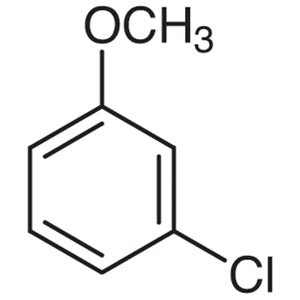
2,5-Dichloroanisole (TCI D2605) is an aromatic ether made of a benzene ring that carries a methoxy group and two chlorine atoms at the 2 and 5 positions. In the laboratory it is classed as a non-heterocyclic building block, meaning a starting material for building more complex substituted aromatic molecules. Its fixed substitution pattern is useful when researchers need a benzene ring with halogen and oxygen groups already in defined positions, so they do not have to introduce each group one at a time.
Each part of the molecule offers its own route for further chemistry. With a catalyst system suited to aryl chlorides, both chlorine atoms can act as reactive sites in transition-metal-catalysed cross-coupling, such as Suzuki or Buchwald-Hartwig reactions. The methoxy group donates electrons and can steer electrophilic substitution or directed metalation toward particular ring positions. If a free phenol is needed, the methoxy group can be removed by demethylation, for example with boron tribromide, to give 2,5-dichlorophenol. Because of these features, one starting material supports several synthetic pathways.
In Indonesia, this compound is relevant to university and research-institute laboratories that work on organic synthesis, medicinal chemistry, and materials research. Research groups that build substituted aromatic scaffolds can use it as a well-defined starting point when designing and testing new routes. It also suits teaching laboratories and graduate projects that study cross-coupling, aromatic substitution, or protecting-group strategies, where a known halogen and methoxy pattern helps students interpret their results with confidence.
- Suzuki cross-coupling studies: both aryl chloride positions can form new carbon-carbon bonds when a catalyst system suited to aryl chlorides is used, so substituted biaryl structures can be built.
- Buchwald-Hartwig amination: the chlorine atoms can serve as coupling sites for forming carbon-nitrogen bonds, which helps when preparing substituted aromatic amines from a single defined precursor.
- Directed metalation and electrophilic substitution: the electron-donating methoxy group helps direct further functionalisation to specific ring positions, giving researchers control over where new substituents are placed.
- Preparation of 2,5-dichlorophenol: demethylation, for example with boron tribromide, removes the methyl group and leaves the free phenol for later steps such as etherification or esterification.
- Synthetic route design and teaching: the compound has a predictable halogen and methoxy layout, so it makes a clear model substrate for comparing reaction conditions and for training students in aromatic synthesis.
| Brand | TCI (product code D2605) |
|---|---|
| CAS number | 1984-58-3 |
| Molecular formula | — |
| Purity | — |
| Category | Chemistry > Building Blocks > Non-Heterocyclic Building Blocks |
| Pack sizes | as listed on the product page for this item |
| Physical form | refer to the TCI product documentation and Safety Data Sheet |
| Storage | keep tightly closed in a cool, dry, well-ventilated place, following the manufacturer's label |
Store 2,5-Dichloroanisole in its original, tightly sealed manufacturer's container in a cool, dry, well-ventilated area, away from direct sunlight, heat sources, and strong oxidising agents. Use well-sealed glass containers that are clearly labelled with the name and CAS number if the material needs to be transferred. Handle it in a fume hood and wear standard protective equipment, including a lab coat, chemical-resistant gloves, and safety glasses. Do not inhale vapours or dust, and avoid contact with skin and eyes. Before use, read the TCI Safety Data Sheet for specific hazard, first-aid, and disposal information. Dispose of halogenated organic waste according to your institution's procedures and local regulations.
—
Produk Terkait
-
2,3-Dichloroanisole TCI D2306
Regular price From Rp 1.868.000,00Regular priceRp 1.271.000,00Sale price From Rp 1.868.000,00 -
2,6-Dichloroanisole TCI D1782
Regular price Rp 2.439.000,00Regular priceRp 1.659.000,00Sale price Rp 2.439.000,00 -
2,4-Dichloroanisole TCI D0326
Regular price Rp 3.658.000,00Regular priceRp 2.489.000,00Sale price Rp 3.658.000,00 -
2-Bromo-5-chloroanisole TCI B3646
Regular price From Rp 1.998.000,00Regular priceRp 1.359.000,00Sale price From Rp 1.998.000,00 -
2-Bromo-4-chloroanisole TCI B3111
Regular price From Rp 494.000,00Regular priceRp 336.000,00Sale price From Rp 494.000,00 -
5-Bromo-2-chloroanisole TCI B3001
Regular price From Rp 883.000,00Regular priceRp 601.000,00Sale price From Rp 883.000,00 -
2,4,6-Trichloroanisole TCI T0867
Regular price From Rp 1.402.000,00Regular priceRp 953.000,00Sale price From Rp 1.402.000,00 -
3-Chloroanisole TCI C1148
Regular price Rp 494.000,00Regular priceRp 336.000,00Sale price Rp 494.000,00