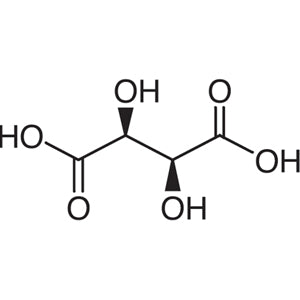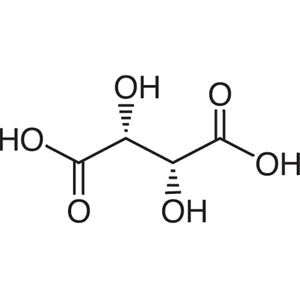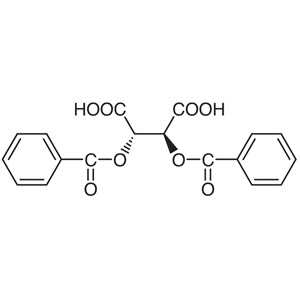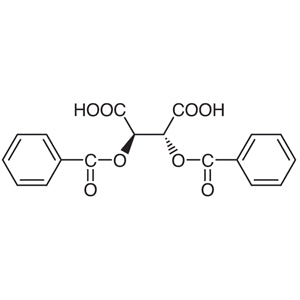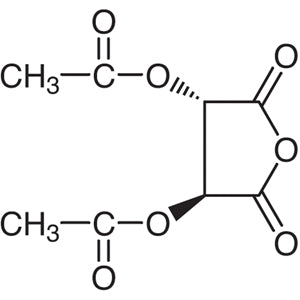


(-)-Dipivaloyl-L-tartaric Acid (TCI D2686) is a derivative of L-tartaric acid. Both of its hydroxyl groups are esterified with pivaloyl (trimethylacetyl) groups, and its two carboxylic acid groups stay free. The compound is classed as a chiral building block and an asymmetric synthesis reagent. Laboratories know it best as a chiral resolving agent, used to separate racemic mixtures into their individual enantiomers. This matters because the two enantiomers of a drug compound can have very different biological activities.
Chemists choose this compound because it pairs the natural chiral backbone of tartaric acid, whose configuration is already defined, with large, lipophilic pivaloyl groups. When the acid reacts with a racemic amine, it forms two diastereomeric salts. The bulky pivaloyl groups can widen the differences in properties between those salts, and the resulting difference in solubility lets one diastereomer crystallize first. Its solubility profile also differs from that of other tartaric acid derivatives such as the dibenzoyl and di-p-toluoyl analogues. That makes it a useful alternative when other resolving agents have not given a satisfactory separation.
In Indonesian laboratories, this reagent is mainly used in university research groups working on organic and medicinal chemistry, in pharmaceutical research and development units, and in synthesis laboratories that need enantiomerically enriched intermediates. Researchers often include it in a screening set of tartaric acid-based resolving agents when developing a resolution method for a new racemic amine. It also serves in teaching and research on stereochemistry and asymmetric synthesis.
TCI brochures (PDF)
- Asymmetric Synthesis 2026-03-18 · p. 6
- Chiral Building Blocks 2025-04-14 · p. 13
- Chiral resolution of racemic amines: the free carboxylic acid groups form diastereomeric salts with amines, and the differing solubilities of those salts allow separation by selective crystallization.
- Screening of resolving agents: its solubility profile differs from dibenzoyl and di-p-toluoyl tartaric acids, which makes it a practical additional candidate when those agents fail to separate a mixture cleanly.
- Preparation of enantiomerically enriched pharmaceutical intermediates: separating enantiomers is essential because the two forms of a drug compound may show very different biological activity.
- Chiral building block in asymmetric synthesis: the defined configuration of the natural L-tartaric acid backbone gives a reliable stereochemical starting point for building more complex chiral molecules.
- Stereochemistry research and teaching: the compound clearly shows how a defined chiral acid and bulky ester groups combine to amplify the differences between diastereomers in crystallization experiments.
| Brand | TCI (product code D2686) |
|---|---|
| CAS number | 65259-81-6 |
| Molecular formula | — |
| Purity | — |
| Category | Chemistry > Asymmetric Synthesis > Chiral Building Blocks |
| Pack sizes | see the available options on the product listing |
| Physical form | refer to the TCI product documentation and certificate of analysis |
| Storage | keep in a tightly closed container in a cool, dry place; follow the TCI label and SDS |
Store (-)-Dipivaloyl-L-tartaric Acid in its original, tightly sealed container, in a cool, dry, well-ventilated area away from direct sunlight, moisture, and heat sources. Keep it apart from strong bases and strong oxidizing agents. Because the compound is an ester derivative, protect it from prolonged contact with humid air to help preserve its quality. Before use, read the Safety Data Sheet supplied by TCI. Wear standard laboratory protective equipment, including safety glasses, gloves, and a lab coat. Handle the material in a fume hood or a well-ventilated area to avoid inhaling dust, and avoid contact with skin and eyes. Reseal the container promptly after each use. Dispose of residues according to institutional and local chemical waste regulations.
—
Produk Terkait
-
(+)-Dipivaloyl-D-tartaricAcid TCI D2702
Regular price From Rp 871.500,00Regular priceRp 609.000,00Sale price From Rp 871.500,00 -
D-(-)-TartaricAcid TCI T0026
Regular price From Rp 1.006.950,00Regular priceRp 701.400,00Sale price From Rp 1.006.950,00 -
L-(+)-TartaricAcid TCI T0025
Regular price From Rp 543.900,00Regular priceRp 386.400,00Sale price From Rp 543.900,00 -
(+)-Dibenzoyl-D-tartaricAcid TCI D3826
Regular price From Rp 927.150,00Regular priceRp 631.050,00Sale price From Rp 927.150,00 -
(-)-Dibenzoyl-L-tartaricAcid TCI D3492
Regular price From Rp 1.116.150,00Regular priceRp 775.950,00Sale price From Rp 1.116.150,00 -
(-)-Di-p-anisoyl-L-tartaricAcid TCI D3491
Regular price Rp 3.021.900,00Regular priceRp 2.072.700,00Sale price Rp 3.021.900,00 -
(+)-Di-p-anisoyl-D-tartaricAcid TCI D3490
Regular price From Rp 790.650,00Regular priceRp 537.600,00Sale price From Rp 790.650,00 -
(-)-Diacetyl-D-tartaricAnhydride TCI D2645
Regular price From Rp 763.350,00Regular priceRp 519.750,00Sale price From Rp 763.350,00