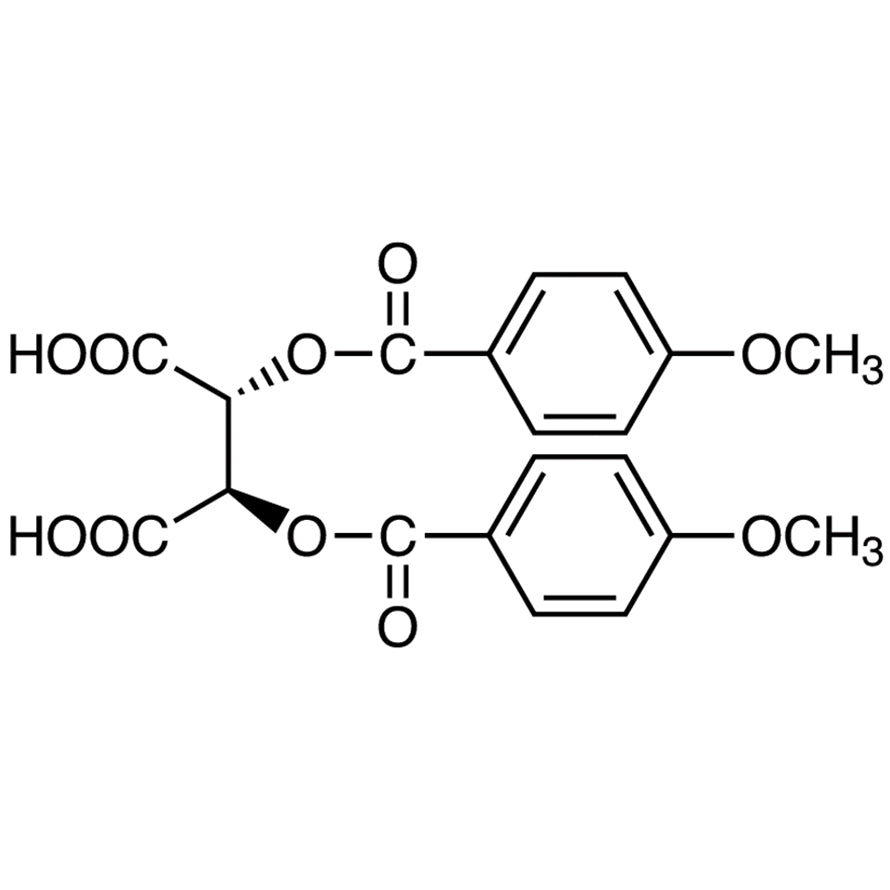
TCI D3491 is (−)-di-p-anisoyl-L-tartaric acid, the enantiomeric counterpart of the D-derivative and an L-configured tartaric acid in which both hydroxyl groups have been esterified with 4-methoxybenzoyl groups. The compound belongs to the chiral building block family and is most frequently employed as a chiral resolving agent for separating racemic mixtures, particularly organic bases such as amines. Its working principle rests on the formation of two diastereomeric salts that differ in solubility in a given solvent, so that one diastereomer can be crystallised selectively and the target enantiomer subsequently liberated.
The properties that make this compound a preferred choice are the rigidity of the tartrate backbone paired with electron-rich aroyl groups. The methoxy substituents on the aromatic rings enhance the ability of the ester groups to interact through aromatic stacking and hydrogen bonding, which in turn leads to the formation of a more clearly defined crystal lattice in the diastereomeric salt. Because the reagent is available in the L form as the opposite of the D form, researchers can select the reagent that precipitates the desired enantiomer without having to redesign the overall process.
That kind of flexibility is valuable in Indonesian laboratories, where a single resolution protocol often has to serve several substrates across academic and industrial projects. Research groups working on asymmetric synthesis, pharmaceutical intermediates, and fine chemical development can keep one established crystallisation workflow and simply switch between the L and D reagents according to which enantiomer is required, reducing method development time and simplifying reagent management in the laboratory.
TCI brochures (PDF)
- Chiral Building Blocks 2025-04-14 · p. 13
- Resolution of racemic amines — the reagent forms diastereomeric salts with organic bases whose differing solubilities allow the desired enantiomer to be crystallised out selectively.
- Chiral building block in asymmetric synthesis — the defined L configuration of the tartrate backbone provides a reliable stereochemical starting point for constructing enantiomerically enriched target molecules.
- Preparation of enantiopure pharmaceutical intermediates — many drug substances are chiral bases, and selective salt crystallisation with this reagent yields the single enantiomer required for further steps.
- Complementary resolution alongside the D-derivative — laboratories can precipitate either enantiomer by simply switching reagents, keeping the same solvent system and crystallisation procedure unchanged.
- Method development for crystallisation-based separations — the electron-rich anisoyl groups promote aromatic stacking and hydrogen bonding, producing well-defined salt lattices that make screening solvent conditions more predictable.
| Brand | TCI |
|---|---|
| CAS number | 50583-51-2 |
| Molecular formula | — |
| Purity | — |
| Category | Chemistry > Asymmetric Synthesis > Chiral Building Blocks |
| Pack sizes | available in standard catalogue pack sizes; please refer to the ordering options for this product |
| Physical form | — |
| Storage | store in a cool, dry place in a tightly closed container |
- Product Code: D3491
- Chemical Name: (−)-Di-p-anisoyl-L-tartaric Acid
Store the material in a cool, dry, well-ventilated area away from direct sunlight, moisture, and incompatible substances such as strong bases and strong oxidising agents. Keep it in the original tightly closed container, or in a chemically resistant amber glass or suitable plastic container that is clearly labelled with the product name and CAS number. Handle the solid inside a fume hood where practical to limit dust generation, and wear standard personal protective equipment including safety goggles, chemically resistant gloves, and a laboratory coat. Weigh and transfer with clean, dry spatulas to avoid contamination and moisture uptake, close the container immediately after use, and wash hands thoroughly after handling. Dispose of residues and contaminated materials in accordance with institutional chemical waste procedures, and consult the manufacturer's safety data sheet before first use.
—
Produk Terkait
-
(+)-Di-p-anisoyl-D-tartaricAcid TCI D3490
Regular price From Rp 769.650,00Regular price -
D-(-)-TartaricAcid TCI T0026
Regular price From Rp 928.200,00Regular price -
L-(+)-TartaricAcid TCI T0025
Regular price From Rp 477.750,00Regular price -
(+)-Dibenzoyl-D-tartaricAcid TCI D3826
Regular price From Rp 903.000,00Regular price -
(-)-Dibenzoyl-L-tartaricAcid TCI D3492
Regular price From Rp 1.035.300,00Regular price -
(+)-Dipivaloyl-D-tartaricAcid TCI D2702
Regular price From Rp 795.900,00Regular price -
(-)-Dipivaloyl-L-tartaricAcid TCI D2686
Regular price From Rp 1.565.550,00Regular price -
(-)-Diacetyl-D-tartaricAnhydride TCI D2645
Regular price From Rp 743.400,00Regular price