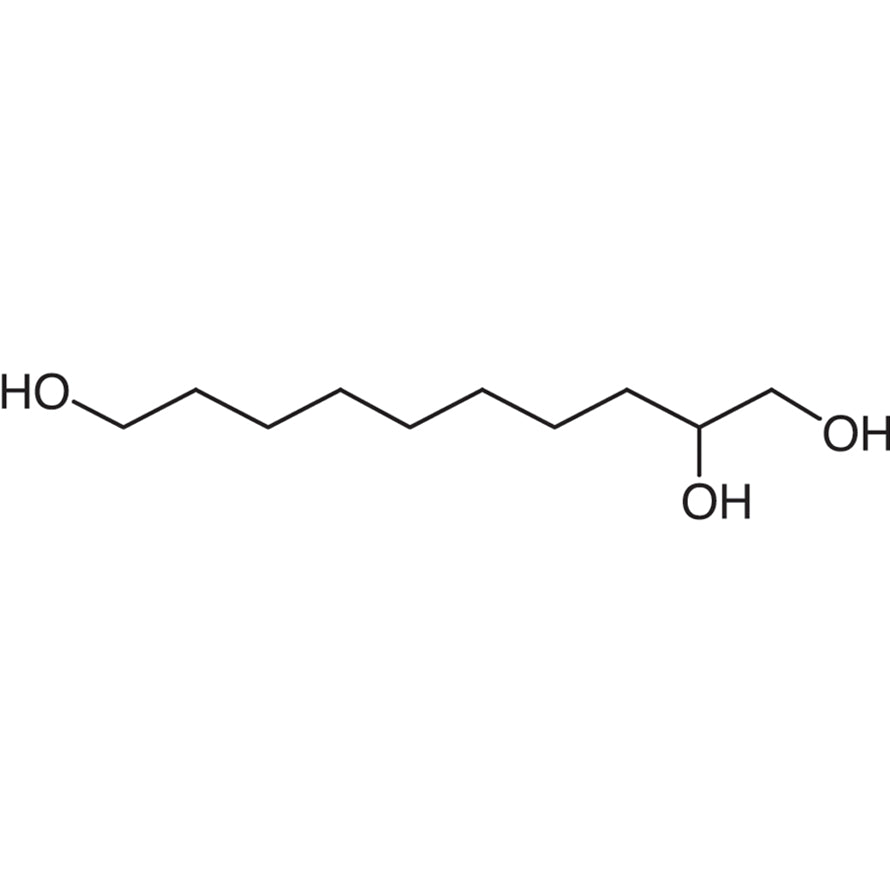
TCI D2721 1,2,10-Decanetriol is an aliphatic ten-carbon compound carrying three hydroxyl groups: two of them are adjacent to one another at positions 1 and 2, while the third sits at the far end of the chain at position 10. As a non-heterocyclic building block, it offers an uncommon combination — a single molecule with three reactive points distributed across different distances. In the laboratory, materials of this kind are used to build branched polymer networks, to assemble amphiphilic molecules with large polar head groups, and to study selective reactions at hydroxyl groups placed in different chemical environments.
The property that makes this compound a preferred choice is the spatial separation of its hydroxyl groups. The 1,2-diol pair can be protected together as a cyclic acetal, leaving the hydroxyl at position 10 free to be reacted separately. Selective protection strategies of this type are highly useful in multi-step synthesis. Three hydroxyl groups also mean strong hydrogen-bonding capability and greater polarity than a simple diol, so the compound interacts readily with aqueous media. In polymer chemistry, triol molecules act as branching points or network junctions rather than as simple linear extenders.
In Indonesian laboratories, a building block of this type is typically used in academic and institutional research settings where multi-step organic synthesis, polymer formulation, and surfactant or amphiphile studies are carried out. It is handled on a research scale rather than a production scale, weighed out for individual reactions and protection–deprotection sequences. Researchers working on branched polyol systems, coating precursors, and structure–reactivity studies of differentiated hydroxyl groups are the usual users of this material.
- Branched polymer network synthesis — the three hydroxyl groups let a single molecule act as a network junction, introducing branching points that a linear diol cannot provide.
- Amphiphilic molecule construction — the polyol end of the ten-carbon chain forms a large polar head group while the hydrocarbon backbone supplies the hydrophobic segment needed for surfactant-type structures.
- Selective protection and deprotection studies — the 1,2-diol pair can be masked together as a cyclic acetal, leaving the terminal position-10 hydroxyl available for independent, sequential transformation.
- Multi-step organic synthesis intermediates — the differentiated spacing of the reactive sites allows chemists to plan stepwise routes where each hydroxyl group is addressed at a separate stage.
- Hydrogen-bonding and polarity investigations — three hydroxyl groups give the molecule strong hydrogen-bonding capability and higher polarity than simple diols, supporting studies of interaction with aqueous media.
| Brand | TCI |
|---|---|
| CAS number | 91717-85-0 |
| Molecular formula | — |
| Purity | — |
| Category | Chemistry > Building Blocks > Non-Heterocyclic Building Blocks |
| Pack sizes | available in standard TCI research-scale packaging; please confirm the pack size when ordering |
| Physical form | — |
| Storage | keep in a tightly closed original container as indicated on the manufacturer's label |
- Product code: D2721
- Chemical name: 1,2,10-Decanetriol
Store the material in its tightly closed original container in a cool, dry, well-ventilated area, away from direct sunlight, heat sources, and incompatible reagents. Because polyols readily form hydrogen bonds and can take up atmospheric moisture, containers should be resealed promptly after each use and kept protected from humidity. Follow the storage conditions stated on the manufacturer's label and safety data sheet. Handle in a fume hood using standard laboratory personal protective equipment — safety glasses, gloves, and a laboratory coat — and avoid contact with skin and eyes as well as inhalation of dust or vapour. Use clean, dry spatulas and glassware when weighing to prevent contamination, and dispose of residues in accordance with institutional chemical waste procedures.
—
Produk Terkait
-
1,2,3-Butanetriol TCI B0918
Regular price From Rp 8.374.800,00Regular price -
1,2,5-Pentanetriol TCI P1350
Regular price From Rp 3.021.900,00Regular price -
1,2,8-Octanetriol TCI O0279
Regular price Rp 9.223.200,00Regular price -
1,2,9-Nonanetriol TCI N0652
Regular price Rp 12.136.950,00Regular price -
1,2,6-Hexanetriol TCI H1069
Regular price From Rp 1.246.350,00Regular price -
1,2,7-Heptanetriol TCI H0957
Regular price Rp 9.646.350,00Regular price -
1,2,6-Hexanetriol TCI H0104
Regular price From Rp 1.087.800,00Regular price -
(1alpha,3alpha,5alpha)-1,3,5-Cyclohexanetriol TCI C2275
Regular price From Rp 5.857.950,00Regular price