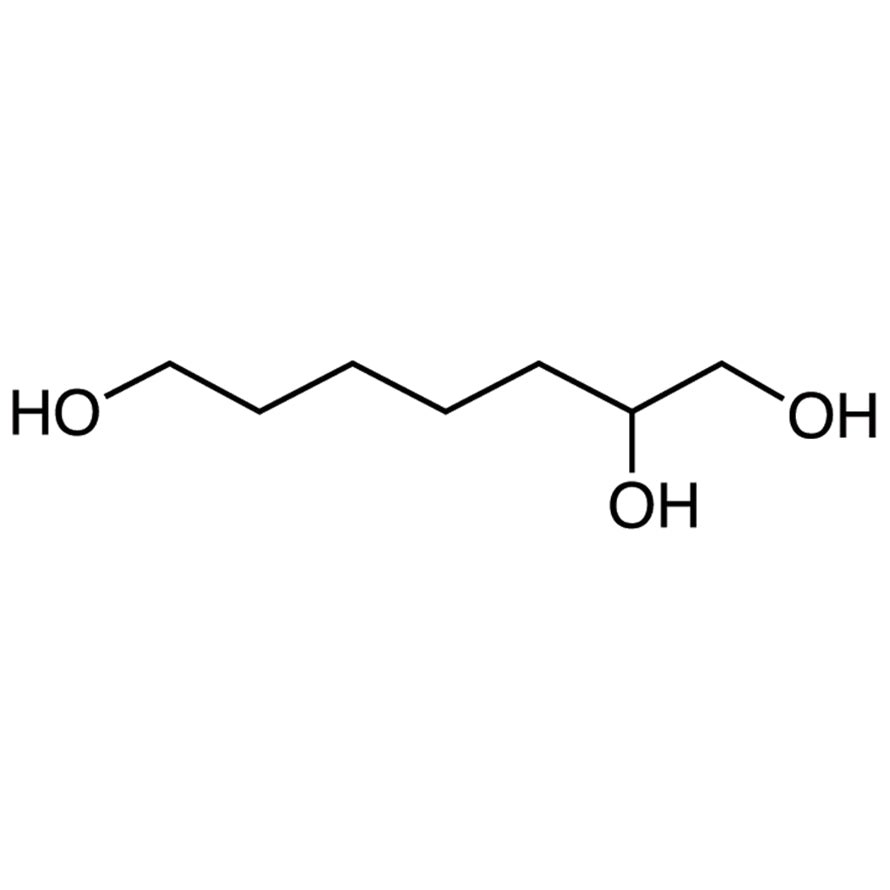
1,2,7-Heptanetriol is a chemical compound widely utilized in laboratory settings as a foundational building block for various chemical reactions. This triol contains three hydroxyl groups positioned at different sites along the heptane chain, making it a versatile molecule in synthetic chemistry. Its unique structure allows it to participate in multiple reaction pathways, enabling the creation of complex organic compounds and polymers. As a key reagent, it supports the development of new materials and chemical processes in both academic and industrial research environments.
The compound’s polar nature and solubility in organic solvents such as ethyl acetate and acetone make it a preferred choice for chemical synthesis. These properties facilitate its use in reactions requiring molecular interactions and compatibility with a range of reagents. Additionally, its chemical stability under controlled conditions enhances its reliability in laboratory applications. The reactivity of 1,2,7-Heptanetriol also makes it suitable for the synthesis of compounds with specific structural requirements, further expanding its utility in organic chemistry.
In Indonesian laboratories, 1,2,7-Heptanetriol is commonly used in chemical research and development. It is integral to experiments involving organic synthesis, material innovation, and reactivity studies. Many research institutions and universities rely on this compound for their experimental work, particularly in the creation of new chemical substances and the exploration of molecular behavior. Its availability through AMI Scientific ensures that it remains a valuable resource for scientific inquiry in the region.
- Organic synthesis applications benefit from 1,2,7-Heptanetriol’s reactivity and structural versatility, enabling the creation of complex organic molecules.
- Polymer development often utilizes this triol due to its ability to form cross-linked structures, enhancing the properties of synthetic materials.
- Chemical reactivity studies rely on its predictable behavior in various reaction conditions, making it ideal for investigating molecular interactions.
- Material innovation research leverages its unique functional groups to design new compounds with tailored properties for industrial use.
- Academic research in chemistry frequently incorporates this compound to explore synthetic pathways and chemical transformations in laboratory settings.
| Brand | TCI |
|---|---|
| CAS number | 37939-50-7 |
| Molecular formula | — |
| Purity | — |
| Category | Chemistry > Building Blocks > Non-Heterocyclic Building Blocks |
| Pack sizes | Available in 500g and 1kg |
| Physical form | Colorless liquid |
| Storage | Store in a cool, dry place away from direct sunlight |
1,2,7-Heptanetriol should be stored in a cool, dry environment to maintain its chemical stability. It is recommended to keep it in a tightly sealed container to prevent exposure to moisture and air. Due to its polar nature, it is advisable to use glass or polyethylene containers that are resistant to chemical degradation. Laboratory personnel should handle the compound with care, using appropriate personal protective equipment such as gloves and safety goggles. It is important to ensure proper ventilation in the workspace to minimize inhalation of vapors. Regular monitoring of storage conditions will help preserve the integrity of the compound for extended use in chemical experiments.
—
Produk Terkait
-
1,2,3-Butanetriol TCI B0918
Regular price From Rp 8.374.800,00Regular price -
1,2,8-Octanetriol TCI O0279
Regular price Rp 9.223.200,00Regular price -
1,2,5-Pentanetriol TCI P1350
Regular price From Rp 3.021.900,00Regular price -
1,2,9-Nonanetriol TCI N0652
Regular price Rp 12.136.950,00Regular price -
1,2,6-Hexanetriol TCI H1069
Regular price From Rp 1.246.350,00Regular price -
1,2,6-Hexanetriol TCI H0104
Regular price From Rp 1.087.800,00Regular price -
1,2,10-Decanetriol TCI D2721
Regular price Rp 6.201.300,00Regular price -
(1alpha,3alpha,5alpha)-1,3,5-Cyclohexanetriol TCI C2275
Regular price From Rp 5.857.950,00Regular price