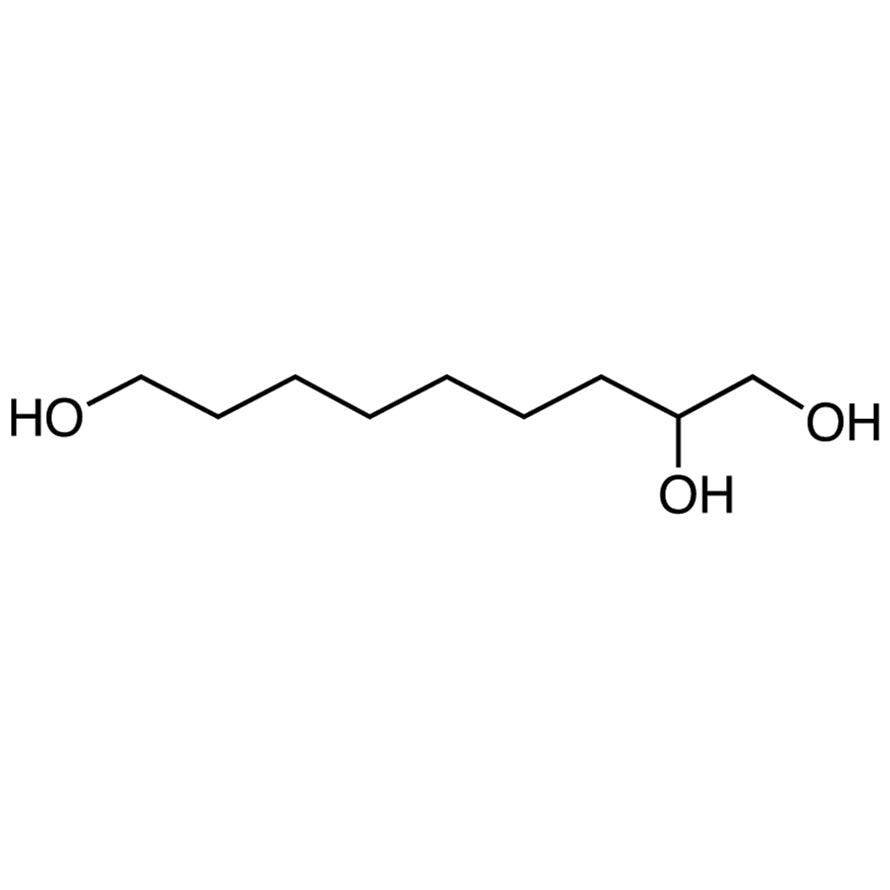
1,2,9-Nonanetriol from TCI is a straight-chain aliphatic compound with nine carbon atoms and three hydroxyl groups. Two of the hydroxyl groups sit next to each other at positions 1 and 2, forming a vicinal diol. The third is a primary hydroxyl group at the far end of the chain, at position 9. The compound is classed as a non-heterocyclic building block. In organic synthesis laboratories, it serves as an intermediate for building more complex molecules, especially those that need a medium-length hydrocarbon chain with several points for functionalization.
The main advantage of this compound is that its hydroxyl groups sit in different positions along the chain. The vicinal diol at one end can be selectively protected as a cyclic acetal or ketal. This leaves the primary hydroxyl group at the other end free for oxidation, esterification, or conversion into a leaving group. As a result, researchers have more freedom to plan the order of their synthetic steps. The nine-carbon chain also balances hydrophobic and hydrophilic character, which is useful when designing amphiphilic molecules, linkers, and surfactant precursors.
In Indonesia, this material suits organic chemistry laboratories at universities, research institutions, and industrial research and development units. It fits academic projects that explore multistep synthesis and protecting-group strategies. It also fits applied research programs that study amphiphilic compounds or new linker designs. AMI Scientific supplies TCI building blocks such as this one so that Indonesian laboratories can get consistent, well-characterized starting materials for their synthetic work.
- Multistep organic synthesis: its three hydroxyl groups give the compound several places to react, so it works well as an intermediate for building more complex molecular structures step by step.
- Protecting-group strategy studies: the vicinal diol can be protected as a cyclic acetal or ketal while the terminal primary hydroxyl stays free, which makes it a practical model for selective protection.
- Selective functionalization of primary alcohols: once the diol end is protected, the position-9 hydroxyl can be oxidized, esterified, or turned into a leaving group without affecting the rest of the molecule.
- Design of amphiphilic molecules: the nine-carbon chain balances hydrophobic and hydrophilic character, so it is a useful starting framework for molecules that need both properties.
- Development of linkers and surfactant precursors: the medium-length chain with hydroxyl groups at both ends lets researchers join molecular fragments or build surfactant-like structures in a controlled way.
| Brand | TCI (product code N0652) |
|---|---|
| CAS number | 382631-42-7 |
| Molecular formula | — |
| Purity | — |
| Category | Chemistry > Building Blocks > Non-Heterocyclic Building Blocks |
| Pack sizes | see the pack options listed on the product page |
| Physical form | see the manufacturer's certificate of analysis and product label |
| Storage | follow the storage conditions given on the TCI label and Safety Data Sheet |
Store 1,2,9-Nonanetriol in its original, tightly closed container in a cool, dry, well-ventilated place. Keep it away from direct sunlight, heat sources, and incompatible materials such as strong oxidizing agents. Always follow the storage conditions on the TCI label and in the Safety Data Sheet. Close the container promptly after each use so the material does not pick up moisture. When handling, wear the usual laboratory protective equipment, including safety glasses, gloves, and a lab coat. Work in a well-ventilated area or a fume hood, avoid contact with skin and eyes, and dispose of waste according to local regulations and your institution's procedures.
—
Produk Terkait
-
1,2,3-Butanetriol TCI B0918
Regular price From Rp 8.374.800,00Regular price -
1,2,5-Pentanetriol TCI P1350
Regular price From Rp 3.021.900,00Regular price -
1,2,8-Octanetriol TCI O0279
Regular price Rp 9.223.200,00Regular price -
1,2,6-Hexanetriol TCI H1069
Regular price From Rp 1.246.350,00Regular price -
1,2,7-Heptanetriol TCI H0957
Regular price Rp 9.646.350,00Regular price -
1,2,6-Hexanetriol TCI H0104
Regular price From Rp 1.087.800,00Regular price -
1,2,10-Decanetriol TCI D2721
Regular price Rp 6.201.300,00Regular price -
(1alpha,3alpha,5alpha)-1,3,5-Cyclohexanetriol TCI C2275
Regular price From Rp 5.857.950,00Regular price