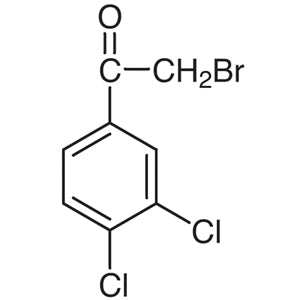
2,4-Dichlorophenacyl Bromide is a chemical compound widely used as a building block in organic synthesis. It serves as a key reagent in various laboratory processes, particularly in reactions involving halogen substitution or the formation of aromatic compounds. This compound is essential for the development of bioactive substances, pharmaceuticals, and industrial chemicals. Its versatility makes it a valuable asset in chemical research, where it is employed to create complex molecular structures through nucleophilic or electrophilic substitution reactions.
The compound's reactivity and stability make it a preferred choice for synthetic chemists. It exhibits good solubility in organic solvents, which simplifies purification and separation processes in the lab. Its molecular structure allows it to participate in a wide range of chemical transformations, making it suitable for applications requiring halogenated substrates. The ease with which it reacts enables researchers to efficiently synthesize target compounds under controlled conditions.
In Indonesian laboratories, 2,4-Dichlorophenacyl Bromide is commonly used in organic chemistry research, especially in the synthesis of bioactive compounds. It is a standard reagent in academic and industrial research settings, supporting studies related to drug development and chemical innovation. Its reliability and effectiveness make it a staple in chemical laboratories across Indonesia, contributing to the advancement of scientific research.
- Organic synthesis for the preparation of bioactive compounds due to its reactivity and halogenated structure.
- Halogen substitution reactions where a brominated aromatic compound is required for further functionalization.
- Pharmaceutical research as a building block in the development of new drug molecules and therapeutic agents.
- Industrial chemical production for the creation of specialty chemicals and intermediates.
- Aromatic compound formation in reactions that require electrophilic or nucleophilic substitution mechanisms.
| Brand | TCI |
|---|---|
| CAS number | 2631-72-3 |
| Molecular formula | — |
| Purity | — |
| Category | Chemistry > Building Blocks > Non-Heterocyclic Building Blocks |
| Pack sizes | Available in standard laboratory quantities as per supplier specifications |
| Physical form | Solid or liquid depending on the batch and storage conditions |
| Storage | Store in a cool, dry place away from light and incompatible materials |
This compound should be stored in a cool, dry environment, away from direct sunlight and sources of heat. It is recommended to use airtight containers made of glass or high-density polyethylene to prevent contamination and moisture ingress. Due to its reactivity, it should be handled in a well-ventilated area, preferably under a fume hood, to minimize exposure. Avoid contact with incompatible substances such as strong bases or reducing agents. Always wear appropriate personal protective equipment, including gloves, safety goggles, and a lab coat, when handling this material. Proper storage and handling are essential to maintain its chemical integrity and ensure safe laboratory practices.
—
Produk Terkait
-
3,4-DichlorophenacylBromide TCI B2837
Regular price From Rp 1.140.300,00Regular price -
4-ChlorophenacylBromide TCI B0568
Regular price From Rp 1.167.600,00Regular price -
4-ChlorophenacylChloride TCI C1306
Regular price From Rp 743.400,00Regular price -
AcetylBromide TCI A0080
Regular price From Rp 689.850,00Regular price -
ValerylBromide TCI V0038
Regular price Rp 2.386.650,00Regular price -
3-BromophenacylBromide TCI B4125
Regular price From Rp 1.115.100,00Regular price -
2-BromophenacylBromide TCI B4124
Regular price From Rp 1.908.900,00Regular price -
3-CyanophenacylBromide TCI B4079
Regular price Rp 7.049.700,00Regular price