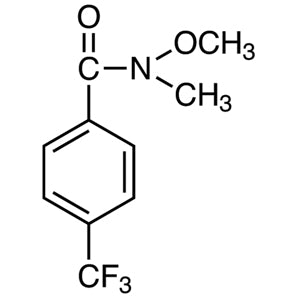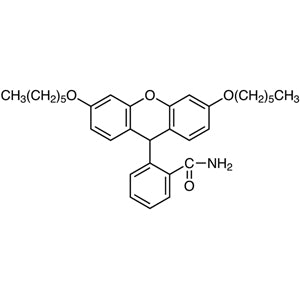
TCI D4142, 2-(3,6-Dihexyloxyxanthen-9-yl)benzamide (CAS 1820618-83-4), is an organic compound belonging to the class of stains and dyes intended for research and experimental use. It is built on a xanthene framework, the classic chromophore core of the fluorescent dye family. The molecule carries two hexyloxy chains at positions 3 and 6 of the xanthene ring, together with a benzamide group at position 9. In the laboratory, compounds with this architecture are used as dye materials, dye precursors, or components within optical imaging and sensing systems under development by chemistry and materials research groups.
What makes this compound attractive is the combination of a xanthene core rich in conjugation with two long alkoxy chains. The conjugated system of the xanthene framework is responsible for absorption in the visible region and for potential luminescence, while the hexyloxy chains improve solubility in organic solvents and non-polar matrices and at the same time reduce the tendency of the molecules to aggregate. The benzamide group at position 9 completes the structure with a polar segment capable of hydrogen bonding, which can influence the equilibrium between molecular forms as well as the optical response of the compound.
In Indonesian laboratories, a material of this kind is typically handled in university and institutional research settings rather than in routine analysis. It is dissolved in organic solvents and used at small scale for preparing dye solutions, for testing optical behaviour, or as an intermediate in the synthesis of new functional dye derivatives. Because it is designated for research and experimental use, it is normally requested by chemistry, materials, and applied-photonics groups working on imaging and sensing projects.
Related TCI products
- TCI T3474 1891-90-3 4-(Trifluoromethyl)benzamide
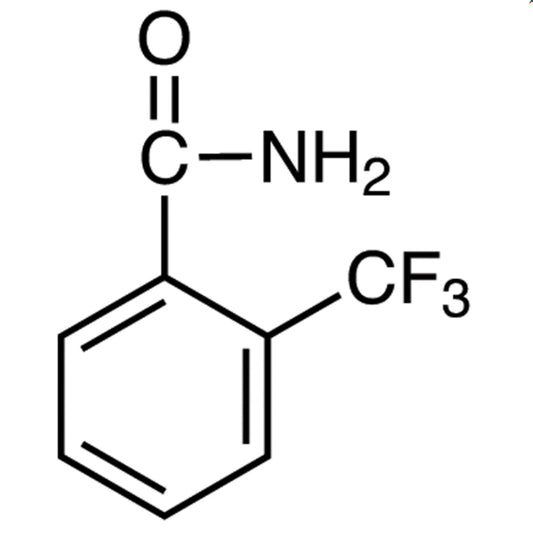
- TCI T3384 360-64-5 2-(Trifluoromethyl)benzamide
- TCI B1882 22227-26-5 3,5-Bis(trifluoromethyl)benzamide
- TCI B0220 55-21-0 Benzamide Zone Refined (number of passes:20)
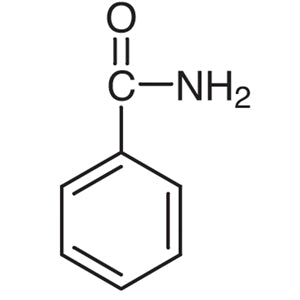
- TCI B0012 55-21-0 Benzamide
- TCI A2897 1451042-18-4 N-(2-Aminophenyl)-4-[1-[2-(3-thienyl)ethyl]-1H-1,2,3-triazol-4-yl]benzamide
- Fluorescent dye preparation — the xanthene chromophore core provides the conjugated system that underlies visible-light absorption and potential luminescence needed for dye solutions.
- Dye precursor synthesis — the benzamide group at position 9 and the xanthene scaffold together offer defined reactive positions for building new functional dye derivatives.
- Optical imaging system development — research groups incorporate compounds of this architecture into imaging platforms where a xanthene-based chromophore response is required.
- Optical sensing studies — the polar, hydrogen-bonding benzamide group can shift the equilibrium between molecular forms, making the optical response sensitive to its chemical environment.
- Non-polar matrix and thin-film work — the two long hexyloxy chains raise solubility in organic media and limit intermolecular aggregation when the dye is dispersed in a matrix.
| Brand | TCI |
|---|---|
| CAS number | 1820618-83-4 |
| Molecular formula | — |
| Purity | — |
| Category | Chemistry > Stains and Dyes (for Research and Experimental Use) > Stains and Dyes (Other) (for Research and Experimental Use) |
| Pack sizes | available in standard TCI research-scale packaging; please confirm the currently offered size when ordering |
| Physical form | — |
| Storage | keep in the tightly closed original container, protected from light and moisture |
- Chemical name: 2-(3,6-Dihexyloxyxanthen-9-yl)benzamide
Store the compound in its original tightly closed container in a cool, dry, well-ventilated place, protected from direct light and from moisture, since xanthene-based dyes are generally sensitive to prolonged light exposure. Amber glass or the supplier's original packaging is suitable; keep the container sealed between uses to avoid moisture uptake. Handle the material only in a laboratory setting with adequate ventilation or in a fume hood, wearing gloves, safety glasses, and a lab coat. Avoid raising dust when weighing, use clean dry spatulas to prevent contamination, and consult the manufacturer's safety data sheet before use. This product is intended for research and experimental use only, not for diagnostic or therapeutic purposes.
—
Produk Terkait
-
4-(Trifluoromethyl)benzamide TCI T3474
Regular price Rp 823.200,00Regular price -
2-(Trifluoromethyl)benzamide TCI T3384
Regular price From Rp 637.350,00Regular price -
3,5-Bis(trifluoromethyl)benzamide TCI B1882
Regular price Rp 5.539.800,00Regular price -
BenzamideZoneRefined(numberofpasses:20) TCI B0220
Regular price Rp 2.332.050,00Regular price -
Benzamide TCI B0012
Regular price From Rp 584.850,00Regular price -
N-(2-Aminophenyl)-4-[1-[2-(3-thienyl)ethyl]-1H-1,2,3-triazol-4-yl]benzamide TCI A2897
Regular price Rp 3.525.900,00Regular price -
N-(Prop-2-yn-1-yl)benzamide TCI P3113
Regular price From Rp 2.094.750,00Regular price -
N-Methoxy-N-methyl-4-(trifluoromethyl)benzamide TCI M2762
Regular price Rp 1.565.550,00Regular price




![1451042-18-4 N-(2-Aminophenyl)-4-[1-[2-(3-thienyl)ethyl]-1H-1,2,3-triazol-4-yl]benzamide - AMI Scientific](http://amiscientific.com/cdn/shop/files/TCI2510A2897.jpg?v=1769141462&width=533)