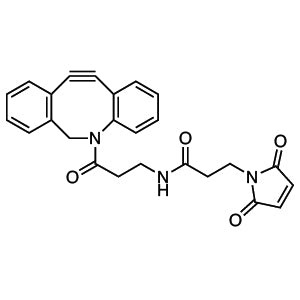
DBCO-maleimide is a chemical compound widely used in conjugation chemistry and click chemistry applications within laboratory settings. It plays a crucial role in enabling specific molecular linkages, making it an essential tool for biochemical reactions. This compound is particularly valuable in research involving the connection of biomolecules such as proteins, peptides, and nanoparticles. Its ability to form stable and selective bonds under controlled conditions makes it indispensable in various scientific investigations.
The high reactivity and specificity of DBCO-maleimide make it a preferred choice for researchers. It selectively reacts with maleimide groups, allowing the formation of strong and durable bonds. This property ensures reliable results in complex chemical systems. Additionally, its stability under typical laboratory conditions simplifies handling and storage, contributing to its widespread use. The compound’s consistent performance across different experimental setups enhances its reliability in scientific research.
In Indonesian laboratories, DBCO-maleimide is commonly used in biomedical, pharmacological, and biomaterial-related research. Its unique chemical properties make it ideal for applications requiring precise molecular conjugation. Researchers in Indonesia rely on this compound for developing advanced techniques in bioconjugation and molecular engineering. Its availability and performance have made it a standard choice in many research projects across the country.
Advantages (TCI brochure)
- Copper-free click reaction with azides due to strained azacyclooctyne moiety
TCI brochures (PDF)
- Copper-free Click Reaction Linkers 2026-04-30 · p. 1
- Cross-linkers 2026-04-14 · p. 2
- Bioconjugation Reagents 2026-07-07 · p. 4
- Click Chemistry 2026-09-08 · p. 17
- Reagents for Biological Research 2025-03-11 · p. 29
Related TCI products
- TCI B4062 1263166-93-3 N-(1R,8S,9s)-Bicyclo[6.1.0]non-4-yn-9-ylmethyloxycarbonyl-1,8-diamino-3,6-dioxaoctane
- TCI D5849 1395786-30-7 DBCO-maleimide (2mg*5)
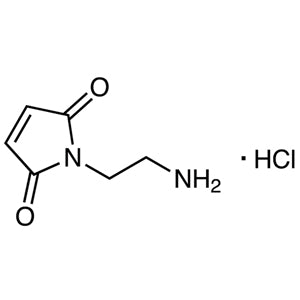
- TCI A2436 134272-64-3 N-(2-Aminoethyl)maleimide Hydrochloride
- TCI H1544 1585-90-6 N-(2-Hydroxyethyl)maleimide
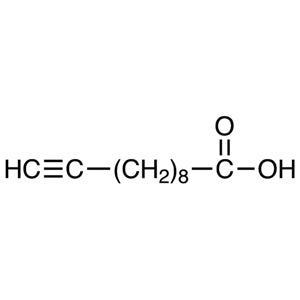
- TCI U0054 2777-65-3 10-Undecynoic Acid
- TCI T3114 208827-90-1 Triethylene Glycol Mono(2-propynyl) Ether
- Biomedical research utilizes DBCO-maleimide for conjugating biomolecules, enabling targeted drug delivery and diagnostic applications.
- Pharmacological studies benefit from its ability to form stable linkages between therapeutic agents and biological targets.
- Biomaterial development relies on this compound to attach functional groups to surfaces, enhancing material properties.
- Molecular imaging applications use DBCO-maleimide to label and track biomolecules within complex biological systems.
- Nanoparticle functionalization employs this compound to attach targeting ligands, improving the specificity and efficacy of nanomedicine.
From the TCI brochure
- Reacts with an azide (N3-R) to give a triazole product
| Brand | TCI |
|---|---|
| CAS number | 1395786-30-7 |
| Molecular formula | — |
| Purity | — |
| Category | Chemistry > Chemical Biology > Conjugation Chemistry/Click Chemistry |
| Pack sizes | — |
| Physical form | — |
| Storage | Store in a cool, dry place away from light |
Data from the TCI brochure
| Pelarut reaksi | EtOH/DMSO (Reaksi dengan N3-R seperti pada skema brosur) |
|---|
Source: TCI brochure RR062 (2026-04-30)
DBCO-maleimide should be stored in a cool, dry environment, away from direct light and sources of heat. It is recommended to keep the compound in a sealed container to prevent moisture absorption and contamination. Proper ventilation is essential when handling the material to minimize exposure. Due to its chemical reactivity, it should be handled with appropriate personal protective equipment, such as gloves and safety goggles. Storage conditions should ensure stability and maintain the compound's effectiveness for laboratory use. Regular inspection of storage conditions is advised to ensure the integrity of the product.
References cited in the TCI brochure
- Helen L. Evans. Bioorthogonal chemistry for 68Ga radiolabelling of DOTA‐containing compounds Journal of Labelled Compounds and Radiopharmaceuticals, 2013. doi:10.1002/jlcr.3153
Product Categories
- Chemical BiologyConjugation Chemistry/Click ChemistryCrosslinker Azides/Alkynes [Conjugation Chemistry/Click Chemistry]
- Chemical BiologyConjugation Chemistry/Click ChemistryCopper-free Click Reaction Reagents
- Chemical BiologyLinkers and CrosslinkersHeterobifunctional Cross-Linkers
- Chemical BiologyBioconjugationCopper-free Click Reaction Reagents
- Chemical BiologyBioconjugationHeterobifunctional Cross-Linkers
- Specialty Synthesis
- Pharmaceutical Development and Drug Discovery Research ReagentsLinkers and CrosslinkersHeterobifunctional Cross-Linkers
- Biochemicals and ReagentsBioconjugationCopper-free Click Reaction Reagents
- Biochemicals and ReagentsBioconjugationHeterobifunctional Cross-Linkers
- Pharmaceutical Development and Drug Discovery ResearchBioconjugationCopper-free Click Reaction Reagents
- Pharmaceutical Development and Drug Discovery ResearchBioconjugationHeterobifunctional Cross-Linkers
- Pharmaceutical Development and Drug Discovery ResearchLinkers and CrosslinkersHeterobifunctional Cross-Linkers
- Pharmaceutical Development and Drug Discovery ResearchConjugation Chemistry/Click ChemistryCrosslinker Azides/Alkynes [Conjugation Chemistry/Click Chemistry]
- Pharmaceutical Development and Drug Discovery ResearchConjugation Chemistry/Click ChemistryCopper-free Click Reaction Reagents
Produk Terkait
-
N-(1R,8S,9s)-Bicyclo[6.1.0]non-4-yn-9-ylmethyloxycarbonyl-1,8-diamino-3,6-dioxaoctane TCI B4062
Regular price From Rp 4.399.500,00Regular price -
DBCO-maleimide(2mg*5) TCI D5849
Regular price Rp 6.042.750,00Regular price -
N-(2-Aminoethyl)maleimideHydrochloride TCI A2436
Regular price From Rp 3.446.100,00Regular price -
N-(2-Hydroxyethyl)maleimide TCI H1544
Regular price From Rp 3.312.750,00Regular price -
10-UndecynoicAcid TCI U0054
Regular price From Rp 1.008.000,00Regular price -
TriethyleneGlycolMono(2-propynyl)Ether TCI T3114
Regular price From Rp 2.411.850,00Regular price -
4-PentynoicAcid TCI P2341
Regular price From Rp 1.538.250,00Regular price -
Propargyl-PEG5-NHSEster TCI P2283
Regular price Rp 4.213.650,00Regular price
![1263166-93-3 N-(1R,8S,9s)-Bicyclo[6.1.0]non-4-yn-9-ylmethyloxycarbonyl-1,8-diamino-3,6-dioxaoctane - AMI Scientific](http://amiscientific.com/cdn/shop/files/TCI2510B4062_d8124249-9a3f-43c3-aba1-176f03bda357.jpg?v=1767435179&width=533)