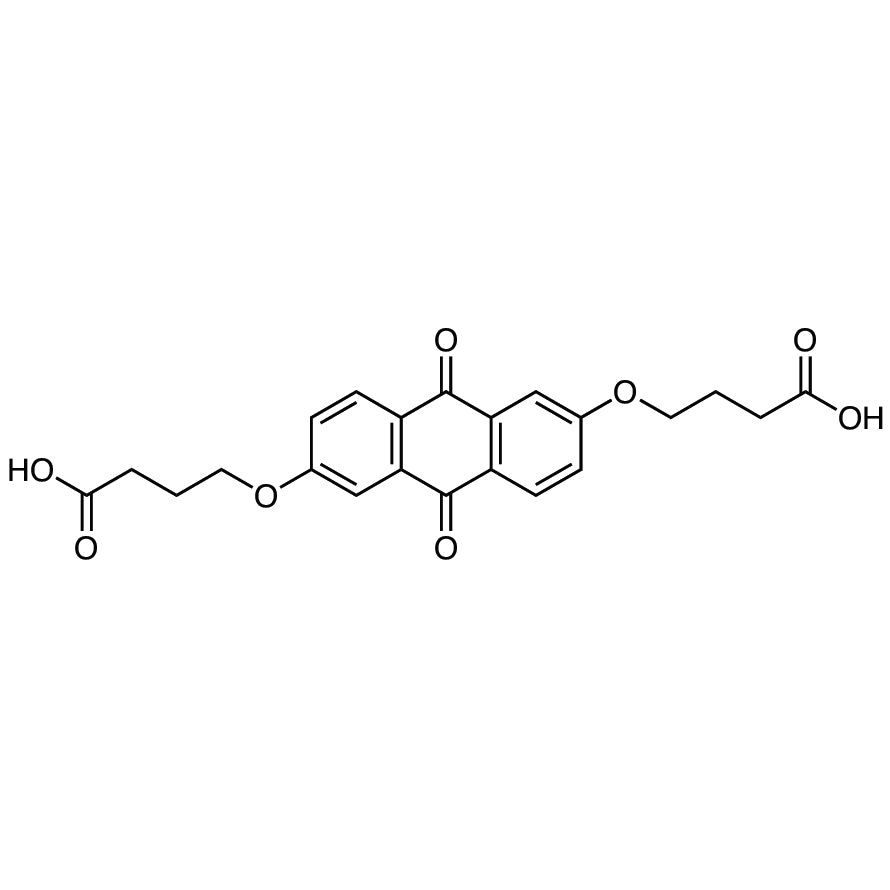
TCI D5764, chemically identified as 2,6-DBEAQ (CAS 2370885-20-2), is a functional anthraquinone-derived material developed specifically as an electrolyte material for organic redox flow batteries. In a redox flow cell, energy is stored in electrolyte solutions that are pumped through a cell stack, and it is the redox-active molecule itself that determines the voltage, capacity, and durability of the system. In the laboratory, 2,6-DBEAQ is used as the active species on the negolyte side of aqueous-based solutions, allowing researchers to assemble test cells, measure cycling performance, and study degradation mechanisms without having to synthesize the active material themselves.
The characteristics that make this material attractive begin with its anthraquinone core, which is capable of undergoing a reversible two-electron redox reaction. This core is combined with side-chain groups carrying carboxylate functionality, which substantially increases solubility in alkaline aqueous solutions. High solubility means the energy density of the electrolyte solution can be raised, while the molecular structure — substituted at the 2 and 6 positions — helps suppress the side reactions that typically drive capacity loss over extended cycling. Because it is supplied as a solid with a clearly defined chemical identity, the material can be weighed and formulated into electrolyte solutions with a reproducible starting composition.
In Indonesian laboratories, this material is typically used within university research groups, national research institutes, and corporate R&D units working on energy storage. It supports work on aqueous organic flow battery chemistry, electrolyte formulation studies, and electrochemical characterization programs. Because it arrives as a defined solid rather than a prepared solution, laboratories can prepare their own concentrations and supporting electrolytes, adapting each experiment to the specific cell configuration and research question under investigation.
TCI brochures (PDF)
- Battery Research Reagents 2026-09-18 · p. 7
Related TCI products
- TCI A0308 853-68-9 Disodium Anthraquinone-2,6-disulfonate
- TCI V0139 13388-33-5 2-Vinylanthraquinone
- TCI V0137 1612793-07-3 2,2'-(2-Vinylanthracene-9,10-diylidene)dimalononitrile
- TCI V0136 736998-56-4 2,2'-(2-Vinylanthracene-9,10-diylidene)bis(1,3-dithiole)
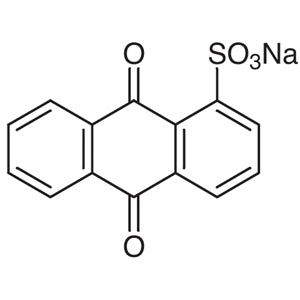
- TCI A1428 128-56-3 Sodium Anthraquinone-1-sulfonate
- TCI A0506 853-35-0 Anthraquinone-1,5-disulfonic Acid Disodium Salt
- Aqueous organic redox flow battery negolyte formulation — serves as the redox-active species dissolved in alkaline aqueous electrolyte, giving researchers a defined starting material for building working test cells.
- Electrochemical characterization studies — suitable for cyclic voltammetry and related techniques used to establish redox potential and reversibility of the two-electron anthraquinone couple in aqueous media.
- Cycling performance and capacity retention testing — the 2,6-substituted structure suppresses common side reactions, making it appropriate for long-duration cycling experiments that evaluate electrolyte stability over time.
- Degradation mechanism research — because the compound has a clearly defined chemical identity, decomposition pathways and capacity fade behaviour can be attributed to the molecule itself rather than to synthesis variability.
- Energy density and solubility optimization work — the carboxylate side-chain functionality supports high solubility in alkaline solution, enabling systematic studies of concentration effects on stored electrolyte energy density.
| Brand | TCI (Tokyo Chemical Industry) |
|---|---|
| CAS number | 2370885-20-2 |
| Molecular formula | — |
| Purity | — |
| Category | Materials Science > Battery Materials > Organic Redox Flow Battery Materials |
| Pack sizes | — |
| Physical form | supplied as a solid; pack sizes available on request |
| Storage | store according to the manufacturer's stated conditions on the product label and safety data sheet |
- Product code: D5764
- Chemical name: 2,6-DBEAQ, an anthraquinone derivative bearing carboxylate-functional side chains
Store the material in its original tightly closed container, kept in a cool, dry, and well-ventilated area away from direct sunlight, moisture, and incompatible chemicals. Follow the storage temperature and conditions stated by the manufacturer on the product label and safety data sheet. Handle the solid in a fume hood or well-ventilated workspace using standard personal protective equipment, including a laboratory coat, chemical-resistant gloves, and safety glasses. Weigh and transfer the material with clean, dry spatulas and glassware to avoid contamination that could affect electrochemical results. Keep containers closed when not in use, label all prepared electrolyte solutions clearly, and dispose of residues and used solutions in accordance with local laboratory waste regulations and institutional chemical safety procedures.
—
Produk Terkait
-
DisodiumAnthraquinone-2,6-disulfonate TCI A0308
Regular price From Rp 5.300.400,00Regular priceRp 3.722.250,00Sale price From Rp 5.300.400,00 -
2-Vinylanthraquinone TCI V0139
Regular price From Rp 2.384.550,00Regular priceRp 1.683.150,00Sale price From Rp 2.384.550,00 -
2,2'-(2-Vinylanthracene-9,10-diylidene)dimalononitrile TCI V0137
Regular price Rp 2.571.450,00Regular priceRp 1.813.350,00Sale price Rp 2.571.450,00 -
2,2'-(2-Vinylanthracene-9,10-diylidene)bis(1,3-dithiole) TCI V0136
Regular price From Rp 3.472.350,00Regular priceRp 2.443.350,00Sale price From Rp 3.472.350,00 -
SodiumAnthraquinone-1-sulfonate TCI A1428
Regular price From Rp 1.192.800,00Regular priceRp 849.450,00Sale price From Rp 1.192.800,00 -
Anthraquinone-1,5-disulfonicAcidDisodiumSalt TCI A0506
Regular price Rp 2.359.350,00Regular priceRp 1.665.300,00Sale price Rp 2.359.350,00 -
DipotassiumAnthraquinone-1,8-disulfonate TCI A0505
Regular price Rp 1.696.800,00Regular priceRp 1.202.250,00Sale price Rp 1.696.800,00 -
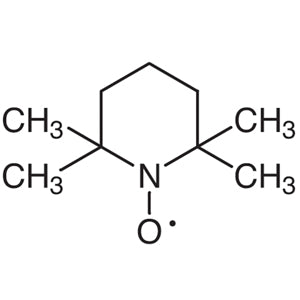
2,2,6,6-Tetramethylpiperidine1-OxylFreeRadical TCI T1560
Regular price From Rp 1.590.750,00Regular priceRp 1.111.950,00Sale price From Rp 1.590.750,00