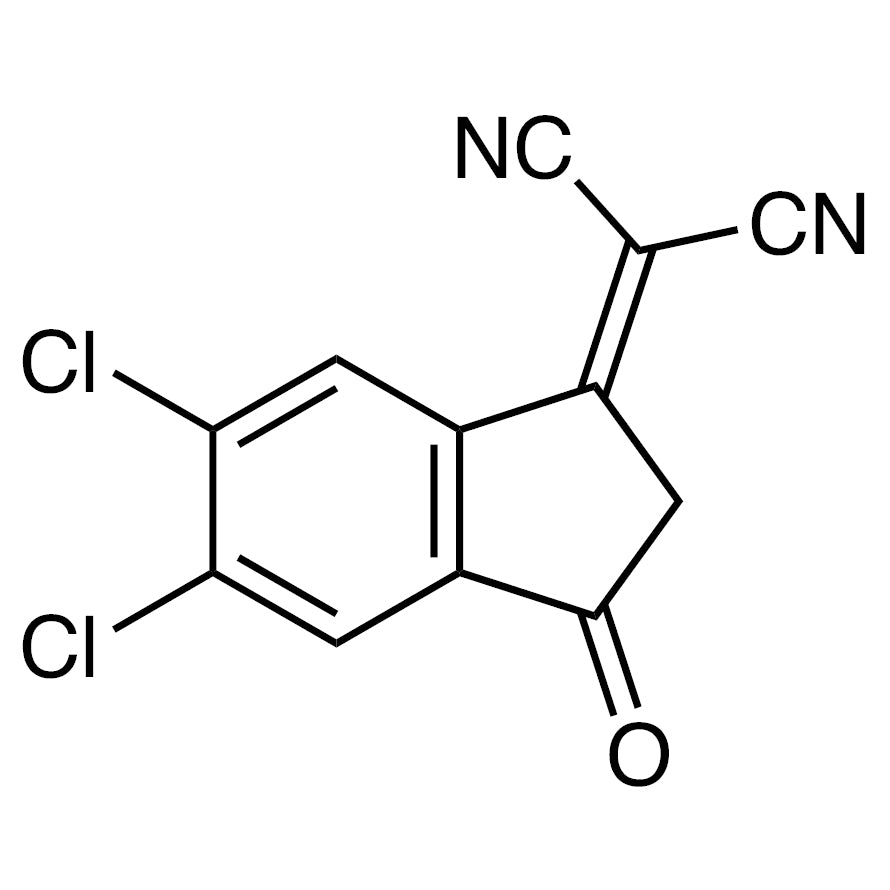
5,6-Dichloro-3-oxo-2,3-dihydro-1H-inden-1-ylidene)malononitrile is a specialized chemical compound widely used in materials science research, particularly in the development of organic semiconductors. This compound serves as a foundational building block for creating complex molecular structures with tailored electronic properties. In laboratory settings, it is essential for synthesizing materials that require precise chemical functionality and structural versatility. Its unique chemical composition makes it a versatile tool for researchers aiming to design advanced semiconductor materials.
The compound's chemical structure features two chlorine atoms at positions 5 and 6, along with two nitrile groups at the molecular ends. These structural elements contribute to its high reactivity and compatibility with various functional groups, making it ideal for synthetic applications. The presence of nitrile groups enhances its ability to participate in chemical reactions, while the chlorine atoms provide additional stability and reactivity control. These properties make it a preferred choice for organic synthesis and material development.
In Indonesian laboratories, this compound is commonly used in semiconductor research and the development of new materials. It is a key component in experiments focused on creating organic electronic materials with specific optical and electrical properties. Its role in scientific innovation is critical, supporting both academic and industrial research in materials science. Researchers rely on its unique chemical profile to achieve desired outcomes in their experimental work.
Advantages (TCI brochure)
- Commonly used building block for non-fullerene acceptor (NFA) materials
- Properties of NFA materials can be tuned by the atoms they contain
TCI brochures (PDF)
- Building Blocks for Organic Semiconducting Non-Fullerene Acceptor Materials 2023-12-28 · p. 1
- Electron-Accepting Building Blocks for Charge Transport Materials 2023-10-20 · p. 1
- Building Blocks for Organic Semiconductor 2026-03-24 · p. 34
Related TCI products
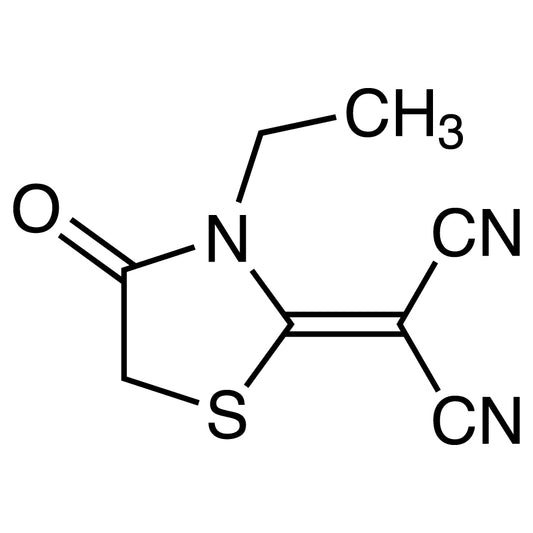
- TCI E1549 623558-68-9 2-(3-Ethyl-4-oxothiazolidin-2-ylidene)malononitrile
- TCI D5815 2083617-82-5 (5,6-Difluoro-3-oxo-2,3-dihydro-1H-inden-1-ylidene)malononitrile
- TCI D5028 6267-02-3 9,10-Dihydro-9,9-dimethylacridine
- TCI T4113 23051-44-7 2-(3,5,5-Trimethylcyclohex-2-en-1-ylidene)malononitrile
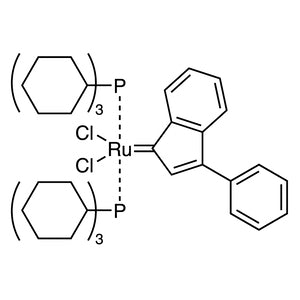
- TCI P2004 250220-36-1 (3-Phenyl-1H-inden-1-ylidene)bis(tricyclohexylphosphine)ruthenium(II) Dichloride
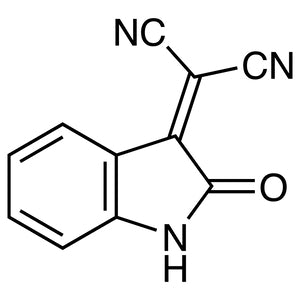
- TCI O0670 6623-89-8 2-(2-Oxoindolin-3-ylidene)malononitrile
- Organic Semiconductor Development: This compound is used to create organic semiconductors with tailored electronic properties, supporting research in optoelectronics and flexible electronics.
- Molecular Structure Synthesis: Its unique chemical structure allows for the synthesis of complex molecules with specific functional groups, enhancing material versatility.
- Material Stability Testing: The compound's reactivity and stability make it suitable for testing material performance under various chemical conditions.
- Functional Group Modification: The presence of nitrile groups enables modification of other functional groups, expanding the range of possible material applications.
- Research in Advanced Electronics: It is utilized in the development of next-generation electronic materials, including sensors and energy storage devices.
From the TCI brochure
- Non-fullerene acceptor (NFA) materials
- Organic solar cells
| Brand | TCI |
|---|---|
| CAS number | 2197167-50-1 |
| Molecular formula | — |
| Purity | — |
| Category | Materials Science > Material Building Blocks > Small Molecule Semiconductor Building Blocks |
| Pack sizes | 50 g |
| Physical form | Solid |
| Storage | Store in a cool, dry place away from light and moisture |
This compound should be stored in a cool, dry environment, away from direct light and moisture to maintain its chemical integrity. It is recommended to use airtight containers made of glass or high-density polyethylene to prevent contamination and degradation. Due to its reactivity, it should be handled with appropriate personal protective equipment, including gloves and safety goggles. Avoid exposure to incompatible substances such as strong acids or bases. In laboratory settings, ensure proper ventilation and follow standard chemical safety protocols to minimize risks. Regular monitoring of storage conditions is advised to ensure optimal performance and safety.
—
Produk Terkait
-
2-(3-Ethyl-4-oxothiazolidin-2-ylidene)malononitrile TCI E1549
Regular price From Rp 1.378.650,00Regular price -
(5,6-Difluoro-3-oxo-2,3-dihydro-1H-inden-1-ylidene)malononitrile TCI D5815
Regular price Rp 9.539.250,00Regular price -
9,10-Dihydro-9,9-dimethylacridine TCI D5028
Regular price From Rp 1.510.950,00Regular price -
2-(3,5,5-Trimethylcyclohex-2-en-1-ylidene)malononitrile TCI T4113
Regular price From Rp 3.419.850,00Regular price -
(3-Phenyl-1H-inden-1-ylidene)bis(tricyclohexylphosphine)ruthenium(II)Dichloride TCI P2004
Regular price Rp 5.009.550,00Regular price -
2-(2-Oxoindolin-3-ylidene)malononitrile TCI O0670
Regular price Rp 5.990.250,00Regular price -
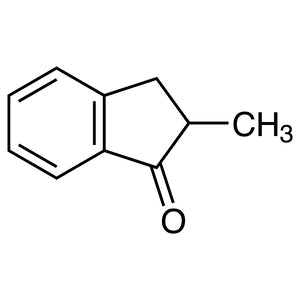
2-Methyl-2,3-dihydro-1H-inden-1-one TCI M3681
Regular price From Rp 1.696.800,00Regular price -
(R)-2,3-Dihydro-1H-inden-1-ol TCI H1186
Regular price From Rp 1.856.400,00Regular price