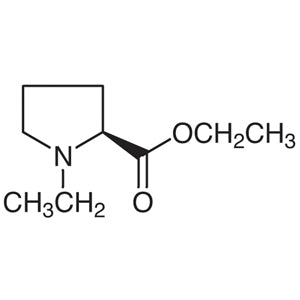
TCI E0469 Ethyl (R)-(+)-1-Ethyl-2-pyrrolidinecarboxylate is the ethyl ester of an N-ethylated proline derivative carrying the R configuration at the alpha carbon, complementing the S variant available in the same series. The compound combines a saturated pyrrolidine ring, a tertiary nitrogen that already bears an ethyl group, and a carboxylate function protected as an ester. That arrangement makes it a ready-to-use intermediate in peptide chemistry, asymmetric synthesis, and the preparation of various bioactive derivatives without requiring the nitrogen protection step that normally lengthens a synthetic route.
Its practical advantages come from two features. First, the ester group is an exceptionally versatile transformation point: it can be hydrolysed to the carboxylic acid, reduced to the primary alcohol, converted to an amide through aminolysis, or reacted with organometallic reagents to form ketones. Second, the R configuration is fixed from the outset, which makes the material ideal for comparative experiments against the S enantiomer, whether in biological activity testing or in the validation of chiral analytical methods that demand clear, repeatable evidence of peak separation.
In Indonesian laboratories, this material is typically handled by university research groups, pharmaceutical development units, and analytical service laboratories that work on chiral building blocks. It suits work where a defined stereocentre must be carried through a multi-step route, and where the availability of the opposite enantiomer in the same product series allows both forms to be studied under identical conditions rather than sourced from different origins.
TCI brochures (PDF)
- Amino Acids and Peptide Synthesis Reagents 2025-08-14 · p. 27
Related TCI products
- TCI E0450 938-54-5 Ethyl (S)-(-)-1-Ethyl-2-pyrrolidinecarboxylate
- TCI B3178 203866-13-1 (2S,4S)-1-(tert-Butoxycarbonyl)-4-fluoro-2-pyrrolidinecarboxylic Acid
- TCI B3177 203866-14-2 (2S,4R)-1-(tert-Butoxycarbonyl)-4-fluoro-2-pyrrolidinecarboxylic Acid
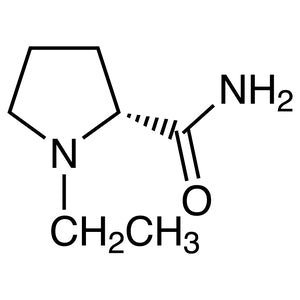
- TCI E0468 381670-32-2 (R)-(+)-1-Ethyl-2-pyrrolidinecarboxamide
- TCI E0452 114812-34-9 (S)-(-)-1-Ethyl-2-pyrrolidinecarboxamide
- TCI D5586 58166-38-4 (4R)-2,2-Dimethyl-4-thiazolidinecarboxylic Acid
- Peptide chemistry building block: the pre-installed N-ethyl group removes the need for a separate nitrogen protection and deprotection sequence, shortening routes toward modified proline-containing peptide analogues.
- Asymmetric synthesis: the fixed R stereocentre on the pyrrolidine ring provides a defined chiral starting point for constructing more complex targets without a separate resolution or asymmetric induction step.
- Chiral method validation: paired with the S enantiomer from the same series, it serves as a reference pair for demonstrating baseline resolution and repeatability on chiral chromatographic systems.
- Ester-based derivatisation studies: the carboxylate ester can be hydrolysed, reduced to a primary alcohol, aminolysed to amides, or treated with organometallic reagents to access ketones.
- Bioactive derivative preparation: the saturated pyrrolidine scaffold with a tertiary nitrogen is a common motif in the synthesis of candidate compounds evaluated for biological activity.
| Brand | TCI |
|---|---|
| CAS number | 381670-33-3 |
| Molecular formula | — |
| Purity | — |
| Category | Chemistry > Chemical Biology > Peptide Chemistry |
| Pack sizes | available in the catalogue pack sizes offered by TCI for this product code |
| Physical form | — |
| Storage | store according to the conditions stated on the manufacturer label and Safety Data Sheet |
- Chemical name: Ethyl (R)-(+)-1-Ethyl-2-pyrrolidinecarboxylate
Keep the container tightly closed and store it in a cool, dry, well-ventilated area away from direct sunlight, heat sources, and incompatible materials, following the conditions printed on the manufacturer label and Safety Data Sheet. Use the original supplier container or a chemically compatible, clearly labelled alternative, and reseal it promptly after each withdrawal to limit moisture uptake and evaporation. Handle the material in a fume hood using gloves, safety glasses, and a laboratory coat. Transfer with clean, dry glassware to avoid contamination that could compromise stereochemical integrity, and consult the Safety Data Sheet before first use and before waste disposal.
—
Product Categories
Produk Terkait
-
Ethyl(S)-(-)-1-Ethyl-2-pyrrolidinecarboxylate TCI E0450
Regular price From Rp 1.565.550,00Regular price -
(2S,4S)-1-(tert-Butoxycarbonyl)-4-fluoro-2-pyrrolidinecarboxylicAcid TCI B3178
Regular price From Rp 477.750,00Regular price -
(2S,4R)-1-(tert-Butoxycarbonyl)-4-fluoro-2-pyrrolidinecarboxylicAcid TCI B3177
Regular price From Rp 557.550,00Regular price -
(R)-(+)-1-Ethyl-2-pyrrolidinecarboxamide TCI E0468
Regular price From Rp 3.472.350,00Regular price -
(S)-(-)-1-Ethyl-2-pyrrolidinecarboxamide TCI E0452
Regular price From Rp 2.862.300,00Regular price -
(4R)-2,2-Dimethyl-4-thiazolidinecarboxylicAcid TCI D5586
Regular price From Rp 1.565.550,00Regular price -
4-Nitrobenzyl(2S,4S)-2-(Dimethylcarbamoyl)-4-mercapto-1-pyrrolidinecarboxylate TCI N0828
Regular price Rp 3.710.700,00Regular price -
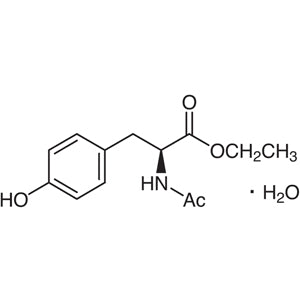
N-Acetyl-L-tyrosineEthylEsterMonohydrate TCI A0118
Regular price From Rp 610.050,00Regular price