

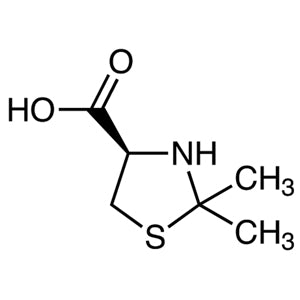
(4R)-2,2-Dimethyl-4-thiazolidinecarboxylic Acid is a chemical compound widely used in laboratory settings for its unique structural properties and reactivity. This compound plays a crucial role in chemical and biochemical research, particularly in the field of peptide chemistry. Its thiazolidine ring structure provides a versatile platform for the synthesis of complex molecules, making it a valuable tool for scientists working on advanced chemical reactions. The compound is commonly utilized in the development of new bioactive compounds and in the modification of peptides, contributing to the advancement of pharmaceutical and biotechnological research.
One of the main reasons this compound is preferred in laboratories is its chemical stability and reactivity under specific conditions. It exhibits good solubility in organic solvents, which simplifies its handling and application in various synthetic processes. Additionally, its non-toxic nature and ease of manipulation make it a safe and reliable choice for laboratory use. These characteristics ensure that researchers can work with it efficiently without compromising safety or experimental accuracy.
In Indonesian laboratories, (4R)-2,2-Dimethyl-4-thiazolidinecarboxylic Acid is frequently used in scientific research and the development of pharmaceutical and biotechnology products. Its role in the synthesis of bioactive compounds and its compatibility with various chemical processes make it an essential component in both academic and industrial research settings. The compound supports innovation and discovery in the fields of chemistry and biology, contributing to the growth of scientific knowledge in Indonesia.
- Peptide Synthesis: This compound is ideal for peptide synthesis due to its thiazolidine ring structure, which facilitates the formation of stable peptide bonds during chemical reactions.
- Bioactive Compound Development: Its unique molecular structure enables the creation of bioactive compounds, making it suitable for pharmaceutical research and drug development.
- Organic Chemistry Reactions: The compound's solubility in organic solvents and reactivity make it a preferred choice for various organic chemistry reactions and functional group modifications.
- Molecular Modification Studies: It is commonly used in studies involving molecular modification, where its structural versatility supports the design of new chemical entities.
- Biotechnology Research: The compound's stability and reactivity make it a valuable tool in biotechnology research, particularly in the development of novel biochemical applications.
| Brand | TCI |
|---|---|
| CAS number | 58166-38-4 |
| Molecular formula | — |
| Purity | — |
| Category | Chemistry > Chemical Biology > Peptide Chemistry |
| Pack sizes | — |
| Physical form | — |
| Storage | Store in a cool, dry place away from direct sunlight |
This compound should be stored in a cool, dry place, away from direct sunlight and sources of heat. It is recommended to use airtight containers to prevent moisture absorption and maintain its chemical integrity. Proper ventilation is essential when handling the compound to ensure a safe working environment. Due to its non-toxic nature, it is generally considered safe for laboratory use, but standard safety protocols should still be followed. The compound does not require special protective equipment beyond standard laboratory practices, making it accessible for routine use in research settings. Always ensure that the compound is stored in a secure location to prevent accidental exposure or contamination.
—
Produk Terkait
-
(2S,4S)-1-(tert-Butoxycarbonyl)-4-fluoro-2-pyrrolidinecarboxylicAcid TCI B3178
Regular price From Rp 477.750,00Regular price -
(2S,4R)-1-(tert-Butoxycarbonyl)-4-fluoro-2-pyrrolidinecarboxylicAcid TCI B3177
Regular price From Rp 557.550,00Regular price -
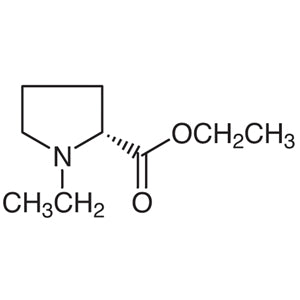
Ethyl(R)-(+)-1-Ethyl-2-pyrrolidinecarboxylate TCI E0469
Regular price From Rp 1.565.550,00Regular price -
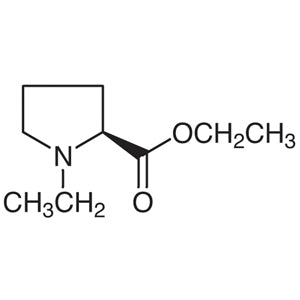
Ethyl(S)-(-)-1-Ethyl-2-pyrrolidinecarboxylate TCI E0450
Regular price From Rp 1.565.550,00Regular price -
(+/-)-4-ThiazolidinecarboxylicAcid TCI T4355
Regular price Rp 2.359.350,00Regular price -
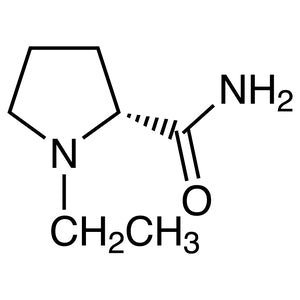
(R)-(+)-1-Ethyl-2-pyrrolidinecarboxamide TCI E0468
Regular price From Rp 3.472.350,00Regular price -
(S)-(-)-1-Ethyl-2-pyrrolidinecarboxamide TCI E0452
Regular price From Rp 2.862.300,00Regular price -
Nalpha-[(9H-Fluoren-9-ylmethyloxy)carbonyl]-Nepsilon-1-(4,4-dimethyl-2,6-dioxocyclohex-1-ylidene)ethyl-L-lysine TCI F1270
Regular price From Rp 2.650.200,00Regular price




![Nalpha-[(9H-Fluoren-9-ylmethyloxy)carbonyl]-Nepsilon-1-(4,4-dimethyl-2,6-dioxocyclohex-1-ylidene)ethyl-L-lysine (CAS 150629-67-7) - TCI F1270 - AMI Scientific](http://amiscientific.com/cdn/shop/files/TCI2510F1270.jpg?v=1768205463&width=533)