TCI E0577 9-Ethylcarbazole-3-carboxaldehyde N-Ethyl-N-(o-tolyl)hydrazone is a carbazole hydrazone derivative bearing an ortho-tolyl group, meaning a benzene ring carrying a methyl substituent at the position adjacent to its point of attachment. In the laboratory this compound is used as a positive charge transport material within amorphous organic layers, particularly in photoconductor research and in studies of molecular optoelectronic devices. Because it serves as an active component rather than a synthetic intermediate, it is normally dissolved directly together with a binder polymer and then coated into thin films for characterisation of their electrical and optical behaviour.
The distinguishing feature of the ortho-tolyl variant lies in the steric hindrance introduced by the methyl group at the ortho position. This hindrance forces the aromatic ring to twist out of the conjugation plane, so the molecular geometry becomes more irregular than that of the unsubstituted phenyl variant. As a consequence, the tendency of the molecules to organise themselves into crystals is greatly reduced, and thin films are far easier to maintain in a clear, amorphous state over long periods. At the same time, the twisting of the ring plane also affects intermolecular orbital overlap, which is part of what researchers evaluate when they select between structural variants.
In Indonesian laboratories this material is typically handled in university research groups and institutional laboratories working on organic electronics, photoconductive coatings and thin-film characterisation. Workers usually weigh out a small quantity, dissolve it with a binder polymer in a suitable solvent, and deposit the solution as a film for subsequent electrical and optical measurement. Since it is supplied as a specialty research item from TCI rather than a bulk commodity chemical, it is generally ordered in the smallest quantity consistent with the planned experimental programme.
TCI brochures (PDF)
- Carbazoles 2025-06-27 · p. 3
Related TCI products
- TCI T3454 640292-02-0 5-(p-Tolyl)isoxazole-3-carboxaldehyde
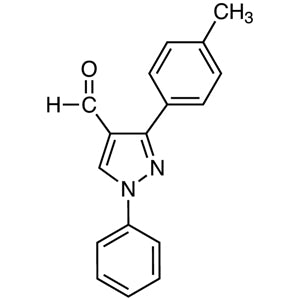
- TCI P2657 36640-52-5 1-Phenyl-3-(p-tolyl)-1H-pyrazole-4-carboxaldehyde
- TCI E0578 81380-24-7 9-Ethylcarbazole-3-carboxaldehyde N-Ethyl-N-(m-tolyl)hydrazone
- TCI E0576 84678-52-4 9-Ethylcarbazole-3-carboxaldehyde N-Ethyl-N-phenylhydrazone
- TCI E0575 88107-84-0 9-Ethylcarbazole-3-carboxaldehyde N-Butyl-N-phenylhydrazone
- TCI E0574 75238-79-8 9-Ethylcarbazole-3-carboxaldehyde N-Benzyl-N-phenylhydrazone
- Organic photoconductor research: the compound acts as a positive charge transport component in amorphous layers, which is precisely the function required when building and evaluating photoconductive films.
- Molecular optoelectronic device studies: it is used as an active charge transporting material rather than an intermediate, so it can be incorporated directly into device layers under investigation.
- Thin film preparation with binder polymers: the material dissolves together with a binder and is coated into films, making it well suited to solution-processed layer fabrication in the laboratory.
- Electrical characterisation of amorphous organic layers: because the ortho-tolyl twist suppresses crystallisation, films remain amorphous and clear, giving stable samples for charge transport measurement.
- Structure-property comparison work: the ortho methyl substituent alters both molecular geometry and intermolecular orbital overlap, making it a useful reference point against unsubstituted phenyl analogues.
| Brand | TCI |
|---|---|
| CAS number | 1274948-12-7 |
| Molecular formula | — |
| Purity | — |
| Category | Chemistry > Building Blocks > Heterocyclic Building Blocks |
| Pack sizes | supplied in TCI research-scale catalogue pack sizes; please confirm the available option when ordering |
| Physical form | — |
| Storage | keep in a cool, dry place protected from light, following the supplier documentation supplied with the product |
- Product code: E0577
Store the container tightly closed in a cool, dry and well ventilated area, away from direct sunlight, heat sources and strong oxidising agents. Keep the material in its original supplier container or in a clean, chemically compatible, well sealed vessel, and protect it from light and moisture to preserve the quality of films prepared from it. Handle the solid in a fume hood or a well ventilated workspace, wearing gloves, safety glasses and a laboratory coat, and avoid generating dust during weighing. Label all solutions clearly, and always consult the safety data sheet supplied with the product before use and before disposal.
—
Produk Terkait
-
5-(p-Tolyl)isoxazole-3-carboxaldehyde TCI T3454
Regular price Rp 3.763.200,00Regular price -
1-Phenyl-3-(p-tolyl)-1H-pyrazole-4-carboxaldehyde TCI P2657
Regular price From Rp 1.060.500,00Regular price -
9-Ethylcarbazole-3-carboxaldehydeN-Ethyl-N-(m-tolyl)hydrazone TCI E0578
Regular price Rp 2.942.100,00Regular price -
9-Ethylcarbazole-3-carboxaldehydeN-Ethyl-N-phenylhydrazone TCI E0576
Regular price Rp 2.969.400,00Regular price -
9-Ethylcarbazole-3-carboxaldehydeN-Butyl-N-phenylhydrazone TCI E0575
Regular price Rp 2.545.200,00Regular price -
9-Ethylcarbazole-3-carboxaldehydeN-Benzyl-N-phenylhydrazone TCI E0574
Regular price Rp 2.625.000,00Regular price -
9-Ethylcarbazole-3-carboxaldehydeDiphenylhydrazone TCI E0571
Regular price Rp 1.829.100,00Regular price -
9-Ethylcarbazole-3-carboxaldehydeN-Methyl-N-phenylhydrazone TCI E0570
Regular price Rp 2.068.500,00Regular price