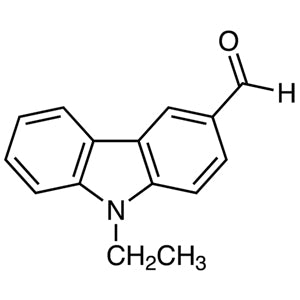
TCI E0575 88107-84-0 9-Ethylcarbazole-3-carboxaldehyde N-Butyl-N-phenylhydrazone is a complex organic compound widely used in laboratory settings for various synthetic reactions. It belongs to the category of heterocyclic building blocks, which are essential for the synthesis of more complex molecular structures. This compound is particularly valued for its versatility in organic chemistry, offering a unique molecular framework that can be modified through different chemical transformations. Its presence in laboratory research is significant due to its ability to participate in a range of chemical processes, making it a valuable tool for chemists working on advanced synthetic pathways.
The compound's molecular structure features a carbonyl group and a hydrazone linkage, which contribute to its reactivity and functional versatility. These properties make it ideal for applications such as substitution reactions, reductions, and catalytic processes. The stability of the compound under controlled laboratory conditions allows for safe handling and storage, ensuring its effectiveness in various experimental setups. Its reactivity and structural complexity make it a preferred choice for researchers aiming to develop new compounds or study molecular behavior in controlled environments.
In Indonesian laboratories, this compound is commonly used in organic synthesis research, particularly in the development of heterocyclic compounds and the creation of new chemical entities. It is frequently found in academic and industrial research settings where precision and accuracy are critical. Many universities and research institutions rely on this compound as a key reagent for experiments that require high chemical specificity and controlled reaction conditions. Its widespread use underscores its importance in the field of organic chemistry within the Indonesian scientific community.
TCI brochures (PDF)
- Carbazoles 2025-06-27 · p. 4
Related TCI products
- TCI E0578 81380-24-7 9-Ethylcarbazole-3-carboxaldehyde N-Ethyl-N-(m-tolyl)hydrazone
- TCI E0577 1274948-12-7 9-Ethylcarbazole-3-carboxaldehyde N-Ethyl-N-(o-tolyl)hydrazone
- TCI E0576 84678-52-4 9-Ethylcarbazole-3-carboxaldehyde N-Ethyl-N-phenylhydrazone
- TCI E0574 75238-79-8 9-Ethylcarbazole-3-carboxaldehyde N-Benzyl-N-phenylhydrazone
- TCI E0571 73276-70-7 9-Ethylcarbazole-3-carboxaldehyde Diphenylhydrazone
- TCI E0570 75232-44-9 9-Ethylcarbazole-3-carboxaldehyde N-Methyl-N-phenylhydrazone
- Organic Synthesis: This compound is widely used in the synthesis of heterocyclic compounds due to its reactive functional groups and structural versatility.
- Catalytic Reactions: Its unique molecular structure makes it suitable for catalytic processes where specific functional groups are required.
- Reductive Reactions: The presence of a carbonyl group allows it to participate in reduction reactions, making it useful in synthetic pathways.
- Substitution Reactions: The hydrazone linkage enables it to be involved in substitution reactions, providing a valuable intermediate in complex molecule synthesis.
- Compound Modification: It is often used as a building block for modifying existing compounds, allowing for the creation of new chemical entities with desired properties.
| Brand | TCI |
|---|---|
| CAS number | 88107-84-0 |
| Molecular formula | — |
| Purity | — |
| Category | Chemistry > Building Blocks > Heterocyclic Building Blocks |
| Pack sizes | Available in various quantities as per supplier specifications |
| Physical form | Solid, typically in crystalline or powder form |
| Storage | Store in a cool, dry place away from direct light and moisture |
This compound should be stored in a cool, dry environment, away from direct sunlight and sources of heat. It is recommended to use airtight containers to prevent exposure to moisture and air, which could affect its stability. Due to its chemical nature, it should be handled with appropriate personal protective equipment, such as gloves and safety goggles, to ensure laboratory safety. It is important to store it in a well-ventilated area to minimize any potential risks associated with its reactivity. Regular inspection of storage conditions is advised to maintain its integrity and ensure it remains suitable for use in laboratory experiments.
—
Produk Terkait
-
9-Ethylcarbazole-3-carboxaldehydeN-Ethyl-N-(m-tolyl)hydrazone TCI E0578
Regular price Rp 2.942.100,00Regular price -
9-Ethylcarbazole-3-carboxaldehydeN-Ethyl-N-(o-tolyl)hydrazone TCI E0577
Regular price Rp 2.942.100,00Regular price -
9-Ethylcarbazole-3-carboxaldehydeN-Ethyl-N-phenylhydrazone TCI E0576
Regular price Rp 2.969.400,00Regular price -
9-Ethylcarbazole-3-carboxaldehydeN-Benzyl-N-phenylhydrazone TCI E0574
Regular price Rp 2.625.000,00Regular price -
9-Ethylcarbazole-3-carboxaldehydeDiphenylhydrazone TCI E0571
Regular price Rp 1.829.100,00Regular price -
9-Ethylcarbazole-3-carboxaldehydeN-Methyl-N-phenylhydrazone TCI E0570
Regular price Rp 2.068.500,00Regular price -
N-Ethylcarbazole-3-carboxaldehyde TCI E0359
Regular price From Rp 1.140.300,00Regular price -
9-Ethylcarbazole TCI E0247
Regular price Rp 1.220.100,00Regular price